
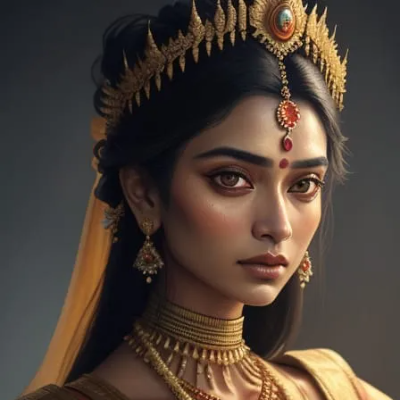
About
Prabha Svarbhanukumari — Daughter of Svarbhanu, Wife of Ayus, Mother of Nahusha
Prabha · Indumati · Svarbhanukumari · Svarbhanu Tanaya · Rahusuta
Prabha, also known as Indumati in certain Puranic passages, is the daughter of the asura Svarbhanu — the being whose head became Rahu and whose body became Ketu after Vishnu's decapitation at the Samudra Manthan — and is therefore the sister of the two shadow-planets in the cosmological order. She is the wife of Ayus, the eldest son of Pururavas and the Apsara Urvashi, and through that union is the mother of five sons, foremost among them Nahusha, the celebrated king of the Lunar dynasty who briefly ruled Svarga in Indra's absence. Her primary attestation is in the Harivamsha, the appendix of the Mahabharata, at Chapter 28 of the Adi Parva of that text, where her parentage from Svarbhanu and her union with Ayus are stated explicitly in the Sanskrit. She also appears as Indumatiin the Padma Purana's account of the birth and adventures of Nahusha, and the Puranic Encyclopaedia of Vettam Mani designates her by the patronymic Svarbhanukumari. The connection of her lineage to Rahu is thus firmly grounded in primary source material, though the precise relationship requires the clarification given below.
✦ The Names and the Rahu Connection Clarified
The name Prabha means radiance, lustre, or brilliant light in Sanskrit, from the root pra meaning forth and bha meaning shine. The name Indumati means possessing the brilliance of the moon, from indu meaning the moon and mati meaning mind or possessing the quality of; it is used as an alternate name in some Puranic contexts. Svarbhanukumari is a patronymic compound meaning daughter of Svarbhanu. The epithet Rahusuta — daughter of Rahu — is a later genealogical shorthand found in secondary literature. It requires an important qualification: Prabha is the daughter of Svarbhanu, the asura who existed before and was then transformed into Rahu by decapitation at the Samudra Manthan. She is not the daughter of Rahu as a shadow-planet. Svarbhanu had a daughter Prabha while still a whole, embodied asura — indeed the Vishnu Purana at Chapter 21 separately lists a Danava also named Swarbhanu as having a daughter Prabha, which may reflect the same tradition. The Harivamsha's genealogical statement that Ayu's sons were begotten on Svarbhanu's daughter is unambiguous in the Sanskrit. The designation "daughter of Rahu" is therefore accurate in the sense that her father is the same being who became Rahu, but it should not be understood to mean she was born after her father's dismemberment and immortalisation.
✦ Lineage
- Father: Svarbhanu — the asura son of Viprachitti (eldest Danava, son of Kashyapa and Danu) and Simhika (Daitya princess, daughter of Kashyapa and Diti); decapitated by Vishnu at the Samudra Manthan; his head became Rahu the ascending lunar node, his body became Ketu the descending lunar node.
- Paternal grandfather: Viprachitti — eldest of the Danava race; king of the Danavas; identified in the Mahabharata as the previous birth of Jarasandha.
- Paternal grandmother: Simhika — Daitya princess, daughter of Kashyapa and Diti, sister of Hiranyakashipu; possessor of the shadow-seizing power; encountered and slain by Hanuman in the Valmiki Ramayana.
- Brothers (in one sense): Rahu — the immortal head of Svarbhanu, ascending lunar node; and Ketu — the immortal body of Svarbhanu, descending lunar node; as the offspring of the same father, she and the two shadow-planets are siblings in origin, though the tradition does not emphasise this relationship.
- Husband: Ayus — eldest son of Pururavas, the celebrated king of the Chandravamsha or Lunar dynasty, and the Apsara Urvashi; Ayus ruled from Pratishthana and is the progenitor of the main Aila line of the Lunar dynasty continuing through Nahusha and Yayati.
- Sons (per Harivamsha, Chapter 28): Five sons, all described as heroic and mighty warriors of great renown in the three worlds — Nahusha (firstborn), Vriddhasharma, Rambha, Raji, and Anena. Of these, Nahusha became the most celebrated, and Raji the most militarily formidable in the short term.
✦ The Primary Source — Harivamsha Chapter 28
The Harivamsha, the appendix to the Mahabharata narrating the lineage and life of Krishna, contains at Chapter 28 of its Adi Parva section the genealogical account of Ayus and his sons. The Sanskrit of verse 1-28-1 states that Ayu's five sons were born through Svarbhanu's daughter Prabha. Verse 1-28-9 repeats the identification, describing Raji as the grandson of Svarbhanu through his daughter Prabha and noting him as a highly powerful king who strengthened the race of Soma. The English prose translation available through Wisdomlib renders this explicitly: Ayu's five sons were begotten on Svarbhanu's daughter. This is a direct, genealogically specific statement in a primary Mahapuranic text, making the identification of Nahusha's mother as a daughter of Svarbhanu — the being who became Rahu — primary-source confirmed rather than inferential.
✦ The Name Indumati and the Padma Purana Account
The Padma Purana's account of the birth of Nahusha, which is narrated at some length and includes the episode of the demon Hunda's attempt to destroy Nahusha at birth and Sage Vasishtha's role in raising the infant, names Ayus's wife as Indumati rather than Prabha. The Puranic Encyclopaedia of Vettam Mani uses the form Indumatī with the parenthetical clarification Svarbhānukumārī — daughter of Svarbhanu — indicating that the scholarly tradition equates the two names as referring to the same figure. The Wikipedia article on Mahabharata characters likewise states that Prabha is sometimes called Indumati. The two names appear therefore to be alternative designations for the same woman in different Puranic textual strands, with Prabha used in the Harivamsha and Indumati in certain Padma Purana passages. The name Indumati — possessing the brilliance of the moon — may have been applied to her because of her position as the mother of the lunar dynasty's continuation through Nahusha and ultimately Yayati.
✦ Significance of the Sons
Of Prabha's five sons, Nahusha is by far the most narratively significant. He became king of Pratishthana and eventually ruled as the temporary king of Svarga during Indra's absence, a position from which he fell through arrogance when he attempted to seduce Indra's wife Shachi and ordered the seven sages to carry his palanquin. Cursed by Agastya to take serpent form, he spent thousands of years as a python in the Dandaka forest until his encounter with Yudhishthira and Bhima during the Pandavas' exile in the Vana Parva of the Mahabharata released him from the curse. His son Yayati became one of the most celebrated kings of the Lunar dynasty, the ancestor of the Yadava and Paurava lines and thus of both Krishna and the Pandavas. Raji, another of Prabha's sons, commanded such extraordinary military prowess that both gods and demons sought his aid in their warfare, and his five hundred sons the Rajeyas became so powerful that they frightened even Indra. Prabha is therefore the maternal ancestress of a lineage that ramifies through virtually the entire subsequent Chandravamsha genealogy.
✦ Connection to the Wider Genealogy
Prabha's genealogical position is one of the most striking in the entire Puranic record: she is the daughter of an asura belonging to the Danava-Daitya combined line of Kashyapa, and the wife of a king of the Chandravamsha, the Lunar dynasty whose founding line descends from Brahma through Atri, the moon god Chandra, Budha, and Pururavas. Her marriage to Ayus thus introduces the blood of Kashyapa's asura progeny — through both the Danava line of Danu and the Daitya line of Diti — directly into the Lunar royal lineage of India's ancient kings. The same Kashyapa who is the ultimate ancestor of Rahu and Ketu through Viprachitti and Svarbhanu is also, through the Aditya line, the grandfather of the solar order. Prabha's sons carry this double cosmic inheritance — part asura, part royal — and it is through them, particularly through Nahusha's son Yayati, that the Lunar dynasty's most consequential branches grow. The Mahabharata's entire Chandravamsha genealogy, culminating in Krishna and the Pandavas, passes through Prabha's womb.
✦ References
- Harivamsha, Adi Parva, Chapter 28, verses 1–2 and 9: Primary and most explicit source; verse 1 states that Ayu's five sons were begotten on Svarbhanu's daughter Prabha; verse 9 confirms Raji as the grandson of Svarbhanu through his daughter Prabha and calls him a powerful king who strengthened the Soma race. The Sanskrit svarbhānu tanayāyāM prabhāyāM at verse 1-28-1 is unambiguous. This is the controlling primary source for the identification.
- Padma Purana (Nahusha birth narrative): Names Ayus's wife as Indumati; narrates the episode of the demon Hunda's kidnapping of the infant Nahusha and Sage Vasishtha's role in raising him; does not specify Indumati's parentage in the surviving summary material consulted, but is identified with the Harivamsha's Prabha through the Puranic Encyclopaedia's equating of the two names.
- Vettam Mani, Puranic Encyclopaedia (1975), entry on Nahusha: Designates Ayus's wife by the patronymic Svarbhanukumari in the genealogical statement, directly confirming the Harivamsha identification; uses the name form Indumatī in the narrative portions of the Padma Purana account.
- Wikipedia, Nahusha article: Modern secondary reference; states explicitly that Ayu was married to Prabha the daughter of Rahu and that she remained childless before the Dattatreya episode; confirms the identification of Prabha with Svarbhanu's daughter.
- Wikipedia, List of characters in the Mahabharata article: Modern secondary reference; states that Prabha, sometimes called Indumati, was the daughter of the asura Svarbhanu who later became Rahu and Ketu, and that she married Ayu and had Nahusha; confirms the equation of Prabha and Indumati as alternate names for the same figure.
- Wisdomlib.org, Harivamsha Chapter 28 translation: Modern reference providing the English prose translation of the Harivamsha passage, confirming the reading of Svarbhanu's daughter as the mother of Ayu's sons.
- Monier-Williams Sanskrit-English Dictionary: Modern reference; etymology of Prabha from pra and bha as brilliant radiance; and of Indumati as possessing the quality of the moon.