
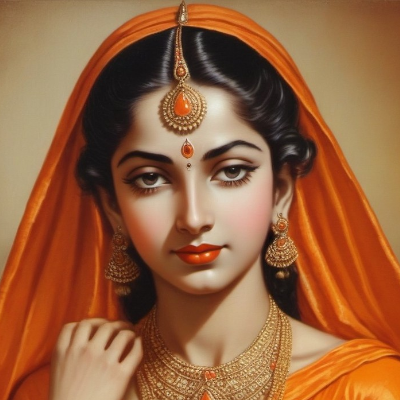
About
Sarama — Wife of Vibhishana, Friend of Sita, Daughter of the Gandharva Shailusa
Sarama · Sara (Manas-lake etymology)
Sarama is the wife of Vibhishana, the youngest son of Vishrava and Kaikesi and the righteous brother of Ravana who defected to Rama's cause during the Lanka war. She is the daughter of the Gandharva Shailusa. She was born on the banks of the Manas Lake (Lake Manasarovar) in the Himalayan region. She is friendly to Sita throughout the period of Sita's captivity in Lanka, a fact that aligns her — like her husband — with dharma against the household in which she lives. Her name arises directly from the circumstances of her birth. The expert on Rama-centric literature Camille Bulcke has noted that Sarama does not appear in the original Ramayana; she first enters the text in later interpolations present in all recensions of Valmiki's poem. Her formal identification as Vibhishana's wife is introduced in the Uttara Kanda, itself a later addition to the core text. Within the textual strata that do include her, she performs two distinct functions: she comforts Sita in the Sundara Kanda's Maya-shirsha (illusory head) episode, and she informs Sita of Hanuman's burning of Lanka in an interpolated passage of the Northern recension. She and Vibhishana are named as the parents of Trijata in the dominant post-Valmiki tradition.
✦ The Name
The Sarama Wikipedia article gives the specific etymology of her name as preserved in the Uttara Kanda backstory: when the infant was born on the banks of the Manas Lake and began to cry at the sight of the rising waters, her mother commanded the lake: Saroma vardhata — "Lake, do not rise" (or, more precisely, sara = lake, maa = do not, which in the exclamation condenses to the child's name Sarama). The rsachi.blogspot summary of Uttara Kanda Sarga 12, which paraphrases the primary text directly, confirms this birth-at-Manas-Lake narrative. The name Sarama thus encodes the place and moment of her birth. The same name belongs to another character in Hindu tradition — the divine hound Sarama, who in the Rigveda is Indra's messenger and the mother of the Sharameyas; the two are entirely distinct. In the context of the Ramayana, Sarama refers exclusively to Vibhishana's wife.
✦ Lineage
- Father: Shailusa — a Gandharva; see the separate profile below for the textual attestations of this figure
- Mother: unnamed in the tradition; she is mentioned only as the mother who commanded the Manas Lake not to rise at the time of Sarama's birth
- Race: Gandharvi — of Gandharva lineage; though the Sarama Wikipedia article notes that some accounts describe her as a rakshasi, the dominant and textually primary identification is Gandharva descent; the Telugu Sita Puranamu explicitly foregrounds her Gandharva (and implicitly "Aryan") lineage in contrast to the Rakshasa identity of her husband
- Husband: Vibhishana — youngest son of Vishrava and Kaikesi; full brother of Ravana, Kumbhakarna, and Shurpanakha; the righteous Rakshasa who counselled Ravana to return Sita, was expelled from Lanka, joined Rama's forces, disclosed key intelligence in the war, and was crowned king of Lanka after Ravana's death; one of the Ashta Chiranjivi
- Daughter: Trijata — identified as Sarama and Vibhishana's daughter in the Kamba Ramayanam, Govindaraja's commentary, the Oriya Balaramadasa Ramayana, and the Javanese Kakawin Ramayana; the identification is standard in post-Valmiki literature though not firmly established in the original Valmiki text; the Trijata Wikipedia article notes that the scholar Goldman considers the identification "strange" given Trijata's apparent advanced age in the Sundara Kanda passages
- Son-in-law (in Southeast Asian traditions): Hanuman — in the Thai Ramakien tradition, Hanuman marries Trijata; this is entirely absent from the Valmiki tradition and Indian mainstream accounts
✦ Textual History and the Question of Original Presence
The Wikipedia article on Sarama (Ramayana) is the most precise available source on the textual stratification of her appearances. Its key findings, drawing on the scholarship of Camille Bulcke, are as follows. Sarama does not appear in the original Ramayana. She enters through later interpolations that are now present in all recensions of the text. Her first appearance is in the Maya-shirsha (illusory head of Rama) episode, which is set in the Sundara Kanda — one of the core six books. However, neither this episode nor the second episode attributed to her (the Sarama-vakyam, a Northern recension interpolation in which she informs Sita of Hanuman's burning of Lanka) actually establishes any relationship between Sarama and Vibhishana. They present her as a character who helps Sita, but do not identify her as Vibhishana's wife. The identification of Sarama as Vibhishana's wife is introduced only in the Uttara Kanda, the last and most clearly later book of the Ramayana, in the context of Ravana's arrangement of marriages for his brothers. The Uttara Kanda states that "Ravana obtained Sarama, the daughter of the gandharva Sailusa, to be his brother Vibhishana's wife" — it was Ravana himself, as the family patriarch, who arranged the marriage, acquiring Sarama from her Gandharva family and assigning her to Vibhishana.
The Kamakoti.org Uttara Ramayana summary (rsachi.blogspot source, summarising Uttara Kanda Sarga 12) confirms this arrangement, noting that Ravana's siblings "find spouses and get married" in this sarga, with "Shailusha gandharva's daughter Sarama with Vibhishana." The Uttara Kanda is regarded by scholars including Hermann Jacobi as a later addition. In the tradition's overall construction, however, Sarama as Vibhishana's wife has become the dominant understanding, and the post-Valmiki literature develops her role considerably.
✦ The Maya-shirsha Episode: Sarama and the Illusory Head
The Sundara Kanda episode in which Sarama appears most clearly is the Maya-shirsha ("illusory head of Rama") scene. As summarised in the Sarama Wikipedia article from the primary text: after Rama's vanara army has landed on Lanka, Ravana — determined to break Sita's resistance — orders his magician Vidyujihva to create an illusory severed head of Rama and his bow, and to present them to Sita in the Ashoka Vatika to convince her that Rama is dead. The magician complies. Sita, seeing the apparent head of her dead husband, is devastated and laments. Ravana then leaves for a council of ministers. As soon as he departs, the illusory head and bow disappear — they were purely magical constructs that could not persist without Ravana's presence sustaining them. At this moment Sarama approaches Sita, tells her she secretly witnessed the trick, and explains that the head was pure illusion. She then reassures Sita that Rama is alive and has arrived in Lanka with his army, and that she herself has seen Rama. The Sarama Wikipedia article also notes a second episode, confined to the Northern recension as an interpolated canto called Sarama-vakyam ("conversation with Sarama"), in which Sarama informs Sita of the burning of Lanka by Hanuman. She further offers to take a message to Rama from Sita, and carries intelligence about Ravana's intentions back to Sita. These episodes portray Sarama as a woman who, despite living in Ravana's Lanka, aligns herself with Sita's cause in ways parallel to her husband's eventual public defection.
✦ Character and Conduct
The Sarama Wikipedia article describes her as "friendly companion and friend" to Sita, drawing on the Kakawin Ramayana's epithets. The vedicfeed.com account of Vibhishana notes that Sarama was "a pious lady" who "aided him in his effort" to turn the people of Lanka from adharma to dharma after the war. The dollsofindia.com Surpanakha account records Sarama as one of the people Vibhishana informed of his plan to leave Lanka — "he also told his wife Sarama about his plans and asked her to take good care of herself" — before he flew to Rama's camp. This detail, if accepted, implies Sarama knew of and accepted her husband's defection even while remaining in Lanka, a dangerous position. Her loyalty to Sita during the captivity period, and her loyalty to Vibhishana's plan during the war, are consistently represented as consistent with each other. The Ananda Ramayana records that both Sarama and Trijata journeyed to Ayodhya in the Pushpaka Vimana after Rama's victory; and that when Sita later visited Lanka during her exile, she instructed Sarama to treat Trijata as she would treat Sita herself — a mark of deep friendship and trust.
✦ Sarama in Regional Traditions
The Telugu Sita Puranamu by Ramaswami Chaudari presents Sarama in a notably different and negative light. In this account, Sarama is described as the "Aryan (gandharva) wife of the Dravidian Vibhishana," who sways her husband's opinion toward Rama and effectively forces him to betray his "just brother Ravana." This politicised reading — in which the Dravidian-Aryan divide is mapped onto the Rakshasa-Gandharva and Ravana-Rama axes — belongs to a distinct interpretive tradition that arose in connection with twentieth-century south Indian nationalist politics and is not present in any Sanskrit primary source. The Sarama Wikipedia article notes this explicitly. In the Bengali Krittivasi Ramayana, the text emphasises the friendship between Sarama and Sita and presents Trijata in a negative light (appealing to Sita to accept Ravana), effectively reversing the roles assigned to mother and daughter in other traditions. These regional variations confirm that Sarama's character was not fixed in the post-Valmiki tradition but continued to be reinterpreted.
✦ Textual Variants and Inconsistencies
Rakshasi or Gandharvi: The Sarama Wikipedia article notes that some accounts describe Sarama as a rakshasi while others attribute Gandharva lineage to her. The Uttara Kanda's identification of her as "daughter of the gandharva Shailusa" is the primary-text basis for the Gandharva identification. The Rakshasi description may derive from later accounts that assumed her identity by her role — a woman living among Rakshasas in Lanka as Vibhishana's wife — rather than by her actual lineage. No source has been identified that specifies a Rakshasa father distinct from Shailusa.
The Sarama-vakyam interpolation: The conversation in which Sarama informs Sita of Hanuman's burning of Lanka appears only in the Northern recension and is absent from the Southern recension. As the Sarama Wikipedia article explains, neither this passage nor the Maya-shirsha episode itself establishes Sarama as Vibhishana's wife within the Sundara Kanda — that connection comes only through the Uttara Kanda. This means the Sundara Kanda's Sarama and the Uttara Kanda's Sarama were originally separate textual figures who became conflated over time.
Trijata as daughter vs other relationships: As noted in the Vibhishana profile, Trijata's identification as Sarama and Vibhishana's daughter is standard in post-Valmiki literature but is "strange" in the original Valmiki context (Goldman, cited in the Trijata Wikipedia article) given her apparent age. The Ananda Ramayana treats Trijata as Vibhishana's wife. The Marathi Bhavartha Ramayana treats her as his sister.
✦ Connection to the Wider Genealogy
Sarama's entry into the Lanka family introduces Gandharva blood — the lineage of celestial musicians, singers, and supernatural beings associated with the sky, with Kubera's realm, and with sensory pleasure and music — into the Pulastya-Kaikesi Rakshasa line. Through her marriage to Vibhishana she becomes the daughter-in-law of Vishrava and Kaikesi, and thus connected to the same genealogy as Ravana, Kumbhakarna, and Shurpanakha. Through her father Shailusa, she is also connected — if the Mahabharata Sabha Parva reference to Shailusa serving in Kubera's assembly is the same individual — to the Yaksha world of Kubera, who is Vibhishana's paternal half-brother. This would make Sarama's father an attendant of Vibhishana's own half-brother, creating an intriguing cross-connection between the Gandharva and Yaksha worlds within the Lanka genealogy. This inference depends on identifying the Mahabharata's Shailusa with the Uttara Kanda's Shailusa, which is discussed in the Shailusa profile.
✦ References
Primary Sources
- Valmiki Ramayana, Uttara Kanda, Sarga 12: The primary source for both figures together; records Ravana arranging Sarama, daughter of the Gandharva Shailusa, as wife for Vibhishana; confirmed by the rsachi.blogspot paraphrase of the Uttara Kanda reading of this sarga. The Uttara Kanda is considered a later addition to the core text.
- Valmiki Ramayana, Sundara Kanda (Maya-shirsha episode): Sarama appears comforting Sita after the illusory head deception; she is not named as Vibhishana's wife here but the episode is the earliest point in the text (of the core six books) where her character appears; summarised in the Sarama Wikipedia article from the primary Sundara Kanda.
- Valmiki Ramayana, Sundara Kanda, Northern recension (Sarama-vakyam canto): An interpolated canto present in the Northern recension in which Sarama informs Sita of the burning of Lanka by Hanuman; absent from the Southern recension.
- Mahabharata, Sabha Parva, Chapter 10, Verse 26: Names a Gandharva Shailusa as a member of Kubera's assembly; attested in the Wisdomlib Shailusha definition entry.
- Agni Purana, Chapter 11: Records Bharata killing a "wicked Gandharva named Shailusa and his three crores of sons" on the Sindhu River banks during the Rama Rajya period; attested in the Wisdomlib Shailusha definition entry.
- Kamba Ramayanam, Uttara Kanda: Records Rama dispatching Bharata to destroy a class of Gandharvas called Shailusas causing trouble on the eastern ocean shore; attested in the Wisdomlib Shailusha definition entry.
Secondary and Reference Works
- Wikipedia — Sarama (Ramayana) article: The primary secondary source for Sarama; documents Camille Bulcke's finding that Sarama does not appear in the original Ramayana; traces her introduction in the Uttara Kanda; establishes her Gandharva lineage through Shailusa and her birth at the Manas Lake; explains the etymology of her name; surveys the Maya-shirsha and Sarama-vakyam episodes; notes the Telugu Sita Puranamu negative reading and the Krittivasi Ramayana variant.
- Wisdomlib.org — definition of Shailusha: The most comprehensive secondary aggregation of Shailusa references across texts; collects the Uttara Ramayana, Mahabharata Sabha Parva, Agni Purana, and Kamba Ramayanam attestations in one entry; provides the Dharmashastra meaning of Shailusa as "one who makes a living by dancing."
- Wikipedia — Trijata article: Documents the identification of Trijata as daughter of Sarama and Vibhishana across the post-Valmiki tradition; notes Goldman's reservation about the identification in the original Valmiki text.
- Rsachi.blogspot — Valmiki Ramayana reading diary, Uttara Kanda Sargas 11–12: The most direct available paraphrase of the primary Uttara Kanda passage on the marriages of Ravana's siblings, confirming "Shailusha gandharva's daughter Sarama with Vibhishana."
- Kamakoti.org — Essence of Valmiki Uttara Ramayana: Confirms the same Sarga 12 content in its summary of the Uttara Kanda.
- Vedicfeed.com — Ramcharitmanas facts: Notes "Sarama is the daughter of Gandharva king Shailush and the wife of the asura king Vibhishana," confirming the standard identification in a secondary source drawing on the Tulsidas tradition.
- Dollsofindia.com — Vibhishana: Loyalty Versus Righteousness: Records Vibhishana informing Sarama of his plan to leave Lanka before departing for Rama's camp.