
About
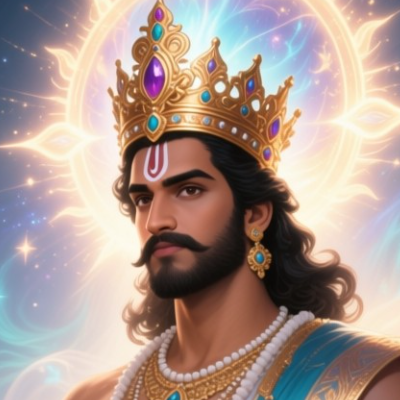
Nahusha — King of the Lunar Dynasty, Temporary Indra of Svarga, Son of Ayu, Father of Yayati
Nahusha · Nahuṣa · Aila · Chandravamsha-nripa · Devaraja-nahusha · Sarpabhuta · Ayu-putra · Yayati-pita · Ashokasundari-pati · Viraja-pati
Nahusha is a king of the Chandravamsha — the Lunar Dynasty — and one of the most celebrated and most cautionary figures in the Puranic and epic tradition. He is the son of Ayu (the eldest son of Pururavas and Urvashi) and Prabha (the daughter of Svarbhanu, the eclipse-demon Rahu); the husband of Ashokasundari (daughter of Shiva and Parvati, per the Padma Purana) or Viraja (the mind-born daughter of the Pitrs, per the Harivamsa); the father of Yati, Yayati, and four or five other sons; and the king of Pratishthana in the Lunar Dynasty. He was renowned in his time as a sovereign of extraordinary virtue, justice, learning, and tapas — a king who had performed a hundred Ashvamedha yagnas and whose fame extended throughout the three worlds — and it was on the basis of these accumulated merits that the devas chose him as their temporary king when Indra was forced to absent himself from Svarga. The choice proved fateful. Nahusha's fall from the pinnacle of divine sovereignty to the form of a serpent on the earth — brought about by the double act of desiring Indra's wife Shachi and striking the sage Agastya with his foot while demanding that the Saptarishis carry his palanquin — is the tradition's most concentrated illustration of how swiftly accumulated merit can be destroyed by a single act of arrogant disregard for the boundaries of dharma. He remained in serpent form for thousands of years until the encounter with Yudhishthira during the Pandavas' forest exile released him. His story is mentioned in the Rigveda (Mandala 1), repeated in the Mahabharata (Vana Parva), and elaborated in the Puranic Encyclopaedia of Vettam Mani and the Harivamsa.
✦ The Name
The Sanskrit name Nahusha is interpreted by the tradition as meaning the fearless one — a name given to him by the sage Vasishtha when he found the infant abandoned at his hermitage doorstep and named him. The Geni.com and Wikipedia sources both confirm the naming by Vasishtha with this meaning. Wisdomlib records the Puranic Encyclopaedia interpretation of the name in several references across the Mahabharata and Puranas. He is called Devaraja-Nahusha in the texts that refer to his period as ruler of Svarga; Sarpabhuta — the one who became a serpent — in the texts that describe his cursed state; and Aila as a patronymic of the Aila (Lunar) Dynasty. The synonyms used for him in the Mahabharata as recorded by the Puranic Encyclopaedia include Devaraja, Devaraat, Devendra, Jagatpati, Naga, Nagendra, Suradhipati, and Surapati — all of which are ordinarily titles of Indra, reflecting that during his tenure as king of Svarga he bore Indra's full authority and titles.
✦ Lineage
- Descent from Vishnu (Wisdomlib, Puranic Encyclopaedia): Vishnu — Brahma — Atri — Chandra (the moon god) — Budha — Pururavas — Ayu — Nahusha; the full Chandravamsha genealogy connecting Nahusha to the primordial divine origin of the Lunar Dynasty
- Father: Ayu — also called Ayus; the eldest son of Pururavas and Urvashi; who completed his education at the ashrama of the sage Chyavana; who married the Asura princess Prabha; who sought the blessing of Dattatreya for a worthy son and received Nahusha
- Mother: Prabha — also called Indumatī (Svarbhānukumārī) in the Puranic Encyclopaedia; daughter of Svarbhanu (Rahu); the Asura princess who bore Nahusha and four other sons to Ayu
- Paternal grandfather: Pururavas — the first king of the Chandravamsha on earth; son of Ila and Budha; who fell in love with the apsara Urvashi; whose sons included Ayu (eldest), Amavasu, Vishvayu, Shrutayu, Shatayu, and Dridhayu
- Paternal great-grandmother: Ila — the primordial figure who was both male (Sudyumna) and female (Ila) in different lunar phases; the first human to combine the solar and lunar lineages; daughter of Vaivasvata Manu
- First wife (Harivamsa tradition): Viraja — also called Su-Swadha; described as the mind-born daughter of the Pitrs (the ancestral spirits); the principal wife in the epic tradition; mother of all six or seven sons of Nahusha in the Harivamsa
- Second wife (Padma Purana tradition): Ashokasundari — daughter of Shiva and Parvati; born from the Kalpavriksha of Nandanvana; whose marriage to Nahusha was prophesied by Parvati at the moment of her creation; already profiled in this series; mother of Yayati and a hundred daughters in the Padma Purana
- Sons: Yati (eldest; who renounced the throne and became an ascetic, attaining Brahma-realisation); Yayati (second son; who succeeded to the throne; ancestor of the Yadavas and Pauravas; already profiled below); Samyati; Ayati; Dhruva; and Pancika or Suyati — the sixth name varying between the Mahabharata Adi Parva (which gives Dhruva) and the Harivamsa (which gives Suyati and Pancika separately); all six described as possessed of Indra-like splendour
- Famous sword: received from his father Ayu; recorded in the Mahabharata Shanti Parva (Chapter 266, Stanza 7)
✦ Birth and Childhood — The Vasishtha Episode
The Padma Purana's account of Nahusha's birth, already summarised in the Ashokasundari profile above, records that the infant Nahusha was kidnapped from his parents' palace by the demon Hunda on the very night of his birth — Hunda had been waiting for the infant's arrival, knowing that Ashokasundari's curse named Nahusha as his slayer and wishing to eliminate the threat before it could materialise. The cook to whom Hunda handed the infant to be prepared as a meal could not bring herself to kill the child and instead passed him to another servant who left him at the doorstep of the sage Vasishtha. Vasishtha found the infant in the morning, named him Nahusha — the fearless one — and raised him in his ashrama. Under Vasishtha's guidance Nahusha mastered the Vedas, the Shastras, the art of statecraft, and the use of weapons. When the time came, Vasishtha revealed Nahusha's true parentage; Nahusha returned to his parents and then set out to find and kill Hunda. He killed Hunda in battle, fulfilling Ashokasundari's curse. He then married Ashokasundari at Kailasha, receiving Shiva and Parvati's blessing.
✦ Reign at Pratishthana — Conquest and Virtue
Nahusha's earthly reign at Pratishthana — the capital established by Pururavas at what is now Prayagraj (Allahabad) — was a period of extraordinary accomplishment. He performed a hundred Ashvamedha yagnas; he gave mountains of gold and billions of cows to Brahmins; he came down to the world in Indra's aerial chariot to observe Arjuna's battle (Virata Parva, Chapter 56, Stanza 9); he conversed with the sage Chyavana about the wealth of cattle and received a boon from him (Anushasana Parva, Chapter 51); his fame extended throughout the three worlds and in the heavens. The Rigveda (Mandala 1, Anuvaka 7, Sukta 31) mentions his becoming Indra. Manu's code records his sovereignty over the three worlds as won through sacrifices, austerities, sacred study, self-restraint, and valour. The Harivamsa records that the divine chariot of Indra — given to Nahusha — was so swift that it was unimpeded anywhere in creation and that Nahusha used it to conquer the whole earth in six days; the same chariot later became the prized possession of all the Pauravas lineally through the Kuru dynasty.
✦ Ruler of Svarga — The Rise and the Corruption
The episode that defines Nahusha's cosmic significance is his appointment as temporary king of Svarga. Indra had been afflicted with the sin of Brahminicide — incurred when he killed the demon Vritra who had Brahmin status — and was forced to withdraw from Svarga and go into hiding within a lotus stalk in a sacred lake, invisible to all. The devas were without a king and in urgent need of a regent who could protect them from Asura attack. They surveyed all possible candidates and chose Nahusha — the most virtuous human king, whose accumulated merit from a hundred Ashvamedhas, his tapas, his scholarship, and his just governance, were unmatched. Nahusha was initially modest and hesitant: he pointed out that he was merely a man and asked how he could have Indra's divine powers. The gods assured him that he would absorb the power of every being he looked upon — a boon that proved to be as dangerous as it was useful. He accepted the role. Initially his reign was just and his governance sound.The corruption came gradually. The extraordinary power and splendour of Svarga affected his judgment. He became proud of his status and began to behave with increasing arrogance. The decisive deterioration was his desire for Indrani — Shachi, the wife of Indra, who was still Indra's wife regardless of his absence. Nahusha sent word to her that he was now Indra and she should accept him as her lord. Shachi, distressed, went to the divine preceptor Brihaspati for counsel. Brihaspati advised her to delay: send word to Nahusha that she would receive him, but require that he come to her in a palanquin carried by the greatest sages of the three worlds. Nahusha received this condition and, seeing it as an entertaining demonstration of his supreme power, immediately summoned the Saptarishis — the seven great sages — and commanded them to carry his palanquin.The sages, bound by the situation and unable to refuse the temporary king of heaven outright, complied. But the sage Agastya — short in stature and moving slowly — fell behind. Nahusha, impatient to reach Shachi, struck Agastya with his foot and shouted the word Sarpa — meaning both move faster and a serpent. Agastya straightened up, fixed Nahusha with a look of concentrated sagehood, and pronounced the irrevocable curse: the king who had struck a sage with his foot and shouted the word for serpent would become that which he had named — a sarpa, a great serpent — and would remain in that form until a meeting with a righteous man who could answer his questions on dharma would release him. Nahusha fell from the palanquin instantly, transformed into a python, and dropped to the earth below.
✦ The Serpent Years — Capture of Bhima and the Meeting with Yudhishthira
Nahusha as a python remained on earth for thousands of years. The Mahabharata (Aranyaka Parva, Chapters 177–180) records the episode of his release. During the Pandavas' twelve years of forest exile, Bhima was walking alone in the forest when a massive python — of supernatural size and strength, capable of restraining even Bhima's extraordinary physical power through a boon that weakened any being it seized — coiled around him. Bhima, unable to break free despite all his efforts, was trapped. The python had received from Agastya at the moment of the curse a boon that any being taken by it, however superior in strength, would immediately lose their power. Yudhishthira, searching for his missing brother, found Bhima in the coils of the serpent. The python revealed itself as Nahusha and disclosed the terms of his release: he would free Bhima if Yudhishthira could answer his questions on dharma and the nature of a true Brahmin. Yudhishthira and Nahusha conducted a sustained philosophical dialogue on the nature of dharma, the characteristics of a true Brahmin, the duties of a king, and the causes of his own fall. Yudhishthira's answers satisfied Nahusha. He revealed the full story of his pride and fall to Yudhishthira, acknowledged his faults, and asked him to learn from them. With the last answer given, the curse was complete; the serpent form dissolved; Nahusha — restored to his celestial form — ascended back to Svarga, and Bhima simultaneously recovered his full strength.
✦ Other Episodes in the Canon
The Puranic Encyclopaedia records a series of canonical cross-references to Nahusha across the Mahabharata. He was allowed to enter heaven because he made himself pure by performing the Vaishnava Yajna (Vana Parva, Chapter 257, Stanza 5). He came down to the earth in Indra's aerial chariot to witness Arjuna's battle (Virata Parva, Chapter 56, Stanza 9). He received a famous sword from his father Ayu (Shanti Parva, Chapter 266, Stanza 7). He conversed with the hermit Chyavana about the wealth of cows (Anushasana Parva, Chapter 51), and on another occasion Chyavana granted him a boon (Anushasana Parva, Chapter 51, Stanza 44). He gave lakhs of cows as alms to Brahmins (Anushasana Parva, Chapter 81, Stanza 5). After death he stayed in the palace of King Yama (Sabha Parva, Chapter 8, Stanza 8). The story of the Worth of Kine by Sister Nivedita records that the sage Chyavana was accidentally caught in a fishing net and taken to Nahusha, who offered a cow as payment for the sage — an episode illustrating his respect for dharma in everyday matters.
✦ References
- Rigveda (Mandala 1, Anuvaka 7, Sukta 31) — the earliest reference to Nahusha becoming Indra; already present in the oldest layer of the Vedic tradition
- Mahabharata (Adi Parva, Chapter 75, Stanza 30) — the six sons of Nahusha listed: Yati, Yayati, Samyati, Ayati, Ayati, and Dhruva; (Vana Parva, Chapters 177–180 — the serpent episode, Bhima's capture, the dialogue with Yudhishthira, the curse's release); (Vana Parva, Chapter 257, Stanza 5 — the Vaishnava Yajna); (Virata Parva, Chapter 56, Stanza 9 — the aerial chariot); (Shanti Parva, Chapter 266, Stanza 7 — the famous sword); (Anushasana Parva, Chapter 51 — the Chyavana dialogues); (Sabha Parva, Chapter 8, Stanza 8 — residence in Yama's palace after death)
- Harivamsa (Harivamsha Parva, Chapter 30) — the full Nahusha genealogy; Viraja as wife and mother of six sons; Nahusha's conquest of the earth in six days using Indra's divine chariot; the chariot's subsequent history through the Paurava dynasty
- Padma Purana (Bhumi Khanda) — the birth episode and Hunda kidnapping; Vasishtha as foster-father; the killing of Hunda; the marriage to Ashokasundari
- Puranic Encyclopaedia (Vettam Mani, Wisdomlib) — the most comprehensive cross-reference compilation of all Nahusha references across the Mahabharata, Puranas, and Vedic texts
- Wikipedia — Nahusha; Hindu Temple Talk — Nahusha Rise Fall and Redemption; VedicFeed — Ashoksundari; Hindumythologyforgennext.blogspot.com — Nahusha and Indra; Geni.com — King Nahusha Ayu: modern summaries drawing from the above primary sources