
About
Ashokasundari — Daughter of Shiva and Parvati, Born of the Kalpavriksha, Wife of Nahusha, Mother of Yayati
Ashokasundari · Ashoka Sundari · Asokasundari · Bala Tripurasundari · Maha Lalitha Tripurasundari · Balika Taaruni · Kalpavriksha-putri · Shiva-Parvati-putri · Nahusha-patni · Yayati-mata
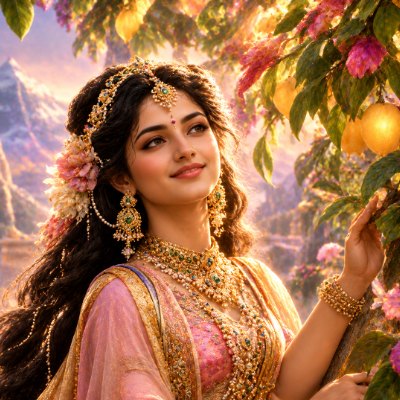
Ashokasundari is the daughter of Shiva and Parvati; the wife of Nahusha, king of the Lunar Dynasty; and the mother of Yayati — the ancestor of both the Yadava and the Paurava dynasties, and through them the ultimate genealogical progenitor of both the Pandavas and the Kauravas of the Mahabharata. She was not born through natural biological generation but was created by Parvati from the Kalpavriksha — the wish-fulfilling tree of the celestial gardens of Nandanvana — when Parvati, alone on Kailasha after Kartikeya had left to take up his divine duties, was overwhelmed with loneliness and longed for a daughter's companionship. She is described as a younger sibling of Kartikeya and an elder sibling of Ganesha — born between the two more celebrated divine children of Shiva and Parvati — and is among the least textually attested of all the major divine figures connected to the Shiva-Parvati household. Her canonical record is contained almost entirely within the Padma Purana (Bhumi Khanda) — she is not found in the Shiva Purana, the Bhagavata Purana, the Linga Purana, the Skanda Purana, or any other major Mahapurana. Despite the narrowness of her textual base, she is a living object of devotion — worshipped principally in South India and Gujarat as Bala Tripurasundari (the young, beautiful Tripura Sundari), as the daughter-form of the supreme goddess Tripura Sundari, and as the presiding divine energy at the central bindu of the Sri Yantra.
✦ The Name
The name Ashokasundari is a compound of two Sanskrit words: ashoka — without sorrow, the remover of sorrow; and sundari — a beautiful woman, the lovely one. The combined name means the sorrowless beautiful one or the beautiful one who removes sorrow. The Wikipedia article on Ashokasundari records the precise occasion of the name: Parvati gave her the name because her birth removed Parvati's own sorrow — her shoka, her grief of loneliness — and because the child was beautiful. The compound name thus carries the memory of its own origin: every time the goddess's name is spoken, it recalls the moment when a lonely mother wished for a daughter and a divine tree granted her request. Her alternate name Bala Tripurasundari — the young Tripurasundari — identifies her as the daughter-form of the supreme goddess Lalita Tripurasundari, the goddess of the Sri Chakra; and her epithet Maha Lalitha Tripurasundari in the Om Spiritual Shop source identifies her as the most complete saguna (with-form) manifestation of Shakti to take birth.
✦ Textual Note — Padma Purana Exclusivity
Ashokasundari's story is recorded in the Padma Purana (Bhumi Khanda) — one of the eighteen major Mahapuranas — and is not found in any other major canonical Hindu scripture. The Wikipedia article on Ashokasundari states this plainly: barring the Padma Purana, she is not found in any major Hindu scriptures. The Hinduism Facts source confirms: there are no other references to her in Hindu scriptures. The Shiva Purana — the most comprehensive canonical text of the Shaiva tradition — does not mention her. This narrow textual base does not diminish the validity of her worship — the Padma Purana is a major canonical text and its Bhumi Khanda section is a primary source — but it must be stated clearly in keeping with the standing instruction of this genealogical series to distinguish canonical information from popular tradition. Her subsequent popularity and widespread worship in South India and Gujarat is a living tradition that grew from this single textual source and from devotional practice that developed independently of the major Puranic canon.
✦ Lineage
- Father: Shiva — Mahadeva; the Destroyer in the Trimurti; lord of Kailasha; already profiled in this series
- Mother: Parvati — daughter of Himavat and Mena; younger sister of Ganga; reincarnation of Sati; already profiled in this series; who created Ashokasundari from the Kalpavriksha to relieve her loneliness after Kartikeya's departure from Kailasha
- Older brother: Kartikeya — the war-god; commander of the divine army; slayer of Tarakasura; who had left Kailasha to take up his divine duties and whose departure was the occasion of Parvati's loneliness
- Younger brother: Ganesha — the elephant-headed god of wisdom and auspicious beginnings; born after Ashokasundari; the Dharmakshethra source records her as the second child of Shiva and Parvati, born before Ganesha but after Kartikeya
- Maternal grandfather: Himavat — the Himalayas personified; already profiled in this series
- Maternal grandmother: Mena — wife of Himavat; daughter of Svadha and the Pitrs
- Maternal aunts: Ganga and Mainaka — Parvati's elder sister and brother per the Valmiki Ramayana tradition
- Husband: Nahusha — son of Ayu and Prabha; Ayu was the eldest son of Pururavas and Urvashi; Prabha was the daughter of Svarbhanu (Rahu); king of Pratishthana in the Aila (Lunar) Dynasty; who temporarily ruled Svarga in Indra's absence; who was cursed to become a serpent by the sage Agastya for his arrogance; who was liberated from the serpent-form by Yudhishthira during the Mahabharata's Aranyaka Parva
- Sons: Yayati — the most celebrated; ancestor of both the Yadava and Paurava dynasties; through his sons Yadu (ancestor of the Yadavas and Krishna) and Puru (ancestor of the Pauravas, Kauravas, and Pandavas) the two major dynasties of the Mahabharata descend; and five other sons including Yati (eldest; who became a sage), Samyati, Ayati, Ayus, and Dhruva per variant texts; the Subkuz source records additionally that she bore Nahusha other valiant sons
- Daughters: one hundred beautiful daughters — prophesied by the Kinnara couple at the time of Hunda's abduction; not named individually in the available sources
- Grandson (through Yayati): Yadu — ancestor of Krishna; and Puru — ancestor of the entire Kuru dynasty; making Ashokasundari the great-grandmother of both Krishna and the Pandavas and Kauravas simultaneously through the Lunar Dynasty
✦ Birth from the Kalpavriksha
The Padma Purana (Bhumi Khanda) records the birth of Ashokasundari as follows. Shiva, being of deeply yogic disposition, would frequently withdraw into solitary meditation on Kailasha. During one of these periods of Shiva's absence, Parvati felt acutely lonely. Kartikeya had grown up and departed Kailasha to take up his divine duties as the commander of the celestial armies. Parvati requested Shiva to take her to the most beautiful garden in the world. Shiva took her to Nandanvana — the celestial pleasure garden. There, among all the trees, Parvati was drawn particularly to one: the Kalpavriksha, the divine wish-fulfilling tree. The Hinduism Facts source, citing the Padma Purana directly, records Parvati's words to Shiva: she told him that in her mind a great longing had sprung up, and she wished to try the Kalpavriksha. Shiva confirmed the tree's identity and its power. Parvati made her wish: she desired a beautiful daughter. The tree fulfilled the wish immediately. A girl was born from it — radiant, golden-complexioned, with eyes and face like the lotus, hands resembling lotuses, and hair adorned with fragrant flowers. The newborn girl asked Parvati why she had been created and what she was required to do. Parvati replied that she had conceived her through curiosity about the tree's power, and that the child was undoubtedly her daughter, endowed with all good fortune. She then gave her the name Ashokasundari — because she had removed her shoka (sorrow) — and prophesied her destiny: in the lunar dynasty, a king named Nahusha would be born who would be equal to Indra, the king of heaven, and he would be her husband. Parvati and Shiva then returned to Kailasha. In the Padma Purana's account they did not take Ashokasundari with them at that point — she remained in Nandanvana, living there and enjoying the company of the daughters of the gods. In the television series and popular retellings she is brought to Kailasha immediately; the Padma Purana text records her remaining in Nandanvana for a period. The Dharmakshethra source records that she was born even before Ganesha and was the second child of Shiva and Parvati.
✦ The Demon Hunda — Rejection, Deception, Curse, and Escape
The principal episode of Ashokasundari's life — the one to which all the Padma Purana-derived sources devote the most detail — is her encounter with the demon Hunda. The sources give slightly varying accounts of how the encounter began. The Wikipedia article and most sources record that Ashokasundari was one day roaming in Nandanvana with her maids and companions when a Rakshasa named Hunda entered the garden, saw her, and was immediately overwhelmed by her beauty. He proposed marriage. Ashokasundari rejected him firmly: she was already destined for Nahusha, whom she considered her husband even though he had not yet been born. The Hinduism Facts source records the precise formulation: even though Nahusha was not yet born, she considered herself his wife and told Hunda to seek another woman. Some sources — the Subkuz source and the Dharmakshethra source — call the demon Hunda or Nighunda; these appear to be variant names for the same figure in different manuscript traditions of the Padma Purana. Hunda, unable to accept the rejection, devised a deception. He disguised himself as a widow — a woman whose husband he had killed — and approached Ashokasundari with a tale of distress, asking her to accompany her to her hermitage. Ashokasundari, moved by compassion, went with the disguised demon. When they reached what the demon claimed was the widow's cottage or hermitage, the disguise was dropped and Hunda seized her, taking her to his palace. There he told her he would wait for her to grow up and then marry her. Ashokasundari, in Hunda's captivity, issued a curse against him with complete resolve: her husband Nahusha would kill him. The curse was irrevocable. Hunda, recognising that Nahusha had not yet been born and that preventing his birth would neutralise the curse, attempted to kidnap the infant Nahusha from his palace. A maidservant of Hunda's own household rescued the infant prince and took him to the ashrama of Vasishtha — Shiva and Parvati's family sage — who raised him in safety. Ashokasundari meanwhile managed to escape Hunda's captivity and returned to her parents on Kailasha. At some point after her escape, while still distressed by Hunda's claim that he had killed Nahusha, Ashokasundari was consoled by a Kinnara couple — celestial beings of the gandharva class — who informed her that Nahusha was alive and well, being raised in Vasishtha's ashrama, and prophesied that she would be the mother of a powerful son named Yayati and one hundred beautiful daughters.
✦ Nahusha's Coming of Age — The Battle with Hunda and the Marriage
Nahusha grew up in the ashrama of Vasishtha, understanding from an early age the destiny laid out for him — to avenge the insult to Ashokasundari, to kill Hunda who had cursed and imprisoned her, and to take her as his wife. When he reached the age of a warrior and was fully trained, he challenged Hunda. The battle was fierce. Nahusha prevailed, killing Hunda and fulfilling Ashokasundari's curse. He then went to Kailasha, where Shiva and Parvati blessed the union. The marriage was performed with divine ceremony, attended by celestial beings, gods, and sages. The Verandah Club source records that they met, fell in love, and were married in fulfilment of the divine prophecy that Parvati had announced at the moment of Ashokasundari's naming.
✦ Nahusha's Reign and Fall — Ashokasundari as Witness
After their marriage, Nahusha and Ashokasundari had their children — Yayati and the others — and lived in Pratishthana. In time, Indra was forced to absent himself from Svarga — most accounts record that Indra went into hiding after being afflicted by the sin of Brahminicide for his killing of the demon Vritra who had Brahmin status. In Indra's absence, the gods needed a regent for Svarga. Nahusha — renowned for his qualities of justice, courage, learning, and yoga — was chosen as temporary king of heaven. At first he ruled well. But the extraordinary power and privilege of Svarga corrupted his judgment. He grew proud and arrogant. He attempted to seduce Indra's wife Indrani — the one act that placed him irrevocably on the wrong side of cosmic dharma. Indrani, to delay him, told Nahusha he could come to her only if he was carried in a palanquin borne by the greatest sages of the three worlds. Nahusha, in his arrogance, had the Saptarishis carry his palanquin. When the sage Agastya moved too slowly, Nahusha struck him with his foot and cried the word Sarpa — move faster. Agastya, the great sage whose curse was irresistible, instantly turned Nahusha into a serpent — the Sanskrit word sarpa means both a command to move and the word snake, and the curse fulfilled both meanings simultaneously. Nahusha fell from the palanquin as a great python and descended to earth, where he remained for thousands of years, waiting for the encounter with Yudhishthira that alone could release him. The Mahabharata (Aranyaka Parva, Chapters 177–180) records the conclusion of Nahusha's serpent-curse. During the Pandavas' forest exile, Bhima encountered a massive python that seized him with irresistible strength. Yudhishthira found his brother in the python's coils and engaged it in a philosophical dialogue on dharma. When Yudhishthira answered correctly, the python was released from the curse, and Nahusha, restored to his celestial form, ascended to heaven.
✦ The Salt Connection — Witness to the Ganesha Episode
The tradition records an unusual connection between Ashokasundari and salt. The Dharmakshethra and Verandah Club sources describe the episode as follows. When Shiva, returning to Kailasha and not recognising Ganesha, severed the boy's head — the foundational episode of Ganesha's mythology already profiled in the Parvati section — Ashokasundari was present on Kailasha. Terrified by her father's act and overwhelmed with fear, she hid behind a sack of salt. When Parvati discovered what had happened to Ganesha, her grief turned to cosmic fury — and in that fury, she briefly cursed Ashokasundari as well, cursing her to become part of the salt. When Shiva restored Ganesha with the elephant head and pacified Parvati, Ashokasundari was also restored and pacified. From this episode the tradition associates her with salt — a substance that is essential to life but often overlooked, present in every meal without being prominently noticed. The Verandah Club source notes that salt without which life is tasteless is her symbol; the VedicFeed source records the folk practice that in the month of Chaitra, salt is not purchased in her memory. This connection to salt — humble, essential, invisible in ordinary circumstances — is one of the most unusual attributes in the entire canon of divine figures profiled in this series.
✦ Genealogical Significance — Ancestral Mother of the Mahabharata's Principal Dynasties
Ashokasundari's most consequential genealogical role is as the mother of Yayati — the king of the Lunar Dynasty whose two principal sons, Yadu and Puru, became the founding ancestors of the two major dynasties of the Mahabharata. Yadu is the ancestor of the Yadava dynasty — the lineage of Krishna himself — through the line: Yadu — Kroshthu — ... — Shura — Vasudeva — Krishna. Puru is the ancestor of the Paurava-Kuru dynasty — through the line: Puru — Janamejaya — ... — Shantanu — Bhishma; and through Shantanu's sons Chitrangada, Vichitravirya, and the subsequent Pandavas and Kauravas. Through both these lines simultaneously, Ashokasundari — the daughter of Shiva and Parvati, born from the Kalpavriksha of Nandanvana — is the divine great-grandmother of both Krishna and Arjuna. This genealogical significance makes Ashokasundari a figure of extraordinary importance in the wider lineage network of this series: she is the daughter of the Shaiva tradition's supreme deity and the mother of the founding ancestors of the Vaishnava tradition's supreme avatar. The two supreme deities of the Hindu tradition — Shiva and Vishnu — are connected in this genealogical series through Ashokasundari as daughter of one and ancestor of the other.
✦ Worship — South India and Gujarat
Ashokasundari is worshipped principally in South India and Gujarat. In South India she is identified with and worshipped as Bala Tripurasundari — the young, beautiful, daughter-form of the supreme goddess Tripura Sundari (Lalita), the presiding deity of the Sri Yantra. She is believed to reside at the central bindu of the Sri Chakra — the dimensionless point at the very centre of the Sri Yantra's complex geometric structure — and is regarded as the most complete saguna-roopa (with-form) manifestation of Shakti to take birth. In this identification she is not a separate deity from Tripura Sundari but her daughter-aspect — the young, fresh, unblemished manifestation of the same divine beauty that Tripura Sundari embodies in her full royal majesty. She is also connected to Jyotirgamaya in Karnataka and to various temple traditions along the Kerala-Tamil Nadu border. Her wider visibility in contemporary popular culture was significantly expanded by the Hindi television series Devon Ke Dev Mahadev, which devoted several episodes of its eighth season to her story, bringing the Padma Purana narrative to a mass audience that had not previously encountered it.
✦ References
- Padma Purana (Bhumi Khanda) — the sole major canonical source for Ashokasundari's birth, story, and genealogy; the Kalpavriksha birth narrative; the naming by Parvati; the prophecy of Nahusha as husband; the encounter with Hunda in Nandanvana; Hunda's deception and her captivity; her curse on Hunda; her escape to Kailasha; the Kinnara couple's prophecy; Nahusha's upbringing at Vasishtha's ashrama; his battle with Hunda; the marriage; the prophecy of Yayati and a hundred daughters
- Mahabharata (Aranyaka Parva, Chapters 177–180) — the Nahusha-as-serpent episode and his liberation by Yudhishthira; Nahusha's identity and lineage as husband of Ashokasundari confirmed in this context; the philosophical dialogue between the serpent-Nahusha and Yudhishthira on dharma
- Mahabharata (Adi Parva — the Nahusha genealogy) — Nahusha's place in the Lunar Dynasty as son of Ayu and father of Yayati; the lineage connecting Ashokasundari to the Pandavas and Kauravas
- Wikipedia — Ashokasundari — the most concise accurate modern summary of the Padma Purana account; the textual note that she does not appear in any major scripture other than the Padma Purana
- Hinduism Facts — Ashokasundari The Daughter of Lord Shiva — the most complete retelling of the Padma Purana Bhumi Khanda episode including the precise wording of Parvati's declaration of the name and the Nandanvana setting; the textual confirmation of her non-appearance in other scriptures
- VedicFeed — Ashoksundari Daughter of Shiva Parvati; Dharmakshethra — Lord Shiva's Daughters; The Verandah Club — The Beautiful Daughter of Lord Shiva and Goddess Parvati; Om Spiritual Shop — Ashoka Sundari; Subkuz — Mysterious Birth of Goddess Ashok Sundari; Asttrolok — Who Was Ashok Sundari; Bejandaruwalla — Who Is The Daughter Of Lord Shiva And Parvati: modern summaries drawing from the Padma Purana and from popular devotional tradition