
About
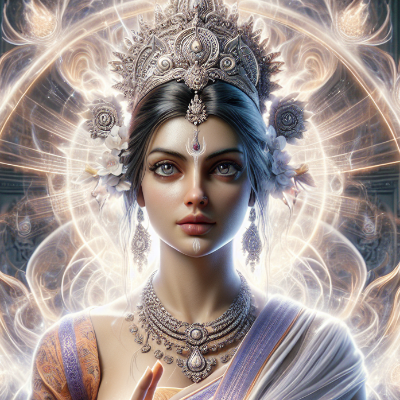
Arishta — Mother of the Gandharvas and Daughter of Daksha
Arishta · Gandharvamata · Dakshakanya · Kashyapapatni
Arishta is a daughter of Daksha, the primordial progenitor lord and one of the Prajapatis appointed by Brahma to multiply beings across the cosmos, and one of the wives of the sage Kashyapa — grandson of Brahma through the seer Marichi and the progenitor of the full range of living beings through his many wives. Arishta is identified in the Puranic genealogical tradition as the mother of the Gandharvas — the celestial musicians and singers who inhabit the heavenly realms and who occupy a significant position in the divine hierarchy as attendants, performers, and inhabitants of the intermediate celestial spaces between the earth and the higher heavens. She is listed among the wives of Kashyapa in the genealogical enumerations of the Vishnu Purana and the Bhagavata Purana. Her textual presence is almost entirely confined to these genealogical lists; she is not the protagonist of any extended narrative episode in the surviving primary sources, and the profile presented here is accordingly proportionate to the limited attestation of the source material.
✦ The Name
The name Arishta derives from the Sanskrit root rish, meaning to harm or injure, with the negative prefix a, yielding the primary sense of "the unharmed one," "she who is without injury," or "the auspicious one." The term arishta in classical Sanskrit also carries the meaning of a bad omen or ill sign in certain contexts, representing a semantic duality in the name — it can denote freedom from harm or, in other usages, the presence of an ill portent. In the context of this figure as a wife of Kashyapa and a daughter of Daksha, the name functions simply as a proper name and is not elaborated etymologically in the primary texts. The epithet Gandharvamata means "mother of the Gandharvas."
✦ Lineage
- Father: Daksha — a Prajapati and primordial progenitor, son of Brahma, who gave his daughters in marriage to the sage Kashyapa and to other sages and divine figures as a means of generating the diverse races of beings.
- Mother: The name of Daksha's wife varies across sources as it does for all of his daughters — Panchajani in some Puranic passages, Prasuti in the Bhagavata Purana, and Virani in certain Mahabharata references. These represent distinct textual traditions.
- Siblings: Arishta is one of the group of Daksha's daughters given to Kashyapa. Her sisters in this household, all co-wives of Kashyapa, include Aditi (mother of the twelve Adityas), Diti (mother of the Daityas), Danu (mother of the Danavas), Kadru (mother of the Nagas), Vinata (mother of Garuda and Aruna), Surasa (mother of a group of Nagas), Muni (mother of the Apsaras in some accounts), Krodhavasha, Tamra, Ira, Surabhi, and Timi, among others listed in the Vishnu Purana and Bhagavata Purana.
- Spouse: Kashyapa — the supreme primordial seer through whose various wives all the major races of beings are generated.
- Children — the Gandharvas: Arishta is named in the Vishnu Purana as the mother of the Gandharvas through Kashyapa. The Gandharvas are celestial musicians and singers who inhabit the intermediate celestial spaces and the heavenly realms. They are associated with the Apsaras — celestial nymphs — and together the two groups constitute the performing arts dimension of the divine realm. Named individual Gandharvas associated with the tradition include Chitrasena, Vishvavasu, and others prominent in the Mahabharata and Puranas, though the texts do not consistently assign all of them to Arishta's line specifically. The Vishnu Purana does not provide a detailed enumeration of Arishta's Gandharva sons comparable to the enumeration it gives for Kadru's Nagas.
✦ The Gandharvas in the Wider Tradition
Although Arishta herself receives minimal narrative elaboration, her progeny — the Gandharvas — are significant figures throughout the Vedic, Puranic, and epic traditions. In the Rigveda, the Gandharva (singular in the Vedic texts) is a mysterious celestial figure associated with the soma plant and with the waters. In later texts the Gandharvas become a collective class of beings — celestial musicians, guardians of the soma, and inhabitants of the Gandharvaloka. In the Mahabharata they appear in numerous episodes: they abduct Draupadi on one occasion, they engage in conflict with the Pandavas and Kaurava princes at Dvaitavana, and Chitrasena the Gandharva is specifically named as a teacher of music and dance to Arjuna during his period in the heaven of Indra. In the Puranas the Gandharvas are regularly paired with the Apsaras as the celestial performing community who entertain the gods. Their connection to Arishta as their progenitress is stated in the genealogical lists without being further elaborated in narrative terms.
✦ Textual Variants and Inconsistencies
The attribution of the Gandharvas to Arishta is not universal across all texts. Several Puranic passages attribute the Gandharvas to Brahma directly, or to other divine sources. The Bhagavata Purana attributes the origin of the Gandharvas to Brahma's breath or to beings generated from his nose or voice in different passages of its cosmogonic sections, without reference to Arishta. The Vishnu Purana's genealogical framework, in which Arishta is named as their mother through Kashyapa, represents one specific and internally consistent tradition, but it exists alongside other origin accounts for the Gandharvas in the broader textual corpus. Additionally, another figure named Muni — also a wife of Kashyapa and a daughter of Daksha in the same Vishnu Purana list — is in some texts associated with the Apsaras, and the boundary between the Apsaras and the Gandharvas' origin accounts is not always clearly maintained across the sources. These overlapping and sometimes contradictory attributions are characteristic of the Puranic genealogical material for the secondary and tertiary divine beings.
✦ Theological Significance
Arishta's theological significance is primarily genealogical. As the mother of the Gandharvas through Kashyapa, she provides the divine performing arts community with a place within the same cosmological household that generates the gods, the demons, the serpents, and the birds. The Puranic system's placement of the Gandharvas within the Kashyapa-Daksha genealogical network reflects the tradition's consistent effort to integrate all categories of non-human being into a single cosmological genealogy rooted in Brahma's creation and expressed through the household of Kashyapa and his wives. Arishta's own textual profile is thin, and the tradition has preserved her name in the genealogical lists without elaborating her personal narrative. This brevity is honestly reflected in the present profile, which does not extend beyond what the primary sources support.
✦ Connection to the Wider Genealogy
Through her father Daksha, Arishta connects to the primordial creative line of Brahma. Through her husband Kashyapa she is a co-wife of Aditi, Diti, Danu, Kadru, Vinata, Rohini, and the other daughters of Daksha who together generate the full range of divine and semi-divine beings in the Puranic cosmos. Her Gandharva sons are members of the celestial community who inhabit the heavenly realms alongside the gods born of her sister Aditi, and their role as performers and musicians places them within the cultural and aesthetic dimension of the divine order rather than in the cosmic political and military dimensions occupied by the Adityas and Daityas. The Gandharvas' consistent pairing with the Apsaras in later texts — who are separately generated in most cosmogonic accounts — reflects the tradition's understanding of the celestial arts as a complementary system, with the male and female performers together constituting the complete performing community of the divine realm.
✦ References
Primary Sources
- Vishnu Purana, Book 1, chapter 21: The primary source for naming Arishta as a wife of Kashyapa and as the mother of the Gandharvas; this is the most explicit attribution of the Gandharva lineage to Arishta in any major Puranic text.
- Bhagavata Purana, Book 6, chapter 6: Lists Arishta among the daughters of Daksha given to Kashyapa in the context of the broader genealogical enumeration, though it does not elaborate her progeny in the same terms as the Vishnu Purana.
- Mahabharata, Adi Parva, sections 65–66: Includes Arishta in the genealogical list of Kashyapa's wives within the broader cosmological genealogy provided at the opening of the epic.
- Matsya Purana, chapter 6: Names Arishta among Daksha's daughters and Kashyapa's wives, consistent with the standard genealogical list.
- Rigveda, various hymns referencing the Gandharva: The Vedic Gandharva as a singular cosmic figure associated with soma and the waters; establishes the antiquity of the Gandharva concept prior to the Puranic genealogical framework that assigns their origin to Arishta.
- Mahabharata, Vana Parva (the Dvaitavana episodes) and Virata Parva: Contains extended episodes involving named Gandharvas including Chitrasena, providing narrative context for the race whose progenitress is Arishta.
Modern Reference Works
- Vettam Mani, Puranic Encyclopaedia (1975): Entry on Arishta; notes her position in the genealogical list and her attribution as mother of the Gandharvas, with cross-references to the Gandharva entries.
- A. A. Macdonell, Vedic Mythology (1897): Analysis of the Vedic Gandharva and the transition from the singular Vedic figure to the collective Puranic class of beings; relevant to understanding what Arishta's genealogical role represents in the broader trajectory of the tradition.
- Sukumari Bhattacharji, The Indian Theogony (1970): Examines the cosmogonic genealogies of the Puranas including the Kashyapa household and the origin of the various classes of beings; relevant to situating Arishta within the Puranic genealogical system.