
About
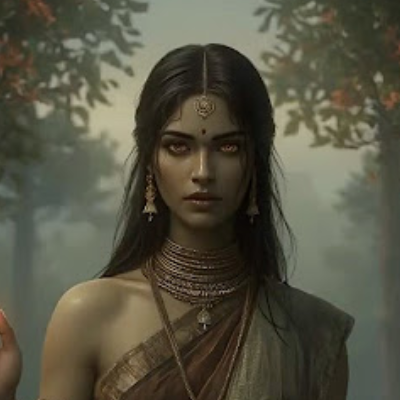
Trijata — Rakshasi Guardian of Sita and Daughter of Vibhishana
Trijata · Trijata · Trijaṭa · Benyakai (Thai tradition) · Dewi Srijati (Malay tradition)
Trijata is a rakshasi who appears in the Valmiki Ramayana as one of the demonesses assigned to guard Sita, wife of Rama, during her captivity in the Ashoka grove of Lanka. In the original Valmiki text she is described simply as an aged and prudent rakshasi, distinguished from her fellow guards by her compassion toward Sita and her refusal to threaten or harm her. Her most significant act in the Valmiki Ramayana is the narration of a prophetic dream, related in the Sundara Kanda, in which she foresees the defeat of Ravana and the liberation of Sita. In later Ramayana literature — including the Tamil Kamba Ramayana, the Oriya Balaramadasa Ramayana, the Javanese Kakawin Ramayana, and Govindaraja's Sanskrit commentary — Trijata is identified as the daughter of Vibhishana, the righteous rakshasa and younger brother of Ravana who defected to Rama's cause. Her mother in this tradition is Sarama, a gandharvi identified as Vibhishana's wife. This identification as Vibhishana's daughter is not made in the original Valmiki text, and the scholar Robert Goldman has noted the difficulty it presents given Trijata's clearly advanced age in the original epic.
✦ The Name
The name Trijata is Sanskrit in form. The element tri means three, and jata means matted locks or braided hair. The compound name thus denotes one with three matted locks or three braids, a physical description that may have originally characterised the figure in an older oral tradition. The name belongs to the category of descriptive personal names common in Sanskrit epic literature. It carries no standard epithet meaning across the textual tradition, and no secondary etymology beyond the literal is given in any primary source.
✦ Lineage
- Father: Vibhishana — the youngest son of the sage Vishrava and the rakshasi Kaikasi, and the younger brother of Ravana, the demon king of Lanka. Vibhishana is distinguished in the epic tradition as a rakshasa of dharmic disposition who counselled Ravana repeatedly to return Sita to Rama, eventually defecting to Rama's army. After Ravana's defeat, Rama installed Vibhishana as king of Lanka. He is counted among the Chiranjivis, the seven immortals of Hindu tradition. His parentage traces through Vishrava to the sage Pulastya, a son of Brahma.
- Mother: Sarama — identified in the Uttara Kanda of the Valmiki Ramayana as the daughter of the gandharva Shailusa, born on the banks of the Manas Lake, and given to Vibhishana as his wife. Sarama is described as friendly to Sita and as having aided her during her captivity. In several Ramayana traditions Sarama replaces Trijata as the more active benefactress of Sita, while in others the two figures occupy complementary roles.
- Sister: Anala — a daughter of Vibhishana and Sarama, mentioned in connection with the episode in which Vibhishana's wife sends her daughter to inform Sita of Ravana's intentions regarding her. In various recensions of the Valmiki Ramayana this daughter is named Kala, Nanda, or Anala. The relationship between Anala and Trijata as sisters is established by their common parentage in the later tradition, though the Valmiki Ramayana does not name Trijata as Vibhishana's daughter and does not present these figures together as siblings in the original text.
- Paternal grandfather: Vishrava — a brahmarshi, son of the sage Pulastya and a descendant of Brahma, father of Ravana, Kumbhakarna, Vibhishana, and Shurpanakha.
- Paternal grandmother: Kaikasi — a rakshasi, daughter of the demon king Sumali, mother of the four principal children of Vishrava.
✦ Role in the Sundara Kanda: The Prophetic Dream
Trijata's most celebrated episode occurs in the twenty-seventh sarga of the Sundara Kanda of the Valmiki Ramayana. Ravana has imposed a two-month ultimatum on Sita to accept his marriage proposal, and the rakshasi guards of the Ashoka grove are threatening her with death and dismemberment. Trijata, described as aged and prudent and as having been asleep, wakes to intervene on Sita's behalf. She rebukes the other rakshasis and commands them to desist from threatening the daughter of Janaka and the daughter-in-law of Dasharatha — Janaka being the king of Mithila and adoptive father of Sita, and Dasharatha being the deceased king of Ayodhya and father of Rama.
Trijata then narrates a dream she has experienced. In it she sees Rama and Lakshmana descending toward Lanka in a celestial chariot drawn by swans, clad in white, and radiant. She sees Sita on a white mountain surrounded by the sea, reunited with Rama. She then sees Ravana with his head shaved, his body smeared with oil, dressed in red garments, and being drawn southward by a woman — the direction of death in Indian cosmological symbolism — toward certain destruction. She sees Ravana's sons and the rakshasi forces fleeing in degradation, riding pigs, while Vibhishana alone is seen in white robes moving safely through the sky. The dream concludes with images of Lanka sinking into the sea. Trijata interprets the vision as a reliable prophecy and urges the other rakshasis to take refuge in Sita, who promises to protect her guards should the dream prove true.
✦ Role in the Yuddha Kanda: Reassurance on the Battlefield
Trijata appears again in the Yuddha Kanda of the Valmiki Ramayana. When Ravana's son Indrajit — the rakshasa prince renowned for his mastery of illusion and divine weapons — strikes Rama and Lakshmana with the Nagapasha weapon, binding them and rendering them unconscious, Ravana orders Sita to be taken aboard his aerial chariot to view the battlefield and witness what he presents as proof of Rama's death. Trijata accompanies Sita on this flight. Sita is overwhelmed by grief at the sight of the fallen brothers and begins to lament. Trijata reassures her, observing signs among Rama's army — in particular the absence of any mourning behaviour among the vanara forces — that indicate the brothers remain alive. She reasons that were Rama truly dead, the conduct of the army and the omens visible on the field would be entirely different. Her reassurance steadies Sita and returns her to the Ashoka grove. In the forty-eighth sarga of the Yuddha Kanda this episode is described in detail, with Trijata articulating her observations and expressing her personal devotion to Sita.
✦ Textual Variants and Inconsistencies
The most significant textual inconsistency surrounding Trijata concerns her identity and relationship to Vibhishana. In the original Valmiki Ramayana she is presented simply as a rakshasi among Ravana's household without any familial identification. The ascription of the status of Vibhishana's daughter first becomes consistent in post-Ramayana commentarial and regional literary traditions, including the Kamba Ramayana, the Balaramadasa Ramayana, the Kakawin Ramayana, and Govindaraja's commentary on the Valmiki text. Goldman's observation — that Trijata's evident advanced age in the Valmiki text sits awkwardly with her being the daughter of Vibhishana, who is not himself described as elderly — reflects a genuine structural tension between the original text and its later reinterpretation.
Further variation exists across traditions regarding Trijata's relationship to Vibhishana. The Ananda Ramayana, a Sanskrit text of approximately the fourteenth or fifteenth century, identifies Trijata not as Vibhishana's daughter but as his wife. The Marathi Bhavartha Ramayana of Eknath regards her as his sister, which would make her a sibling of Ravana himself. The Jain text Vasudevahindi of Samghadasa Gani also presents her as a sister of Ravana, Vibhishana, Kumbhakarna, and Shurpanakha. Jayamangala's commentary on the Bhattikavya similarly describes her as Ravana's sister. These variants indicate that the figure of Trijata circulated in several distinct genealogical relationships with the Pulastya-Vishrava clan across different regional and sectarian traditions, and that the daughter-of-Vibhishana identification, though dominant in the post-Ramayana mainstream, is not universal.
In the Krittivasi Ramayana, the Bengali recension of the epic, Trijata is portrayed in a negative light, depicted as urging Sita to accept Ravana's offer and become the queen of Lanka — a characterisation entirely at odds with her role in the Valmiki text and most other traditions, in which she is Sita's protector and advocate.
In Southeast Asian traditions Trijata's role expands further. In the Thai Ramakien she is called Benyakai and is described as marrying Hanuman, the vanara general of Rama's army, with their union producing a son named Asuraphat, who bears a demon's body and a monkey's head. In the Malay Seri Rama, Vibhishana himself requests Hanuman to wed his daughter Trijata, here called Seri Jati, after the war.
✦ Post-War Tradition and Worship
In the Ananda Ramayana and in the tradition reflected in the Sarama Wikipedia article, both Sarama and Trijata travel to Ayodhya in Ravana's Pushpaka Vimana following the conclusion of the Lanka war. When Sita later visits Lanka, she is said to have instructed Sarama to treat Trijata with the same honour as she would show Sita herself — a mark of profound personal regard. A regional tradition holds that Trijata was originally a devotee of Shiva who was transformed into a rakshasi through a sage's curse, but continued her worship of Shiva even in her demon form. No major iconographic tradition or primary temple cult dedicated specifically to Trijata is recorded in the scholarly sources available for this profile.
✦ References
Primary Sources
- Valmiki Ramayana, Sundara Kanda, Sarga 27 — the primary locus of Trijata's appearance; records her intervention to protect Sita from the rakshasi guards and her narration of the prophetic dream; describes her as aged and prudent but gives no familial identification.
- Valmiki Ramayana, Yuddha Kanda, Sarga 48 — records Trijata's role accompanying Sita over the battlefield and her reassurance that Rama and Lakshmana remain alive despite appearances.
- Valmiki Ramayana, Uttara Kanda — identifies Sarama, daughter of the gandharva Shailusa, as Vibhishana's wife; establishes the parentage from which Trijata's identity as Vibhishana's daughter is later constructed.
- Kamba Ramayana (Tamil; 12th century CE) — identifies Trijata as the daughter of Vibhishana; expands her protective role toward Sita in the Ashoka grove episode.
- Balaramadasa Ramayana (Oriya) — identifies Trijata as Vibhishana's daughter and expands her narrative role during the war episodes.
- Kakawin Ramayana (Javanese) — identifies Trijata as Vibhishana's daughter; honours her as Sita's loyal companion and records her rewarding by Sita at Ayodhya.
- Ananda Ramayana (Sanskrit; c. 14th–15th century CE) — identifies Trijata as the wife rather than the daughter of Vibhishana; records both Sarama and Trijata travelling to Ayodhya after the war.
- Bhavartha Ramayana of Eknath (Marathi) — identifies Trijata as the sister of Vibhishana.
- Vasudevahindi of Samghadasa Gani (Jain) — identifies Trijata as a sister of Ravana, Vibhishana, Kumbhakarna, and Shurpanakha.
- Krittivasi Ramayana (Bengali) — portrays Trijata negatively as urging Sita to accept Ravana's marriage proposal.
- Thai Ramakien — names Trijata as Benyakai, daughter of Vibhishana; records her marriage to Hanuman and the birth of their son Asuraphat.
- Malay Seri Rama — names Trijata as Dewi Srijati; records Vibhishana's request that Hanuman wed her after the war.
Modern Reference Works
- Wikipedia, "Trijata" — comprehensive survey of Trijata's role across primary and regional texts; notes Goldman's observation on the tension between her age in the Valmiki text and her identity as Vibhishana's daughter in later tradition.
- Wikipedia, "Sarama (Ramayana)" — records Sarama as Vibhishana's wife and Trijata's mother in the traditions that identify Trijata as their daughter; notes Camille Bulcke's assessment of Sarama's interpolated status in the original Ramayana.
- Wikipedia, "Vibhishana" — records Vibhishana's genealogy, his daughter Trijata, and his status as a Chiranjivi.
- Wisdomlib, Valmiki Ramayana, Sundara Kanda, Sarga 27 — provides transliteration and translation of the Trijata dream episode directly from the primary text.
- Grokipedia, "Trijata" — synthesises Trijata's characterisation across Ramayana traditions including her role in the Mewar Ramayana and her narrative parallels with Vibhishana.