
About
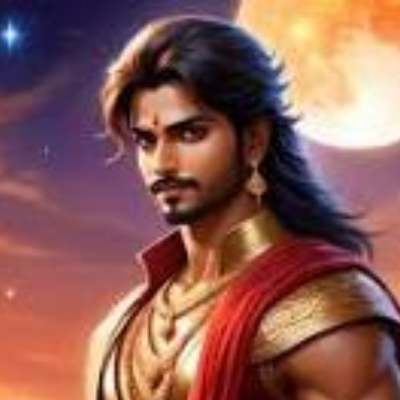
Taranisena — Son of Vibhishana, Warrior of the Lanka War, Bhakta of Rama
Taranisena · Taranisen · Tarani
Taranisena is a son of Vibhishana and Sarama, and one of the most theologically layered minor figures in the extended Ramayana tradition — entirely absent from the Valmiki Ramayana and present only in the Bengali Krittivasi Ramayana of the fifteenth century, where he serves as the vehicle for one of that text's most emotionally charged explorations of bhakti, familial loyalty, and the paradox of seeking liberation through combat with God. The Indica Today article on Bengal's Ramayana tradition confirms directly: "We do not find any mention of Vibhishana's son Taranisen in the Valmiki Ramayana." His story belongs to a distinct and self-aware regional tradition that explicitly transforms the heroic register of the Valmiki text into a devotional one suited to the bhakti movement sweeping Bengal in Krittivasa's era.
✦ The Name
Taranisena is a Sanskrit-derived compound in which taraṇi means the sun or a boat (something that crosses or carries across), and sena means army or warrior. The name thus carries the sense of "warrior who carries across" or "one of the sun's army" — both resonant meanings for a figure whose ultimate desire is to cross from mortal existence to divine liberation at Rama's (Vishnu's) hands. The short form Tarani, used in the Indica Today article's citation of the Krittivasi text, means simply "the sun" and has Vaishnava associations with the solar deity who is the ancestor of Rama's own Solar dynasty.
✦ Lineage
- Father: Vibhishana — youngest son of Vishrava and Kaikesi; righteous brother of Ravana; the Rakshasa who defected to Rama's cause; king of Lanka after the war; Chiranjivi
- Mother: Sarama — daughter of the Gandharva Shailusa; born on the banks of Manas Lake; befriended and aided Sita during the captivity; aligned with her husband's commitment to dharma even while remaining in Lanka during the war
- Maternal grandfather: Shailusa the Gandharva
- Paternal grandparents: Vishrava (sage) and Kaikesi (Rakshasi)
- Paternal uncles: Ravana — to whom Taranisena remained loyal despite his father's defection; Kumbhakarna — already dead before Taranisena enters the battlefield in the Krittivasi account
- Sibling: Anala (Sundara Kanda, core Valmiki text) — eldest daughter of Vibhishana who served as a messenger to Sita; she is Taranisena's sister in the tradition though the two are attested in entirely different textual strata
✦ The Story — Krittivasi Ramayana
The Krittivasi Ramayana, composed by Krittivasa Ojha in the fifteenth century in Bengali and described by the Krittivasi Ramayan Wikipedia article as "the single most popular book in the whole of pre-modern Bengal," is a bhakti-inflected retelling of the Valmiki epic that deliberately heightens emotional drama and introduces characters and episodes not found in the Sanskrit original. Taranisena belongs to this layer of additions.
The Hindu Blog account gives the fullest summary. Taranisena remained with his uncle Ravana in Lanka even after his father Vibhishana defected to Rama's side. He was loyal to Ravana out of a bond of familial obligation and honour — but he was simultaneously, and secretly, a devoted worshipper of Rama, knowing that Rama was Narayana incarnate. His deepest aspiration was to be killed by Rama and thereby attain moksha: liberation and an eternal place in Vishnu's presence. When Ravana summoned him to battle, Taranisena was exhilarated rather than frightened — for him, the summons was an opportunity to finally meet the Lord in person and receive at his hands the liberation he had sought.
He went first to his mother Sarama and asked her permission. Sarama refused: she said she would not allow him to go, that she would take him out of Lanka with her. Taranisena's response, as recorded in the Hindu Blog account, was: "Mother, I know that Rama is none other than Vishnu. Even then, I will fight Rama. If I die at Rama's hands, it will be a place in heaven for me. And Mother, who can kill whom, when all we see around us are different forms of Vishnu? Do not grieve over death. I have heard from father that the body is nothing but a shell. Rama will not kill me if he knows I am a son of Vibhishana. If I am alive, I will come and greet you again." He then sought and received blessings from his father Vibhishana — present in Rama's camp — before entering the battle.
On the battlefield, Taranisena proved devastating: he defeated Sugriva, Hanuman, Nila, and Angada, and rendered Lakshmana unconscious. Neither the vanaras nor Lakshmana could overcome him. Rama himself was moved when Taranisena came and bowed at his feet before resuming the fight — for Taranisena's body was tattooed, every inch, with the name of Rama. Confronted with this, Rama refused to fight: "I will not be able to kill someone who is so devotional. How can I hurt my devotee? If I try to shoot an arrow at him, that will hurt me." He sat down. The alternative version in the wordpress Ramayana novel account adds a further detail: Rama said "How can I kill him? He worships me," and Vibhishana advised "Strike him in his mouth. Knock out his teeth and slice off his tongue for they are not marked with your name. That is the vulnerable spot." Rama remained confused: "He chants my name with great devotion." Vibhishana said, "Strike in the pause between two chants."
In the Hindu Blog account, the resolution is different: Taranisena, understanding that Rama's compassion was preventing him from granting the liberation he sought, deliberately provoked Rama by shouting: "Rama, what gave you the notion that I will not fight? I will now kill you. I will have Sita sit on Ravana's throne." This taunt was calculated — it was designed to force Rama to act. Vibhishana then interceded and told Rama that the only weapon capable of killing Taranisena was the Brahmastra. Rama invoked it. As the weapon descended, Taranisena said: "Please grant me a place near you after I die." The Brahmastra struck and severed his head. As the head fell to the ground, it continued to chant "Rama, Rama." Thus Taranisena attained the moksha he had sought.
The scene that follows is where the Krittivasi text reaches its emotional peak, as analysed by the Indica Today article. Vibhishana collapsed when he learned the slain warrior was his own son. Recovering, he said to Rama: "I was not grieving for my son, as the latter would surely ascend to Vaikuntha, but rather I was grieving for myself — that I was not as fortunate as my son in ascending to Vaikuntha by being killed at the hands of Sri Rama. My son has gained everything. But what have I gained by serving at the feet of the Lord?" Rama rebuked Vibhishana for not having revealed that the warrior was his son from the beginning. Vibhishana replied: "When you are facing an enemy, you should not worry about any kind of relationship on the battlefield. In this war, there is no room for consideration of relationship. Whether it is mother, father, son or anybody else, he figures as an enemy when he takes up arms against you. Especially against God, there can be no question of relationship." The Sai Baba commentary cited at sai-arjan.tripod.com describes this as the supreme demonstration of Vibhishana's Sattvic love for Rama — that he was willing to have even his own son killed for Rama's victory, and then lamented not his son's death but his own comparative deficiency in devotion.
✦ The Krittivasi Ramayana — Its Character and Relationship to Valmiki
The Indica Today article on Bengal's Ramayana tradition provides the scholarly framing: Krittivasa consciously transforms the Veer-rasa (heroic flavour) of the Valmiki Ramayana into the Karun-rasa (tragic flavour) that fuelled Bengal's bhakti movement. The article notes that even Ravana in Krittivasa's telling is "a secret devotee of Rama who did everything for the sake of being killed at his hands" — so Taranisena's combination of outer enmity and inner devotion is characteristic of the whole Krittivasi frame, not an isolated invention. The Krittivasi Ramayana Wikipedia article confirms the text's historic influence: it was "the single most popular book in pre-modern Bengal," inspired Tulsidas's Ramcharitmanas, and shaped the literature of Michael Madhusudan Dutt and Rabindranath Tagore. Its additions to the Valmiki narrative, including Taranisena, became deeply embedded in Bengali religious culture. The Krittivasi Ramayan Wikipedia article also confirms that the version generally in circulation was revised by Jaygopal Tarkalankar and published in 1834 — meaning the text underwent later editorial work, though Taranisena's story is attested in the older layers.
✦ Theological Significance
Taranisena embodies one of the most distinctive propositions of the bhakti tradition: that intense focus on God — even in the mode of apparent opposition — is a form of devotion. This is a theme continuous with the Bhagavata Purana's Jaya-Vijaya framework (Ravana and Kumbhakarna as cursed devotees who achieved liberation through combat with Vishnu's avatar), and Taranisena can be read as Krittivasa applying that theological logic to a figure of the next generation. But Taranisena's case is more extreme even than Jaya-Vijaya: he is not cursed but chooses, with full understanding, to fight against his own father's master and God himself, precisely because he knows this is the path to liberation. His tattooed body — bearing Rama's name on every inch of skin — is the visual expression of a devotion that has made no practical concession to the side he is fighting for. He serves Ravana with his arms; he serves Rama with his soul. The paradox is unresolved until the Brahmastra descends, and the head that falls chanting Rama's name resolves it in the only way the bhakti tradition recognises: through the mercy of the divine name itself, which continues even after the body it inhabited has been destroyed.
Vibhishana's subsequent lament — that his son attained Vaikuntha through death at Rama's hands while he himself, alive and in Rama's service, has not — is the theological climax of the episode. It inverts the expected moral of the story: loyalty and service to Rama while alive is presented as less complete a union with the divine than dying in combat with Rama with absolute devotion. The lament is not theological despair but an expression of the longing that characterises the highest bhakti: the awareness that proximity to the divine is never enough, that the devotee is always haunted by the distance between service and union.
✦ References
Primary Sources
- Krittivasi Ramayana (Krittivasa Ojha, 15th century Bengali): The sole primary source for Taranisena; the episode appears in the Yuddha Kanda equivalent of the text; the edition generally in circulation was revised by Jaygopal Tarkalankar in 1834 but the Taranisena episode belongs to older layers; the Indica Today article confirms its presence in the Krittivasi text and its absence from the Valmiki Ramayana. No Sanskrit primary source contains this figure.
Secondary and Reference Works
- Hindu Blog — "Story of Taranisen, Son of Vibhishana: A Tale from the Krittibasi Ramayana": The most detailed English summary of the episode; gives Sarama's refusal of permission, Taranisena's response, the battle performance, Rama's emotional paralysis, the Brahmastra resolution, and Vibhishana's lament after learning the slain warrior was his son.
- Indica Today — "Sri Rama and Ramayana Tradition in Bengal": The most important scholarly framing; explicitly confirms "We do not find any mention of Vibhishana's son Taranisen in the Valmiki Ramayana"; contextualises the episode within Krittivasa's bhakti transformation of Valmiki's heroic register into tragic-devotional rasa; quotes the original Bengali verse describing Taranisena's severed head continuing to say "Ram, Ram."
- Ramayana97825197.wordpress.com — Ramayana novel retelling: Provides an alternative version of the scene in which Vibhishana advises Rama to strike in the pause between chants, with Taranisena's body tattooed with Rama's name.
- Sai-arjan.tripod.com — Sai Baba discourse on Vibhishana: Records Vibhishana's statement after Taranisena's death about his son having attained Vaikuntha while he himself has not; frames Vibhishana as the "Sattvic friend" of Rama in whose pure love even the sacrifice of his own son was made for the divine victory.
- Wikipedia — Krittivasi Ramayan article: Provides background on the text's composition, cultural significance, and editorial history; confirms its position as the most influential Ramayana in Bengali culture and its deep impact on subsequent literature.