
About
The Five Mahayajnas — Sons of Savitr and Prishni, Divine Forms of the Five Great Daily Sacrifices
Mahayajnas · Panchamahayajna · Pancayajna · Brahmayajna · Pitryajna · Devayajna · Bhutayajna · Nryajna
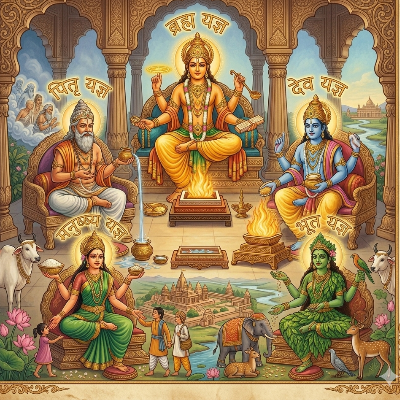
The five Mahayajnas — the five great sacrifices — are named collectively in the Bhagavata Purana, Canto 6, Chapter 18, verse 1 as sons of Prishni and the Aditya Savitr. They are listed alongside their brothers Agnihotra, Pasu, Soma, and Caturmasya, and their sisters Savitri, Vyahriti, and Trayi. Unlike their brothers, who are each a single named divine figure, the five Mahayajnas are a collective group of five, each of whom is the personalised divine form of one of the five great daily sacrifices that the Manusmriti and related dharmashastra texts establish as the binding daily obligation of every Brahminical householder. Their collective birth as sons of Savitr situates these five fundamental daily rites within the solar Aditya lineage, identifying the basic obligations of householder religious life as offspring of the divine animating solar principle. The five are not individually named as separate persons in the Bhagavata Purana verse; they are presented as a group designated by the collective term Mahayajnas or Maha-makhas.
✦ The Name
The term Mahayajna is a compound of maha, meaning great, and yajna, meaning sacrifice or sacred offering, yielding the meaning of a great sacrifice. The five Mahayajnas collectively are called Panchamahayajna or Pancayajna — the five great sacrifices. They are also referred to as the five daily debts or obligations of the householder, since they represent the five categories of beings to whom the householder owes a daily duty of honour and sustenance. The alternative designation Maha-makha, used in the Bhagavata Purana verse, is a synonymous compound with the same meaning.
✦ Lineage
- Father: Savitr — the fifth of the twelve Adityas, son of Kashyapa and Aditi; presiding deity of divine impulsion and the animating solar force.
- Mother: Prishni — consort of Savitr.
- Brothers: Agnihotra — divine form of the daily fire sacrifice; Pasu — divine form of the animal sacrifice; Soma — divine form of the Soma sacrifice; Caturmasya — divine form of the seasonal four-monthly sacrifices.
- Sisters: Savitri, Vyahriti, and Trayi.
- Paternal grandfather: Kashyapa — one of the Saptarishis; son of Marichi, born from Brahma.
- Paternal grandmother: Aditi — daughter of Daksha; mother of all the Adityas.
✦ The Five Mahayajnas and their Significance
The five Mahayajnas are enumerated and described in the Manusmriti at Chapter 3, verses 70–71, and in related dharmashastra texts. They are binding daily obligations of the householder — not elaborate srauta rites requiring specialist priests and days of preparation, but simple daily acts of acknowledgement, honour, and sustenance directed toward the five categories of beings to whom every householder stands in a relationship of debt and duty.
The first is the Brahmayajna — the propitiation of the ancient sages and the maintenance of the Vedic tradition, performed through the daily teaching and recitation of the Vedas. The second is the Pitryajna — the acknowledgement of debt to the departed ancestors, performed through the daily tarpana, the pouring of water as a memorial oblation for their gratification. The third is the Devayajna — the propitiation of the gods, performed through homa, the pouring of oblations into the sacred fire with the utterance of the divine names. The fourth is the Bhutayajna — the acknowledgement of debt to all sub-human beings and the natural world, performed through the offering of a portion of food to animals, birds, and other creatures. The fifth is the Nryajna or Manushyayajna — the honouring of fellow human beings, performed through the offering of food and shelter to an uninvited guest who arrives for a single day, the atithi.
Together the five Mahayajnas constitute a complete moral and religious programme for the householder: they situate him in right relationship with the sages of the past, the ancestors of his lineage, the gods of the cosmos, the non-human natural world, and his fellow human beings simultaneously. They are deliberately non-specialist and accessible — unlike the elaborate srauta sacrifices, they require no special priest, no yagasala, and no rare materials, only the daily intention and the simple acts of recitation, water-offering, fire-offering, food-sharing, and hospitality.
✦ Theological Significance
The five Mahayajnas as sons of Savitr complete the family picture presented in the Bhagavata Purana Canto 6, Chapter 18. Together with their brothers Agnihotra, Pasu, Soma, and Caturmasya — who represent respectively the foundational daily fire sacrifice, the animal sacrifice, the Soma sacrifice, and the seasonal sacrifices — the five Mahayajnas extend the family of the solar impeller into the domain of the most basic and universally accessible forms of religious obligation. The family of Savitr and Prishni thus encompasses the entire vertical range of Vedic and Brahminical religious practice: from the most complex and prestigious srauta rites requiring specialist knowledge and elaborate preparation, down to the simple daily acts of recitation, water-offering, and hospitality that every householder can and must perform. In doing so it presents the whole of Vedic religious life as organically related, a single family of divine beings descended from the solar animating principle and his consort, unified in their common origin and diversified in their specific domains of operation.
✦ References
- Bhagavata Purana, Canto 6, Chapter 18, verse 1 and associated commentary: The primary source naming the five Mahayajnas as sons of Prishni and Savitr; the commentary enumerates the five individual sacrifices they represent — Brahmayajna, Pitryajna, Devayajna, Bhutayajna, and Nryajna.
- Manusmriti, Chapter 3, verses 70–71: The foundational dharmashastra source establishing the five Mahayajnas as the binding daily obligations of the householder and describing each in detail.
- Shatapatha Brahmana: Provides cosmological and ritual context for the sacrificial system within which the five Mahayajnas are situated.
- Apastamba Dharmasutra and Baudhayana Dharmasutra: Early dharmasutra texts prescribing the daily performance of the five Mahayajnas as part of the householder's obligatory daily routine.
- Vettam Mani, Puranic Encyclopaedia (1975): Reference for genealogical cross-checking of Savitr's family and for the identification of the five Mahayajnas within the Puranic tradition.