
About
Kavyamata (Usana) — Wife of Bhrigu, Mother of Shukracharya, Beheaded by Vishnu, Cause of Vishnu's Earthly Avatars
Kavyamata · Kāvyamātā · Usana · Ushana · Bhrigu-patni · Shukra-mata · Deva-yuddha-vijetrī · Vishnu-shapta
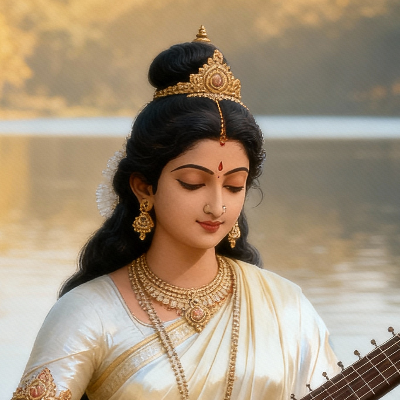
Kavyamata — also known as Usana — is a wife of the Saptarishi Bhrigu and the mother of Shukracharya, the preceptor of the Asuras and the god of the planet Venus. She is described as a great pativrata — a woman of supreme conjugal devotion — whose accumulated tapas gave her extraordinary yogic powers including the ability to put the entire deva army to sleep and to threaten even Vishnu and Indra with annihilation. Her death at Vishnu's hands — beheaded by his Sudarshana Chakra when she was protecting the Asuras who had taken refuge in her hermitage — is the event that made Bhrigu curse Vishnu to undergo multiple human births on earth, thereby generating the divine necessity of all of Vishnu's avatars including Rama and Krishna. She was subsequently revived by Bhrigu. Her story is recorded principally in the Devi Bhagavata Purana (Fourth Skandha) and the Matsya Purana. She is a distinct figure from Bhrigu's other wives Khyati and Puloma — the three women represent three separate unions of the same sage across the Puranic genealogical tradition.
✦ The Name
The name Kavyamata is a compound of kavya — poetry, the poetic, the son Kavya — and mata — mother. The compound means mother of Kavya, referring to her son Shukracharya whose Vedic designation is Ushanas Kavya (son of Kavi, another name of Bhrigu). The name thus records her entirely through her son's identity — she is defined in the tradition by her maternity. Her alternate name Usana or Ushana appears in the Devi Bhagavata Purana and in the Quora source as a personal name for the same figure. The Manuscrypts.com source adds that Bhrigu's wife is also referred to as Kavya (a shortened form of Kavyamata) in some Puranic passages — she and her son sharing the same root-name across slightly different forms.
✦ Lineage
- Parentage: not recorded in the primary canonical sources available
- Husband: Bhrigu — one of the seven Saptarishis; one of Brahma's ten mind-born sons; who revived her after Vishnu beheaded her by sprinkling holy water from his kamandalu
- Son: Shukracharya — the guru of the Asuras; possessor of the Mrita Sanjivani Vidya; the planet Venus; who became the Asuras' preceptor partly as a consequence of his mother's death at Vishnu's hands
✦ The Episode — Protecting the Asuras, Beheading, and Bhrigu's Curse
The Devi Bhagavata Purana and the Matsya Purana narrate the episode that defines Kavyamata's place in the tradition. When Shukracharya left to perform intense penance to Shiva to obtain the Mrita Sanjivani Vidya — the knowledge of raising the dead — the devas seized the opportunity. Knowing the Asuras were without their guru, Indra led the devas in a direct assault on the Asuras. The Asuras, caught without their preceptor and unable to match the divine forces in direct combat, fled to Bhrigu's hermitage. Kavyamata was present. They sought her protection as refugees — invoking the sacred duty of Atithi dharma that binds a householder to protect guests. She agreed.She summoned the Goddess of Sleep and cast the entire deva army into unconsciousness. Indra lay helpless on the ground. In desperation the devas went to Vishnu. Vishnu merged himself into Indra's body to revive him. Kavyamata, seeing this and recognising Vishnu's intervention, was enraged. She threatened to burn both Vishnu and Indra to ashes with the power of her accumulated tapas if they did not retreat immediately. At this point, according to the Devi Bhagavata Purana's account as preserved in the Quora source, Indra urged Vishnu to kill Kavyamata before she could carry out her threat. Vishnu — setting aside his own acknowledgment that it was adharma to kill a woman — invoked the Sudarshana Chakra and beheaded her.When Bhrigu returned and saw his wife's decapitated body, his grief and fury were absolute. He cursed Vishnu — for the sin of killing a woman, Vishnu would be born as a human being on earth repeatedly, enduring the cycle of birth, suffering, and death. The Padma Purana records the curse as demanding seven human births; other versions say multiple births without specifying a number. Vishnu accepted the curse with humility, declaring he would undergo mortal suffering for the good of the worlds. Bhrigu then revived Kavyamata by sprinkling sacred water from his kamandalu on her. She awoke as if from sleep. The curse could not be undone. Bhrigu's curse is the canonical explanation across the Devi Bhagavata Purana, Matsya Purana, Padma Purana, and the Ramayana's Uttara Kanda for why Vishnu took mortal form as Parashurama, Rama, Krishna, and the other avatars.
✦ Theological Significance
Kavyamata holds an unusual position in the tradition — she is the unwilling cause of the most celebrated sequence of divine incarnations in the tradition. The beheading of a pativrata — a woman whose power derived from her conjugal devotion — at the hands of the tradition's most benevolent deity, at the instigation of the tradition's king of heaven, is the tradition's most concentrated statement that even the highest divine beings cannot act outside dharmic consequence. Vishnu's own acknowledgment that killing a woman was adharma, his doing it anyway under pressure from Indra, and his humble acceptance of Bhrigu's curse — all within a single episode — constitute a complex moral record that the tradition does not attempt to simplify. The Grokipedia source notes that her story imparts lessons on non-attachment (vairagya): her death and revival demonstrate the transience of life and the folly of excessive worldly bonds even for the spiritually advanced.
✦ References
- Devi Bhagavata Purana (Fourth Skandha) — the primary canonical source: the Asuras taking refuge with Kavyamata; her yogic power putting the devas to sleep; Vishnu entering Indra's body; Kavyamata's threat; Vishnu beheading her with the Sudarshana Chakra; Bhrigu's curse; Bhrigu's revival of Kavyamata with holy water; the curse as the origin of Vishnu's avatars
- Matsya Purana — the parallel account of the Deva-Asura conflict; Kavyamata protecting the Asuras; her beheading; Bhrigu's curse
- Padma Purana — the curse demanding seven human births from Vishnu specifically
- Valmiki Ramayana (Uttara Kanda) — Durvasa narrating Bhrigu's curse to King Dasharatha; linking Rama's trials directly to the curse
- Wikipedia — Kavyamata; Grokipedia — Kavyamata; Quora — Who was Kavyamata in Hinduism; Quora — Why did Lord Vishnu kill Shukracharya's mother; Manuscrypts.com — Kavyamata; Celestia Explorers — Bhrigu Vishnu Curse Story; VedicFeed — Curse of Bhrigu to Vishnu: modern summaries drawing from the above primary sources