
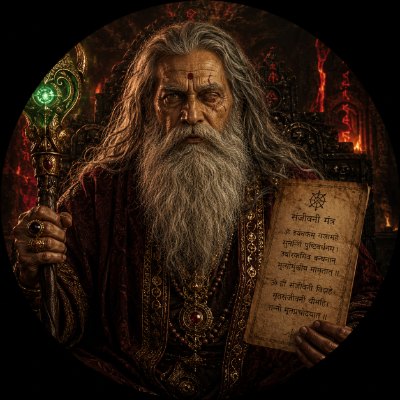
About
Shukracharya (Shukra) — Guru of the Asuras, Bearer of the Mrita Sanjivani Vidya, the Planet Venus, Son of Bhrigu
Shukra · Śukra · Shukracharya · Śukrācārya · Asuracharya · Daitya Guru · Kavya · Ushanas · Bhrigu-putra · Kavyamata-suta · Devayani-pita · Urjasvati-pati · Jayanti-pati · Navagraha · Venus
Shukracharya — known also simply as Shukra and in Vedic literature as Ushanas Kavya — is the son of the Saptarishi Bhrigu and his wife Kavyamata (also called Khyati in some texts); the guru (preceptor) of the Asuras and Daityas — earning him the title Asuracharya; the possessor of the Mrita Sanjivani Vidya — the knowledge of reviving the dead, acquired through intense penance to Shiva; the father of Devayani, who married King Yayati and whose son Yadu is the ancestor of Krishna; one of the nine Navagrahas of Vedic astrology representing the planet Venus; and one of the most complex and morally multifaceted figures in the entire Puranic tradition. He is not presented as a villain — his association with the Asuras arose from righteous grievances against Indra's favouritism toward Brihaspati and from his determination to avenge the killing of his mother by Vishnu's Sudarshana Chakra. He is described in the Bhagavad Gita (10.37) by Krishna himself as among the Kavis he is Ushanas — conferring on Shukra the direct identification with a divine quality. He is the author of the Shukraniti — a celebrated treatise on statecraft and governance. He warned Mahabali against giving three steps to Vamana, foreseeing the deception; when Mahabali overruled him and proceeded to pour the water of gift-giving, Shukracharya attempted to block the spout of the kamandalu and was blinded in one eye by Vamana's kusha grass staff. His student Kacha — son of Brihaspati — came to learn the Mrita Sanjivani Vidya from him, a story involving Kacha's three deaths, Devayani's intervention, Shukra swallowing Kacha, and Kacha learning the Vidya from inside his guru's stomach.
✦ The Names
The Sanskrit name Shukra — written Śukra — means clear, bright, pure, shining, the bright one. It is the same word used for the planet Venus — the brightest object in the night sky after the moon — and as a name for the sage it records both his radiant spiritual quality and his planetary identity. His Vedic name Ushanas — used in the Rigveda where he appears as the seer of several hymns — may derive from Usha (dawn) with a suffix, suggesting connection to the dawn light that Venus heralds. His patronymic Kavya — son of Kavi (another name of Bhrigu) — appears throughout the Vedic literature as his designation: Ushanas Kavya in the Rigveda, Kavya in the Mahabharata. The Hindupedia source records that Bhrigu has another name Kavi and Shukra is called Kavya accordingly. The title Asuracharya — teacher of the Asuras — and Daitya Guru — preceptor of the Daityas — are his most common epithet-titles in the Puranas and epics.
✦ Lineage
- Father: Bhrigu — one of the seven Saptarishis; one of Brahma's ten mind-born sons; whose curse on Vishnu — for beheading Kavyamata — is the canonical explanation for Vishnu's human incarnations; the first compiler of predictive astrology
- Mother: Kavyamata — also called Khyati in some Puranic texts and Ushana or Usha (daughter of Kashyapa) in other traditions; who protected the Asuras from Indra's attack while Bhrigu and Shukra were away; who was beheaded by Vishnu's Sudarshana Chakra; who was subsequently revived by Bhrigu through his ascetic power; whose death was the direct occasion of Shukracharya's enmity toward Vishnu and his decision to become the Asuras' preceptor
- Textual note on mother's name: the Devi Bhagavata Purana and multiple modern sources name her Kavyamata; the Bhagavata Purana names Bhrigu's wife as Khyati (daughter of Kardama and Devahuti) and says Khyati bore Lakshmi (Bhargavi) and sons Dhata and Vidhata — making Shukra either a son of a different wife or of the same wife under a different name; the Wikipedia Bhrigu article records that Bhrigu had Shukra with Kavyamata while Khyati bore Lakshmi, Dhata, and Vidhata — indicating two different wives rather than one; the Sagar World Blog gives Shukra's mother as Ushana daughter of Kashyapa as a third tradition; these three cannot be harmonised from the available primary evidence
- First wife: Urjasvati — also written Urjaswati; sometimes identified as the same as Jayanti in some texts; from whom he had four sons: Chanda, Amarka, Tvastr, and Dharaatra
- Second wife: Jayanti — daughter of Indra, the king of heaven; who was sent by Indra to interrupt Shukra's penance to Shiva but was instead so moved by his devotion that she fell in love with him and requested to become his wife; Shukra agreed; she lived with him for ten years in secret as his wife after his penance was complete
- Daughter: Devayani — born of Jayanti (Indra's daughter) per the Wikipedia article on Shukra and the primary sources; who fell in love with Kacha, her father's student, but was rejected by him because his emergence from Shukra's stomach had made him effectively her brother; who then married King Yayati of the Lunar Dynasty; whose son Yadu is the ancestor of the entire Yadava dynasty and through it of Krishna; making Shukracharya the maternal great-great-grandfather of Krishna through the Devayani-Yayati-Yadu line
- Sons: Chanda and Amarka — who served as ministers of the demon king Hiranyakashipu; Tvastr; and Dharaatra — from his wife Urjasvati; and an unnamed daughter violated by King Danda of the Solar Dynasty, whose violation caused Chyavana to curse the Dandaka forest into existence
✦ Education — From Angirasa to Gautama to Shiva
As a child Shukra was exceptionally bright. He and Brihaspati — the son of the sage Angirasa — studied together under the same teacher: Angirasa himself, Brihaspati's own father. Despite Shukra being more talented and knowledgeable than his fellow student, Angirasa showed consistent favouritism toward his son Brihaspati. The gods — Surya, Chandra, Indra, and Varuna — then appointed Brihaspati as their Guru rather than Shukra. This rejection stung Shukracharya profoundly. He left Angirasa's ashrama and went to study under the sage Gautama instead, completing his Vedic education there. The resentment toward Brihaspati — and by extension toward Indra and the devas who had preferred Brihaspati — became a permanent feature of his character and the background to his eventual alignment with the Asuras.
✦ His Mother's Death and the Decision to Become Asura Guru
The Devi Bhagavata Purana records the episode that transformed Shukracharya from a talented Brahmin sage into the Asuras' committed preceptor. While he was away performing penance to Shiva — hoping to acquire the Mrita Sanjivani Vidya to revive the Asuras who died in repeated battles with the devas — Indra attacked the Asuras. The Asuras, without their guru, went to Bhrigu's ashrama where they found Kavyamata. She agreed to protect them as her guests — Athiti dharma, the sacred obligation to protect guests, demanded it. With a single glance she sent all the devas to sleep. The devas went to Vishnu for help. Vishnu sent his Sudarshana Chakra which broke through Kavyamata's protective power and beheaded her. Bhrigu returned, saw his wife's decapitated body, and cursed Vishnu: for the crime of killing a woman he would have to be born as a human being on earth repeatedly, experiencing the pain of mortal birth and separation from his divine consort. Bhrigu then revived Kavyamata through his ascetic power. When Shukracharya learned of his mother's death at Vishnu's hands, he prohibited the Asuras from worshipping Vishnu and made the decision to dedicate himself entirely to the Asuras' cause. His enmity toward Vishnu and Indra was now personal, principled, and permanent.
✦ The Mrita Sanjivani Vidya — The Penance to Shiva
Shukracharya performed one of the most severe austerities in the tradition — hanging upside down for a thousand years, or surviving only on smoke from burning leaves for a year in certain accounts — to propitiate Shiva and obtain from him the knowledge of raising the dead. Shiva, pleased with his penance, granted him the Mrita Sanjivani Vidya — the mantra and the knowledge through which any dead being could be restored to life. This knowledge gave Shukracharya an overwhelming advantage in the recurring wars between the devas and Asuras: every Asura killed in battle could be revived by their guru, while the devas' dead remained dead. The Brihaspati-sent disciple Kacha came to Shukracharya specifically to steal this knowledge for the devas. Shiva swallowed Shukracharya when he misused the Sanjivani Vidya in a battle against Shiva's own forces — Shukracharya lived inside Shiva's stomach for thousands of years, searching for a way out. He meditated and prayed to Shiva from within, and eventually Shiva released him from his toe — a detail that some texts use to explain why Shukracharya walks with difficulty in certain iconographic traditions.
✦ The Kacha Episode — Knowledge Transmitted From Inside the Stomach
Brihaspati — the guru of the devas and Shukracharya's old rival — sent his son Kacha to study under Shukracharya and secretly acquire the Mrita Sanjivani Vidya. Shukracharya accepted Kacha as a student despite knowing who he was. The Asuras were alarmed at Kacha's presence and killed him twice — once simply, and once by burning him and mixing his ash into wine which they served to Shukracharya. Both times Devayani, who had fallen in love with Kacha, prevailed upon her father to revive him. The third time the Asuras killed Kacha, Shukracharya — having drunk the wine into which the ash was mixed without knowing — summoned Kacha and discovered the voice was coming from inside his own stomach. Kacha had been learning the Mrita Sanjivani Vidya from inside his guru's stomach while waiting to be summoned. Shukracharya found himself in the impossible position of having to rip his own stomach open to release his student or letting him die. Kacha, from inside, told Shukracharya he would emerge, ripping through his stomach — but promised to revive him afterward using the Vidya he had just learned. Shukracharya agreed. Kacha emerged, revived his guru, and departed with the knowledge he had come for. Devayani wanted to marry him. Kacha refused — emerging from a man's stomach made him effectively that man's son and Devayani's brother, making the marriage inappropriate. Devayani, furious at the refusal, cursed Kacha that the Vidya he had learned would never work for him. Kacha cursed her in return that she would not find a husband among the sages' families.
✦ The Vamana Episode — Warning Mahabali and the Loss of an Eye
When Vishnu appeared as Vamana — the dwarf avatar — at Mahabali's Ashvamedha sacrifice to request three steps of land, Shukracharya immediately recognised him through his divine wisdom. He warned Mahabali directly: this was no ordinary Brahmin but Vishnu himself come to deprive the Asuras of their hard-won dominion over the three worlds. He advised the king not to give the gift. Mahabali overruled his guru — a king's word given at a sacrifice, he declared, could not be retracted. Shukracharya, in a final attempt to prevent the transfer, shrank himself and entered the spout of the water-vessel from which Mahabali would pour the ritual water to formalise the gift. By blocking the spout he could delay the gift until Mahabali might reconsider. Vamana, knowing what Shukracharya had done, used a blade of kusha grass to pierce the spout. The grass struck Shukracharya's eye and blinded it. Shukracharya emerged, defeated. The gift was poured. Vamana took his three steps. Mahabali was sent to Sutala. Shukracharya lost the sight of one eye as the price of his loyalty to his king.
✦ In the Mahabharata — Teacher of Bhishma
The Mahabharata records that Shukracharya was one of the mentors of Bhishma — having taught him political science (Arthashastra) in his youth. The Shanti Parva records Yudhishthira questioning Bhishma about Shukracharya's nature and history. Bhishma narrates his entire story — the rivalry with Brihaspati, the decision to teach the Asuras, the Mrita Sanjivani Vidya. The Bhagavad Gita's statement — among the Kavis I am Ushanas — places Shukracharya within the category of beings that are direct manifestations of Krishna's own divine qualities. The Shukraniti — his treatise on governance, statecraft, administration, and ethics — is cited across the Mahabharata's Shanti Parva and Anushasana Parva as an authoritative source on political wisdom.
✦ As Navagraha — The Planet Venus
In Vedic astrology Shukracharya is identified with the planet Venus — one of the nine Navagrahas whose positions govern the pattern of life on earth. He governs Taurus and Libra among the zodiac signs. He represents women, beauty, wealth, luxury, pleasure, and the arts. A powerfully placed Shukra in the birth chart is associated with material prosperity, artistic talent, and romantic success. Friday is called Shukravara in Sanskrit — Shukracharya's day — and is the day dedicated to his worship. The identification of the sage with the planet Venus is among the most ancient in the Vedic astronomical tradition, present in the Atharvaveda (circa 1000 BCE) and continuous through the entire history of Jyotish. The English name Friday ultimately derives from the Norse Frigg (Venus), making Friday and Shukravara parallel designations for the same celestial body across the Indo-European tradition.
✦ References
- Rigveda — Ushanas Kavya named as a rishi and seer of Vedic hymns; the Vedic root of the figure later called Shukracharya
- Bhagavad Gita (10.37) — Krishna's identification: among the Kavis I am Ushanas; the direct divine identification of Shukra's quality
- Mahabharata (Adi Parva — the Kacha-Devayani episode; Shanti Parva — Bhishma narrating Shukracharya's full history to Yudhishthira; Anushasana Parva — Shukraniti references; Udyoga Parva — Shukracharya as one of Bhishma's mentors)
- Bhagavata Purana (Canto 8 — the Vamana episode; Shukracharya warning Mahabali; his blocking of the kamandalu spout; the kusha grass blinding his eye)
- Devi Bhagavata Purana — Kavyamata protecting the Asuras; Vishnu beheading her; Bhrigu's curse on Vishnu; Shukracharya's decision to become Asura Guru; the penance to Shiva; the Mrita Sanjivani Vidya
- Wikipedia — Shukra; Hindupedia — Shukra; VedicFeed — Shukracharya the Guru of Asuras; VedicFeed — Guru Shukracharya; Asttrolok — Who was Asura Guru Shukracharya; InstaAstro — Guru Shukracharya; TaleGuru — Untold Story of Shukracharya; Sagar World Blog — Story of Guru Shukracharya: modern summaries drawing from the above primary sources