
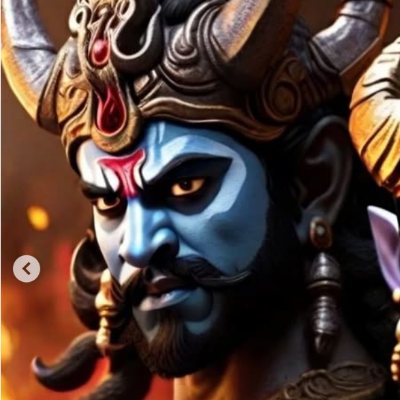
About
Kumbha — Son of Kumbhakarna and Vajrajwala, Slain by Sugriva
Kumbha · son of Kumbhakarna · grandson of Ravana · prince of Lanka
Kumbha is a son of Kumbhakarna — the enormous younger brother of Ravana and one of the most celebrated warriors in the Ramayana — and his wife Vajrajwala, the daughter of Bali and granddaughter of Virochana. He is thus the nephew of Ravana and the grandson of Vishrava, the sage who was the son of Pulastya. Together with his brother Nikumbha, he enters the war of Lanka after their father's death and fights with considerable distinction against Rama's forces, causing great damage to the Vanara army before being killed by Sugriva — the king of the Vanaras and ally of Rama — in one of the Yuddha Kanda's most elaborately described individual combats. He is named in the Valmiki Ramayana's Yuddha Kanda and confirmed as the son of Kumbhakarna in Canto 76 of that book.
✦ The Name
The name Kumbha is a Sanskrit word meaning "pot," "jar," "pitcher," or "water vessel." It is one of the simplest and most direct Sanskrit words for a container, and its use as a name reflects the naming convention shared within the family: his father Kumbhakarna's name means "pot-eared" — combining kumbha with karna, meaning "ear" — and the son's name Kumbha takes the first element of the father's name as the son's complete name. This is a recognisable naming pattern in the tradition, where a son's name encodes a direct relationship to the father's name, suggesting the son as in some sense a continuation or condensation of the father. The name also shares the root kumbha with Kumbhakarna's name, creating a deliberate phonetic and semantic continuity across the generation.
✦ Lineage
- Father: Kumbhakarna — the younger brother of Ravana and one of the most formidable warriors in the Ramayana tradition. Despite his enormous size and his curse-induced sleep of six months at a time, he is described across the tradition as a figure of genuine moral awareness and even wisdom who recognised the wrongness of Ravana's actions and tried to dissuade him, but ultimately chose to fight out of fraternal loyalty. He was slain by Rama himself using the Indrastra during the Lanka war.
- Mother: Vajrajwala — the wife of Kumbhakarna, described as the daughter of Bali and the granddaughter of Virochana. Bali here refers to the celebrated Daitya king — also known as Mahabali or Vamana-Bali — the son of Virochana and grandson of Prahlada, who was subdued by Vishnu in the Vamana avatar. Vajrajwala's descent from this lineage makes her a figure of distinguished Daitya heritage. Her name means "she who blazes like the thunderbolt" — vajra meaning thunderbolt and jwala meaning flame or blaze — a name of fierce and luminous connotation appropriate to a woman of Daitya warrior lineage.
- Brother: Nikumbha — the second son of Kumbhakarna and Vajrajwala, who enters the war of Lanka in the same phase as Kumbha and is slain by Hanuman immediately after Kumbha's death at Sugriva's hands. Profiled separately.
- Paternal uncle: Ravana — the ten-headed demon-king of Lanka, the principal antagonist of the Valmiki Ramayana, whose abduction of Sita precipitated the war in which both Kumbha and his father Kumbhakarna lost their lives.
- Paternal uncle: Vibhishana — Ravana's righteous younger brother who defected to Rama's cause and was crowned king of Lanka after Ravana's defeat.
- Paternal grandfather: Vishrava — a celebrated sage, son of Pulastya and Manini, daughter of Trinabindu, a king of the solar dynasty. He is the father of both Ravana and Kumbhakarna by his wife Kaikesi, making him Kumbha's paternal grandfather.
- Paternal great-grandfather: Pulastya — one of the Saptarishis, a mind-born son of Brahma the creator.
- Maternal great-grandfather: Virochana — a Daitya, the son of Prahlada and the father of Bali. Prahlada was the celebrated devotee of Vishnu, the son of the demon Hiranyakashipu, whose steadfast devotion became one of the most celebrated narratives in the Bhagavata Purana.
- Maternal grandfather: Bali — also known as Mahabali, the celebrated Daitya king whose sovereignty over the three worlds was curtailed by Vishnu in the Vamana avatar, in which Vishnu appeared as a dwarf brahmin and measured the three worlds in three steps. Bali is counted in the Puranic tradition as one of the seven Chiranjivis — immortal or long-lived beings — and is regarded with great reverence despite his Asura lineage, on account of his extraordinary generosity and devotion.
✦ The Battle and Death of Kumbha
Kumbha enters the Lanka war after the death of his father Kumbhakarna, fighting to avenge his father and to continue the defence of Lanka in the service of his uncle Ravana. He is described in the Yuddha Kanda as a warrior of great power and skill who causes significant damage to Rama's forces before he is finally killed. The Valmiki Ramayana devotes an extended account to Kumbha's battle, narrating the successive defeats he inflicts on several of Sugriva's most capable ministers and warriors before the Vanara king himself steps forward to engage him.
Kumbha first fought against and defeated a succession of Vanara commanders — Jambavan, Sushena, Vegadarshin, and Angada among them — overwhelming each with his archery skills and the force of his assault. Even Angada, the son of Vali and one of the most capable warriors in Rama's allied forces, was unable to withstand Kumbha's attack. This progressive failure of the senior Vanara commanders against a single opponent establishes the severity of the threat Kumbha posed and necessitates Sugriva's personal intervention.
Sugriva — the king of the Vanaras, the son of the sun god Surya, and himself a warrior of extraordinary physical power — stepped forward to face Kumbha directly. The Ramayana describes an exchange of mutual admiration and challenge before the combat intensifies: Sugriva praised Kumbha's extraordinary fighting qualities before engaging him, acknowledging that Kumbha's uncle Kumbhakarna had withstood both gods and demons, and that Kumbha himself was now the foremost warrior among the Rakshasas.
The combat between Sugriva and Kumbha was intense and extended. Sugriva hurled trees and rocks at Kumbha, who shattered them with his arrows. The battle reached a dramatic climax when Sugriva seized Kumbha and flung him with tremendous force into the ocean — the Ramayana describes the impact causing the waters to rise to the level of the Vindhya mountains. However, Kumbha rose from the sea, undeterred, and leapt back toward Sugriva, striking him on the chest with a powerful blow of his fist that shattered Sugriva's armour and drew blood. This blow demonstrated that Kumbha's physical strength was genuine and formidable even against the Vanara king.
Sugriva, recovering from the blow, gathered himself and countered with the full force of his own supernatural strength — the strength of a son of the sun god. He raised his own fist and brought it down upon Kumbha's chest with a blow of devastating power. Kumbha, struck by this blow, was shattered by the impact and fell dead. The Ramayana describes his fall as being like a brazier whose brightness is suddenly extinguished.
✦ The Significance of Kumbha's Maternal Lineage
The identification of Kumbha's mother Vajrajwala as the daughter of Bali and granddaughter of Virochana gives Kumbha a maternal lineage of extraordinary distinction within the Daitya tradition. Bali — also called Mahabali — is one of the most celebrated figures in the Puranic tradition, a Daitya king whose sovereignty over the three worlds was so complete and whose character was so genuinely virtuous that Vishnu himself had to take the form of a dwarf brahmin to curtail his reign. Prahlada, Bali's father and Kumbha's maternal great-great-grandfather, is the tradition's supreme exemplar of Vaishnava devotion — the Daitya child who maintained his devotion to Vishnu despite his demon father Hiranyakashipu's violent opposition, and whose story forms the theological centrepiece of the Bhagavata Purana's seventh Skanda.
This lineage gives Kumbha a maternal ancestry that connects him simultaneously to the most celebrated Daitya warriors and to the most celebrated Daitya devotee of Vishnu in the entire tradition. Through his father Kumbhakarna and his uncle Ravana he belongs to the Rakshasa lineage of Lanka; through his mother Vajrajwala and her father Bali he belongs to the Daitya lineage of Prahlada. This dual inheritance — Rakshasa and Daitya — combined with his descent from the sage Pulastya and ultimately from Brahma on the paternal side, makes Kumbha one of the more genealogically complex figures among the lesser-known warriors of the Ramayana.
✦ Textual Variants
The Valmiki Ramayana's Yuddha Kanda, Canto 76, is the primary source for Kumbha's battle and death. His identity as the son of Kumbhakarna is stated explicitly in the text. The identification of Vajrajwala as the daughter of Bali and granddaughter of Virochana is attested in the Wikipedia article on Kumbhakarna drawing on Puranic sources, though the specific Puranic passage should be noted as requiring verification in the primary Puranic texts beyond what is available in the current sources. Regional retellings of the Ramayana vary somewhat in the elaboration given to Kumbha's battle with Sugriva but preserve the core account of his death at Sugriva's hands.
✦ Connection to the Wider Genealogy
Kumbha's genealogical position brings together several of the most significant lineages in the Puranic tradition. Through his father Kumbhakarna and grandfather Vishrava he descends from Brahma through the Pulastya sage line. Through his paternal uncle Ravana he is connected to the central narrative of the Ramayana. Through his mother Vajrajwala and her father Bali he is connected to the Daitya lineage of Prahlada — one of the most theologically celebrated lineages in the Bhagavata Purana tradition. Through his maternal great-grandfather Virochana and great-great-grandfather Hiranyakashipu he is connected to the foundational Daitya mythology of the Puranic tradition. His death at Sugriva's hands connects him to the Vanara royal line and through Sugriva's divine parentage to Surya, the sun god. He leaves no recorded descendants in the primary sources.
✦ References
- Primary Sources
- Valmiki Ramayana, Yuddha Kanda, Canto 76: The principal source for Kumbha's battle — his defeat of successive Vanara commanders including Angada, his extended combat with Sugriva, his being thrown into the ocean and returning to fight, and his final death at Sugriva's hands through a blow of supernatural force.
- Valmiki Ramayana, Yuddha Kanda, Canto 75: Identifies Nikumbha and Kumbha as sons of Kumbhakarna in the context of introducing them to the narrative of the battle sequence.
- Valmiki Ramayana, Yuddha Kanda, Canto 123: The passage in which Rama recounts the fallen warriors of the Lanka war, confirming that Nikumbha and Kumbha the sons of Kumbhakarna were among those killed.
- Secondary Sources
- Mani, Vettam. Puranic Encyclopaedia. Motilal Banarsidass, 1975: Provides an entry on Kumbha recording his identity as a son of Kumbhakarna, his battle with Sugriva, and his death, with cross-references to the Yuddha Kanda passages.
- Wisdomlib (wisdomlib.org): Offers cross-referenced citations of Kumbha across digitised Sanskrit texts, confirming his attestation in the Yuddha Kanda of the Valmiki Ramayana and providing the chapter reference for his death at Sugriva's hands.