
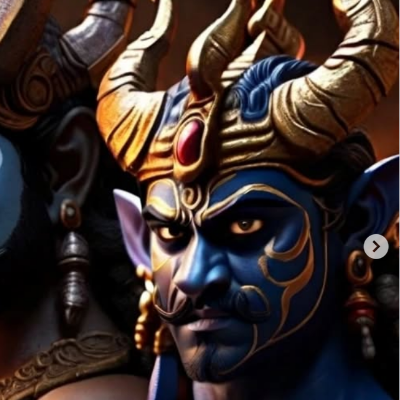
About
Nikumbha — Son of Kumbhakarna and Vajrajwala, Slain by Hanuman
Nikumbha · Ni-kumbha · son of Kumbhakarna · lord of the Pishachas · prince of Lanka
Nikumbha is a son of Kumbhakarna — the enormous younger brother of Ravana — and his wife Vajrajwala, the daughter of Bali and granddaughter of Virochana. He is the brother of Kumbha, with whom he enters the war of Lanka and with whom he is consistently paired in the primary sources. He is slain by Hanuman — the son of Vayu and the most celebrated warrior of Rama's allied forces — in a hand-to-hand combat of great ferocity immediately following his brother Kumbha's death at Sugriva's hands. Beyond the Ramayana tradition, Nikumbha is also mentioned in the Nilamata Purana in an entirely distinct context — as the lord of the Pishachas appointed by Kubera — suggesting that the name belongs to more than one figure in the tradition, and this textual complexity is noted honestly in this profile.
✦ The Name
The name Nikumbha is a Sanskrit compound formed with the prefix ni — which can function as an intensifier meaning "completely," "utterly," or "downward" — and kumbha, meaning "pot" or "jar." One reading of the compound yields "utterly pot-like" or "the complete pot," maintaining the family's kumbha naming theme. Another reading interprets ni as a privative prefix — yielding "without a pot" or "pot-less" — though this reading is less consistent with the family naming convention. The most natural interpretation within the family context is that Nikumbha's name is a variation on the same root as his father Kumbhakarna's name and his brother Kumbha's name, all three names sharing the element kumbha and thereby encoding a deliberate familial naming continuity. The name Nikumbha is also shared by other figures in the Puranic tradition — including a Daitya and the Pishtacha lord mentioned in the Nilamata Purana — reflecting its use as a reasonably common Rakshasa and Asura name rather than as a unique identifier.
✦ Lineage
- Father: Kumbhakarna — the younger brother of Ravana, a warrior of colossal size and genuine moral complexity who recognised the wrongness of Ravana's actions and tried to counsel him toward peace, but ultimately chose to fight out of fraternal loyalty. He was slain by Rama using the Indrastra during the Lanka war.
- Mother: Vajrajwala — the wife of Kumbhakarna, daughter of Bali and granddaughter of Virochana. Bali is the celebrated Daitya king whose sovereignty over the three worlds was curtailed by Vishnu in the Vamana avatar, counted among the seven Chiranjivis of the Puranic tradition and revered for his extraordinary generosity. Virochana was Bali's father and Prahlada's son — Prahlada being the most celebrated Vaishnava devotee in the Daitya lineage. Vajrajwala's name means "she who blazes like the thunderbolt," encoding a quality of fierce luminosity appropriate to a woman of warrior Daitya lineage.
- Brother: Kumbha — the elder son of Kumbhakarna and Vajrajwala, who fights alongside Nikumbha in the Lanka war and is slain by Sugriva — the king of the Vanaras — in the battle narrated in Yuddha Kanda Canto 76. Profiled separately.
- Paternal uncle: Ravana — the ten-headed demon-king of Lanka and principal antagonist of the Valmiki Ramayana.
- Paternal uncle: Vibhishana — Ravana's righteous younger brother who defected to Rama's cause and was crowned king of Lanka after Ravana's defeat. It is through Vibhishana's role as Rama's intelligence source that the identity and connections of many of Lanka's warriors are established in the Yuddha Kanda.
- Paternal grandfather: Vishrava — a celebrated sage, son of Pulastya and Manini, daughter of Trinabindu, a king of the solar dynasty. He is the father of Ravana and Kumbhakarna by Kaikesi, making him Nikumbha's paternal grandfather.
- Paternal great-grandfather: Pulastya — one of the Saptarishis, a mind-born son of Brahma the creator.
- Maternal grandfather: Bali — the celebrated Daitya king, son of Virochana and grandson of Prahlada, whose generosity and sovereignty over the three worlds form the subject of one of the Bhagavata Purana's most celebrated narratives.
- Maternal great-grandfather: Virochana — a Daitya, son of Prahlada and father of Bali.
✦ The Battle and Death of Nikumbha
Nikumbha's principal episode in the Valmiki Ramayana occurs in the Yuddha Kanda, Canto 77, immediately following his brother Kumbha's death at Sugriva's hands in Canto 76. The sequence of the two brothers entering battle together and dying in quick succession is a deliberate narrative pairing — first Kumbha falls to the Vanara king Sugriva, and then Nikumbha, enraged by his brother's death, rushes into battle and falls to Hanuman. The pairing of Sugriva and Hanuman as the killers of the two brothers — Vanara king and Vanara champion — is itself structurally significant.
Seeing his brother Kumbha killed by Sugriva, Nikumbha was overcome with grief and rage. He seized an iron club — a massive weapon of tremendous weight — and rushed toward the battle with it, intent on avenging his brother. The Ramayana describes his advance as a figure of terrifying aspect, his grief transformed into fury, charging with a weapon capable of levelling an entire army.
Hanuman stepped forward to meet Nikumbha's charge directly. Hanuman struck Nikumbha forcefully on the chest with his fist — the same technique with which he had killed other opponents throughout the war. Unlike many others who fell to this blow, Nikumbha was not immediately felled. The Ramayana specifically notes that Nikumbha, struck by Hanuman's fist, was unmoved — his physical strength was sufficient to withstand even Hanuman's blow without being incapacitated. This detail establishes Nikumbha as a warrior of genuine and exceptional physical power, not merely a lesser opponent dispatched quickly.
Nikumbha responded to Hanuman's blow by seizing Hanuman and lifting him physically off the ground — an act that demonstrates the Rakshasa's extraordinary strength, as Hanuman's weight and physical power are described throughout the Ramayana as supernatural. Hanuman, however, was not subdued. He freed himself from Nikumbha's grip and threw Nikumbha forcefully to the ground. He then descended upon the fallen Nikumbha, pounded his chest with his fist, caught hold of his head, and tore it from his body. The decisive end of the combat — Hanuman tearing off Nikumbha's head — is described in the Ramayana as the moment that ends the two brothers' challenge to Rama's forces.
✦ Nikumbha as Lord of the Pishachas
The Nilamata Purana — a Purana associated with the region of Kashmir — contains a reference to a Nikumbha who is described as the noble and strong lord of the Pishachas, instructed by Kubera to watch over this class of beings. The Pishachas are a class of supernatural beings in the Hindu tradition generally associated with the dead, with disease, and with places of cremation — they are ranked among the less elevated classes of supernatural beings and are considered impure in most Puranic contexts. Kubera, as lord of the Yakshas and related classes of semi-divine beings, has authority over various such groups, and his appointment of Nikumbha as their overseer reflects this broader governing role.
Whether the Nikumbha of the Nilamata Purana who serves Kubera as lord of the Pishachas is the same individual as Nikumbha the son of Kumbhakarna in the Ramayana is a question the sources do not resolve. The two roles — a Rakshasa warrior and nephew of Ravana on one hand, and an official of Kubera's celestial administration on the other — are not inherently irreconcilable if one allows that the same figure could hold both identities across different narrative contexts and different phases of cosmic time. However, the sources do not explicitly make this identification, and it is equally possible that the name Nikumbha is shared between two distinct figures in different traditions, as is the case with the two figures named Nikumbha in the Yuddha Kanda itself — one killed by Nila in Canto 43 and a different one, the son of Kumbhakarna, killed by Hanuman in Canto 77.
✦ Textual Note — Two Nikumbhas in the Yuddha Kanda
A textual complexity specifically affecting this profile must be noted. In the Yuddha Kanda, a figure named Nikumbha is killed by the Vanara Nila in Chapter 43, during an earlier phase of the battle. This Nikumbha is not identified as the son of Kumbhakarna in that passage. The Nikumbha who is explicitly identified as the son of Kumbhakarna appears in Chapters 75 to 77 and is killed by Hanuman. Scholarly analysis of this apparent duplication — two Nikumbhas killed in the same war — has concluded that these are two different individuals sharing the same name rather than a scribal error or narrative inconsistency, the distinction being that the earlier Nikumbha's parentage is not stated while the later Nikumbha's parentage as Kumbhakarna's son is explicitly given. This profile concerns the latter — Nikumbha son of Kumbhakarna, killed by Hanuman — and the earlier Nikumbha killed by Nila is a distinct figure.
✦ Connection to the Wider Genealogy
Nikumbha's genealogical position is identical in its main lineage connections to that of his brother Kumbha. Through his father Kumbhakarna and grandfather Vishrava he descends from Brahma through the Pulastya sage line. Through his paternal uncle Ravana he is connected to the central narrative of the Ramayana. Through his mother Vajrajwala and her father Bali he is connected to the Daitya lineage of Prahlada, one of the most theologically celebrated Daitya lineages in the Puranic tradition. His death at Hanuman's hands — torn apart by Vayu's son — connects him to the divine power of the wind god at its most fearsome expression. Through the Nilamata Purana's account of a Nikumbha serving Kubera as lord of the Pishachas he is potentially connected to the divine household of the lord of wealth, though this identification remains uncertain. He leaves no recorded descendants in the primary sources.
✦ References
- Primary Sources
- Valmiki Ramayana, Yuddha Kanda, Canto 77: The principal source for Nikumbha's battle — his enraged response to his brother Kumbha's death, his advance with the iron club, his confrontation with Hanuman, his lifting of Hanuman, and his death when Hanuman tore off his head.
- Valmiki Ramayana, Yuddha Kanda, Canto 75: Identifies Nikumbha alongside Kumbha as sons of Kumbhakarna in the context of introducing them to the battle narrative.
- Valmiki Ramayana, Yuddha Kanda, Canto 43: Names a different Nikumbha — not identified as Kumbhakarna's son — who is killed by Nila in an earlier phase of the battle, a distinct figure from the subject of this profile.
- Valmiki Ramayana, Yuddha Kanda, Canto 123: Confirms Nikumbha and Kumbha as sons of Kumbhakarna among the fallen warriors of the Lanka war, in the passage where Rama recounts the dead.
- Nilamata Purana: Refers to a Nikumbha as the noble and strong lord of the Pishachas, instructed by Kubera to watch over this class of beings; the relationship of this figure to Nikumbha son of Kumbhakarna is unresolved in the primary sources.
- Secondary Sources
- Mani, Vettam. Puranic Encyclopaedia. Motilal Banarsidass, 1975: Provides an entry on Nikumbha recording his identity as a son of Kumbhakarna, his battle with Hanuman, and his death, with cross-references to the Yuddha Kanda passages.
- BVParishat scholarly discussion (groups.google.com/g/bvparishat): Contains a detailed scholarly analysis of the two Nikumbhas in the Yuddha Kanda — the one killed by Nila in Chapter 43 and the one killed by Hanuman in Chapter 77 — concluding that these are two distinct individuals sharing the same name rather than a scribal duplication.
- Wisdomlib (wisdomlib.org): Offers cross-referenced citations of Nikumbha across digitised Sanskrit texts, confirming his attestation in the Yuddha Kanda of the Valmiki Ramayana and noting the Nilamata Purana reference to a Nikumbha as lord of the Pishachas.