
About
Shachi — Danava-Born Queen of the Gods, Wife of Indra
Shachi · Indrani · Paulomi · Aindri · Mahendri · Shakri · Shatakratu-patni
Shachi is the principal wife and queen of Indra — the king of the Devas, lord of Svarga, and wielder of the thunderbolt Vajra — and is one of the most prominent female figures in both the Vedic and the Puranic traditions. She is the daughter of Puloman, a Danava of the first generation born to the progenitor sage Kashyapa and his wife Danu, and through this parentage she carries the epithet Paulomi — daughter of Puloman — by which she is regularly identified across the Mahabharata, the Ramayana, and numerous Mahapuranas. Her name Indrani designates her as the feminine counterpart and consort of Indra, and she is counted among the group of powerful goddess-consorts associated with the Ashtamatrikas — the eight divine mothers — in certain Puranic and Tantric enumerations. Shachi appears in the Rigveda, making her one of the few female figures whose textual presence spans from the earliest Vedic layer through the full Puranic tradition. She is known for her beauty, her fierce loyalty, her capacity for decisive action in crisis, and her role as a protector of her husband's honour and position. Her most extended narrative in the Puranic sources concerns the crisis that followed the killing of the brahmin Vritra by Indra, during which Indra fled in shame and Shachi took active measures to restore him to his throne.
✦ The Name
The name Shachi derives from a Sanskrit root conveying the sense of power, ability, and gracious strength — a word that in the Vedic register could denote the force or potency that accompanies a great being, used both of Indra himself and of his consort. In the Rigveda the word shachi appears in contexts suggesting help, favour, or the exercise of beneficent power. As a personal name applied to Indra's wife, it marks her as a being of inherent power and capacity rather than merely a passive consort. The epithet Indrani — formed from Indra's name with the feminine suffix — designates her straightforwardly as Indra's wife and the feminine sovereign of Svarga. Paulomi, her most frequently used patronymic, derives from her father Puloman's name and is used throughout the epics and Puranas as a standard designation. Aindri and Mahendri are further variants designating her as the consort of the great Indra. The epithet Shatakratu-patni — wife of the one who performed a hundred sacrifices, a standard epithet of Indra — also appears in certain Puranic passages.
✦ Lineage
- Father: Puloman — a Danava of the first generation, son of the progenitor sage Kashyapa and his wife Danu, daughter of Daksha; listed among the sons of Danu in the Vishnu Purana and the Bhagavata Purana; later slain by Indra, making Indra the killer of his own father-in-law.
- Paternal grandfather: Kashyapa — the great progenitor sage, son of the Prajapati Marichi who was himself born of Brahma the creator; through Kashyapa's wife Danu, the entire Danava lineage descends; through his wife Aditi, the Devas descend, making Shachi's father and her husband half-brothers through a common paternal ancestor.
- Paternal grandmother: Danu — daughter of the progenitor Daksha; the Danavas as a class take their collective name from her.
- Husband: Indra — king of the Devas and lord of Svarga, son of the progenitor sage Kashyapa and his wife Aditi; wielder of the thunderbolt Vajra forged from the bones of the sage Dadhichi; sovereign of the thirty-three gods and regent of the eastern quarter; a central figure of the Rigveda and one of the most extensively narrated beings in the entire Hindu textual tradition.
- Son: Jayanta — son of Indra and Shachi; appears in the Ramayana and several Puranas; in the Valmiki Ramayana he is the young son of Indra who approached Sita in the form of a crow and was punished by Rama with a blade of grass charged with the power of the Brahmastra.
- Son: Midhvan — named in certain Puranic lists as a son of Indra and Shachi.
- Daughter: Jayanti — named in several Puranic sources as a daughter of Indra and Shachi; she is identified in the Puranic tradition as the wife of Shukracharya, the preceptor of the Asuras and master of the Mritasanjivani knowledge — a union that further interweaves the genealogies of the Deva and Asura worlds.
✦ Shachi in the Rigveda
Shachi's presence in the Rigveda is modest but significant as evidence of her antiquity in the tradition. She appears in a small number of hymns — most notably in one hymn in the tenth mandala that is attributed to her own voice, making it one of the rare instances in the Rigveda of a hymn spoken by a female figure in the first person. In this hymn she asserts her own power and preeminence, declaring that she is the greatest among those who are honoured and that her husband shall not be overcome. The assertive, self-confident quality of the Vedic Shachi is consistent with her later Puranic characterisation as an active and decisive figure rather than a passive consort.
✦ The Crisis of Brahmahatya — Indra's Flight and Shachi's Role
The most extensively narrated episode in which Shachi plays a central and independent role concerns the aftermath of Indra's killing of Vritra. Vritra was a great Asura or demon of cosmic proportions who had obstructed the waters and was slain by Indra with his thunderbolt Vajra — a deed celebrated across the Rigveda as Indra's supreme heroic act. However, in the Puranic elaboration of this myth, Vritra is identified as a brahmin or as a being of brahminical nature, and Indra's killing of him therefore constituted brahmahatya — the sin of killing a brahmin — one of the gravest transgressions in the dharmic order. Overwhelmed by the weight of this sin, Indra abandoned Svarga and went into hiding, concealing himself within the filament of a lotus in a remote lake, withdrawing entirely from the governance of the celestial realm.
With Indra absent, the gods were without a sovereign and Svarga fell into disorder. The Puranic accounts — most fully in the Bhagavata Purana and the Mahabharata — describe how in this interregnum the sage Nahusha, a powerful king of the lunar dynasty renowned for his merits, was elevated by the gods to serve as Indra in the interim. Nahusha accepted the position of acting sovereign of Svarga and initially discharged it with propriety. However, he then turned his attention to Shachi, demanding that she become his wife on the grounds that as acting Indra he was entitled to all that Indra possessed.
Shachi refused. She did not submit to Nahusha's demand, nor did she accept his claim. Faced with his persistent pressure and lacking her husband's protection, she sought the counsel of the divine preceptor Brihaspati — the teacher of the gods, son of the sage Angiras, and the foremost authority in the celestial realm on matters of dharma and strategy. Brihaspati gave her refuge and advised her. Shachi then approached Nahusha and asked him to grant her time — she would consent, she told him, if he came to her carried in a palanquin borne by the great sages, a demand designed to produce Nahusha's downfall rather than her submission.
Nahusha agreed and assembled the sages to carry his palanquin. During the procession, impatient at the sages' slow pace, he struck or kicked the sage Agastya — one of the seven great primordial sages, a being of immense austerity and power — with his foot. Agastya, enraged by this supreme act of disrespect toward a sage, cursed Nahusha on the spot, pronouncing that he would fall from his position and become a serpent. Nahusha was immediately cast down from Svarga, his usurpation ended.
Meanwhile, Shachi had sought out Indra in his hiding place with the assistance of the goddess Upashruti — a deity associated with night and with the conveyance of secret knowledge — who guided her to the lake where Indra was concealed. Shachi found Indra and urged him to return to Svarga and resume his sovereignty. The gods, with the aid of the creator Brahma and Vishnu, arranged for the sin of brahmahatya to be distributed and diminished, allowing Indra to be purified and restored. Indra returned to Svarga and resumed his throne, and Shachi's position as his queen was restored with him.
✦ Jayanta and the Crow Episode in the Ramayana
Shachi's son Jayanta appears in the Valmiki Ramayana in an episode set during Rama's forest exile. Jayanta, taking the form of a crow, approached Sita — the wife of Rama, prince of Ayodhya and avatar of Vishnu — and wounded her with his beak. Rama, perceiving the transgression, charged a blade of grass with the power of the Brahmastra and launched it at Jayanta as a weapon. Jayanta fled through the three worlds seeking refuge but found no being willing to shelter him against Rama's wrath — not Brahma, not the gods, not his own father Indra. He ultimately returned and prostrated himself before Rama, who relented and spared his life but destroyed one of his eyes as a consequence. The episode is narrated in the Aranya Kanda of the Valmiki Ramayana and serves as a demonstration of Rama's divine power surpassing even that of Indra.
✦ Shachi among the Ashtamatrikas
In the Puranic and Tantric traditions that enumerate the Ashtamatrikas — the eight divine mothers who are the feminine counterparts or shaktis of the principal male deities — Indrani or Aindri is included as the shakti of Indra. In this role Shachi is understood as embodying the feminine power that underlies and sustains Indra's sovereignty and might. The Devi Mahatmya, embedded in the Markandeya Purana, includes Indrani among the matrikas who arise to assist the goddess Durga in her battle against the demon Mahisha and his forces. In this context Shachi's identity merges into the broader collectivity of divine feminine power, though she retains her individual characteristics — her association with Indra, her weapon the Vajra, and her mount the elephant Airavata.
✦ Iconography
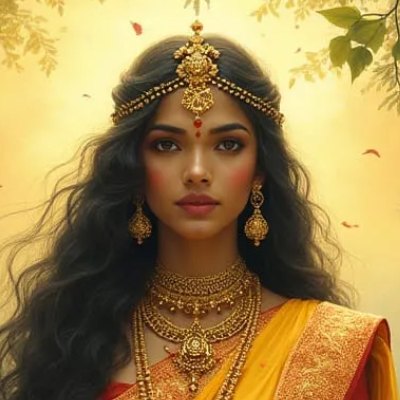
In her iconographic form as Indrani or Aindri, Shachi is typically depicted as a beautiful goddess of golden or fair complexion, richly adorned with celestial ornaments. She is commonly shown seated upon or accompanied by an elephant — sometimes Airavata, the white elephant mount of Indra himself — or upon a lion in her more martial aspects. She may hold a lotus, a noose, a goad, or a miniature thunderbolt as attributes, and is sometimes depicted with multiple arms in her Tantric forms. Her iconography reflects both her identity as the queen of Svarga — emphasising beauty, sovereignty, and celestial splendour — and her nature as a shakti — emphasising power, weapons, and fierce protective capacity.
✦ Theological and Philosophical Significance
Shachi's theological position is shaped by two apparently contradictory aspects of her identity: she is the queen of the gods and the embodiment of divine feminine sovereignty in Svarga, yet she is the daughter of a Danava and thus born of the class of beings that stands in primordial opposition to the divine order her husband defends. The tradition does not treat this as a contradiction requiring resolution; instead it allows the tension to stand as a reflection of the deeper Puranic understanding that the Deva-Asura opposition is not an absolute moral binary but a structural feature of a cosmos in which all beings ultimately descend from the same progenitor.
Her active role in the Nahusha episode — refusing coercion, seeking counsel, devising a strategy, locating her hidden husband, and ultimately restoring order to Svarga — positions her as a figure of practical wisdom and dharmic agency rather than merely a symbol of conjugal fidelity. She does not wait to be rescued; she acts. In this respect she stands alongside figures such as Savitri and Damayanti in the tradition of women whose decisive agency in a crisis determines outcomes that the men in their lives could not secure on their own.
✦ Textual Variants and Inconsistencies
The account of the Nahusha episode varies in detail across the Mahabharata, the Bhagavata Purana, the Devi Bhagavata Purana, and the Brahma Purana, with differences in the precise sequence of events, the role of Brihaspati, the nature of Shachi's stratagem, and the manner of Nahusha's curse and fall. The core elements — Indra's flight, Nahusha's usurpation and demand upon Shachi, her refusal and stratagem, the kicking of Agastya, the curse, and Indra's restoration — are consistent across all major versions. The Mahabharata's Udyoga Parva and Shanti Parva contain significant passages on this episode, as does the Bhagavata Purana's sixth and eighth books.
The number and identity of Shachi's children vary somewhat across sources. Jayanta is consistently named as a son. Jayanti's identification as a daughter of Indra and Shachi is present in several Puranas but not universally attested — some sources give her a different parentage. The figure of Midhvan as a son of Indra and Shachi appears in certain enumerations but is not developed narratively in any primary source.
✦ Connection to the Wider Genealogy
Through her father Puloman and paternal grandmother Danu, Shachi belongs genealogically to the Danava lineage descended from Kashyapa. Through her husband Indra and his mother Aditi — also a wife of Kashyapa — she is connected to the Aditya lineage of the Devas. Both her natal family and her marital family thus descend from the same progenitor Kashyapa, making her marriage a union within the extended family of Kashyapa's progeny across the Deva-Asura division. Through her daughter Jayanti's marriage to Shukracharya — the preceptor of the Asuras, son of the sage Bhrigu and his wife Puloma — Shachi becomes a grandmother within the Asura preceptorial lineage, adding yet another strand of Deva-Asura genealogical interweaving to her family's history. Through her son Jayanta, she is the mother of a figure whose humiliation at Rama's hands in the Ramayana serves as a measure of the avatar's divine power exceeding even that of the celestial king.
✦ References
- Rigveda, Mandala 10, Hymn 159: The hymn attributed to Shachi's own voice; one of the few Rigvedic hymns spoken by a female figure in the first person; establishes Shachi's antiquity in the tradition and her characterisation as a figure of assertive power.
- Mahabharata, Udyoga Parva and Shanti Parva: Contains significant passages on the Nahusha episode, Indra's brahmahatya, Shachi's role in the crisis, and her strategy for Nahusha's downfall; also uses the epithet Paulomi consistently in reference to Shachi.
- Bhagavata Purana, Skandha 6 and Skandha 8: Narrates the Vritra episode, Indra's flight from brahmahatya, the Nahusha interregnum, and Shachi's active role in locating Indra and restoring him; also contains the genealogical lists placing Puloman among the sons of Danu.
- Devi Bhagavata Purana: Contains variant accounts of the Nahusha episode and further elaboration of Shachi's character and actions during the crisis.
- Brahma Purana: Additional Puranic source for the Nahusha episode and Shachi's role; includes her in the genealogical context of Indra's household.
- Markandeya Purana, Devi Mahatmya: Includes Indrani among the Ashtamatrikas who arise to assist the goddess Durga; places Shachi within the broader framework of divine feminine power.
- Valmiki Ramayana, Aranya Kanda: Narrates the episode of Jayanta — son of Indra and Shachi — who approached Sita in crow form and was punished by Rama; identifies Jayanta's parentage explicitly.
- Vishnu Purana, Book 1: Enumerates Puloman among the sons of Kashyapa and Danu; provides the genealogical framework within which Shachi's Danava paternal lineage is established.
- Puranic Encyclopaedia by Vettam Mani (Motilal Banarsidass, 1975): Modern reference work with consolidated entries on Shachi, Indrani, Paulomi, the Nahusha episode, Jayanta, and Jayanti.
- The Mahabharata, translated by Kisari Mohan Ganguli (1883–1896): Complete English translation consulted for the Udyoga Parva and Shanti Parva passages concerning Shachi, the Nahusha episode, and the epithet Paulomi.
- Valmiki Ramayana, translated by Robert P. Goldman et al. (Princeton University Press): Critical edition translation consulted for the Aranya Kanda episode involving Jayanta.