
About
Karkati — Wife of Kumbhakarna and Mother of Bhimasura
Karkati · Kumbhakarnapatni · Bhimasuramata · Rakshasi · Vajrajvala-sahachara
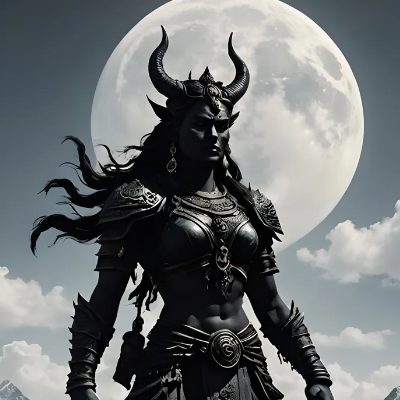
Karkati is the wife of Kumbhakarna — the giant demon brother of Ravana, king of Lanka, and one of the most formidable warriors in the Rakshasa world — and the mother of Bhimasura, a Rakshasa figure who appears in certain Puranic texts as a demon of considerable power. She belongs to the extended genealogical world of the Lanka Rakshasa clan whose ancestry traces back through Sumali and Sukesa to the primordial Rakshasa lineages, and through Kumbhakarna's paternal line to the sage Vishrava and ultimately the Prajapati Pulastya. Karkati's textual presence in the primary sources is confined to genealogical enumerations and brief references in texts dealing with the Rakshasa lineage descending from Ravana and his brothers. She is not the subject of any extended independent narrative episode in the surviving primary sources that are widely regarded as canonical across the tradition, and the primary sources that do mention her vary in the details they provide. This profile is proportionate to the limited and somewhat dispersed textual evidence available, and it carefully distinguishes this Karkati from the philosophically significant Karkati of the Yoga Vasishtha — a distinct figure sharing only the name — who was profiled separately in this series.
✦ The Name
The name Karkati, as noted in the profile of the Yoga Vasishtha's Karkati, derives from the Sanskrit root associated with the crab — karkata — carrying connotations of a gripping or seizing quality, or alternatively from a reddish or whitish colouration in some usages. In the context of this Karkati — the wife of Kumbhakarna — the name functions as a proper name within the genealogical records of the Rakshasa tradition without receiving etymological commentary in the primary passages that mention her. The distinction between this Karkati and the Yoga Vasishtha's philosophical Rakshasi of the same name is a genuine disambiguation problem in the tradition — the two figures share a name and both belong to the Rakshasa category but are otherwise unconnected in the surviving primary sources. The epithet Kumbhakarnapatni means "wife of Kumbhakarna." Bhimasuramata means "mother of Bhimasura."
✦ Lineage
- Parentage: The primary texts do not record Karkati's own parentage. The sources that name her as Kumbhakarna's wife do not specify her father, mother, or the branch of the Rakshasa lineage from which she comes. This profile accordingly makes no claim about her birth family beyond what the sources state.
- Husband: Kumbhakarna — the second of the three principal sons of the sage Vishrava and the Rakshasi Kaikasi, and thus the younger brother of Ravana and the elder brother of Vibhishana. Kumbhakarna is one of the most physically imposing beings in the tradition — described in the Valmiki Ramayana as of enormous stature, comparable in size to a mountain, sleeping for six months at a time due to a curse pronounced upon him by Brahma, and awakened by tremendous effort during the siege of Lanka to fight against Rama's forces. He is celebrated for his martial power and for the singular fact that despite being Ravana's brother and obligated by dharmic loyalty to fight on his side, he privately acknowledged the justice of Rama's cause and told Ravana so before entering battle. He was killed by Rama himself in single combat during the Yuddha Kanda of the Valmiki Ramayana — one of the war's most dramatic episodes — struck by Rama's divine weapons and killed after an extraordinary battle in which Kumbhakarna wreaked devastating destruction on the monkey army before being brought down. His death is narrated at length in the Valmiki Ramayana's Yuddha Kanda.
- Son: Bhimasura — the primary son recorded as born of Kumbhakarna and Karkati in the texts that name this family relationship. Bhimasura is a Rakshasa figure who appears in certain regional and Puranic traditions as a demon of great power, though his biography and deeds are not elaborated in the principal Mahapuranic texts with the same degree of development as those of his father Kumbhakarna or his uncle Ravana. Some traditions associate Bhimasura with specific regional narratives and with the origin of particular sacred sites, though the specific claims and their textual foundations vary across regional traditions and are not uniformly attested in the widely canonical primary sources.
- Other son (variant accounts): Some texts that deal with Kumbhakarna's family list a second son named Kumbha alongside Bhimasura, and in some accounts Kumbha is presented as the more prominent of the two sons in terms of military activity. The Valmiki Ramayana's Uttara Kanda and certain Puranic accounts give varying lists of Kumbhakarna's descendants; the consistency of Karkati's identification as the mother of these sons across different texts is discussed in the Textual Variants section below.
✦ Kumbhakarna's Lineage — the Context of Karkati's Marriage
In order to situate Karkati's position accurately, the lineage of her husband Kumbhakarna requires narration. Kumbhakarna's father was Vishrava — the son of the Prajapati Pulastya, one of the mind-born sons of Brahma. Pulastya is one of the seven primordial sages, and through Vishrava he is the grandfather of Ravana, Kumbhakarna, Vibhishana, and Shurpanakha. Vishrava had two families: his first wife was Ilavida or Ilavila, a woman of divine character, by whom he fathered Kubera — the lord of wealth, the king of the Yakshas, and the original ruler of Lanka before Ravana seized the city from him. His second wife was Kaikasi — the daughter of the Rakshasa Sumali, who had himself arranged the marriage in order to produce a son of great power who would reclaim Lanka for the Rakshasas. Kaikasi bore Vishrava four children: Ravana, Kumbhakarna, Vibhishana, and the daughter Shurpanakha. Kumbhakarna is thus the half-brother of Kubera through the paternal line and the full brother of Ravana and Vibhishana through the maternal line.
Through his maternal grandfather Sumali, Kumbhakarna descends from Sukesa — the son of Vidyutkesa and the Apsara Salakatankata — who is the progenitor of the three great Rakshasa lords Malyavan, Mali, and Sumali who first established themselves in Lanka. Karkati's marriage to Kumbhakarna thus places her within this entire genealogical web — as the daughter-in-law of Vishrava and Kaikasi, as the niece-in-law of Ravana by marriage, and as the sister-in-law of Vibhishana.
✦ Kumbhakarna's Family in the Valmiki Ramayana
The Valmiki Ramayana — the primary and most elaborated account of Kumbhakarna's biography — does not name Karkati explicitly in its main narrative sections concerning Kumbhakarna. The Yuddha Kanda's extensive account of Kumbhakarna's awakening, his conversation with Ravana, his battle against Rama's forces, and his death at Rama's hands does not refer to his wife or children in the context of these episodes. The Ramayana's treatment of Kumbhakarna is entirely focused on his martial identity and on the moral complexity of his situation — a man of private virtue and clear judgment fighting on the wrong side out of loyalty to his elder brother — without elaborating his domestic life.
The Uttara Kanda of the Valmiki Ramayana — which provides the retrospective genealogical and biographical material for the Rakshasa world — contains genealogical details about the extended families of Ravana and his siblings. It is in this context and in related Puranic genealogical passages that information about Kumbhakarna's wife and children is found. The Uttara Kanda's reliability as a source is subject to the scholarly consensus that it is a later addition to the core Ramayana and that its genealogical details, while broadly consistent with the main text's narrative world, were composed in a different period and with different emphases.
✦ Bhimasura — the Son of Karkati and Kumbhakarna
Bhimasura is the son recorded as born of Karkati and Kumbhakarna in the genealogical tradition that names this family. The name Bhimasura is a compound of bhima — terrible, fearful, or of great power — and asura — demon or anti-god — yielding the sense of "the terrible demon" or "the demon of great power." The name Bhima in this compound should not be confused with Bhima the Pandava — the son of Kunti and the wind god Vayu — who bears the same first element in his name; the two are entirely distinct figures. Bhimasura as a Rakshasa demon inherits from his father Kumbhakarna the tradition of extraordinary physical power and demonic capacity, and some regional traditions associate him with specific episodes of demonic activity that required divine intervention. However, the primary canonical texts — the Mahabharata, the Valmiki Ramayana's core books, and the eighteen Mahapuranas — do not give Bhimasura an extended independent narrative comparable to those of his father or uncles. His significance is primarily genealogical — as a link in the chain of the Lanka Rakshasa lineage carrying forward the descent from Kumbhakarna and through him from Vishrava, Pulastya, and the primordial creative line of Brahma.
✦ Textual Variants and Inconsistencies
The evidence for Karkati as Kumbhakarna's wife and the mother of Bhimasura is dispersed across a range of sources that include the Valmiki Ramayana's Uttara Kanda, certain Puranic texts, and regional and vernacular Ramayana traditions, and these sources do not present an entirely uniform account. The following specific inconsistencies deserve clear statement.
The name of Kumbhakarna's wife: Not all texts that discuss Kumbhakarna's family name his wife as Karkati. Some passages of the genealogical literature name her differently — the name Vajrajvala appears in certain versions of Kumbhakarna's family genealogy as a wife or alternative wife. Whether Karkati and Vajrajvala refer to the same person under different names, or whether Kumbhakarna is credited with two different wives in different textual traditions, is not resolved within the primary sources. The Uttara Kanda and the main Puranic genealogical texts that deal with the Rakshasa lineages do not always agree on the name of Kumbhakarna's wife, and this inconsistency should be acknowledged rather than papered over by arbitrarily selecting one account as correct.
The number and names of Kumbhakarna's sons: As noted in the Lineage section, some texts give Bhimasura as Kumbhakarna's son while others give Kumbha, or give both Kumbha and Nikumbha as Kumbhakarna's sons. Kumbha and Nikumbha are warrior figures who appear in some versions of the Ramayana tradition as fighting against Rama's forces, and their assignment to Kumbhakarna's paternity varies across texts. The Valmiki Ramayana's main text does not clearly assign Kumbha and Nikumbha to Kumbhakarna rather than to other Rakshasa parents, and the Uttara Kanda's genealogical assignments for these figures are not entirely consistent with other parts of the tradition. Bhimasura specifically as the son of Kumbhakarna and Karkati is an assignment found in certain Puranic and regional texts; it is not universally confirmed across all major Mahapuranic genealogies.
The distinction from the Yoga Vasishtha's Karkati: As stated in the profile's opening, the Karkati who is Kumbhakarna's wife is entirely distinct from the Karkati of the Yoga Vasishtha's philosophical parable. The two figures share only their name and their membership of the Rakshasa category. Any identification of the two as the same being would be an error without support in the primary sources.
✦ Theological and Narrative Significance
Karkati's theological significance within the tradition is modest and almost entirely genealogical. As the wife of Kumbhakarna and the mother of Bhimasura, she is the figure through whom the Kumbhakarna branch of the Lanka Rakshasa lineage continues into the generation following the Ramayana war. Her husband Kumbhakarna died at Rama's hands during the war — one of the most devastating individual losses suffered by the Rakshasa world — and the continuation of his line through Bhimasura and any other recorded children represents the survival of this branch of the great Rakshasa genealogy beyond the destruction of Lanka's principal warrior generation.
The broader theological significance of the Kumbhakarna family within the Ramayana tradition concerns the moral complexity of Kumbhakarna himself — who privately disagreed with Ravana's conduct, articulated his disagreement clearly, and then fought and died on Ravana's side out of fraternal loyalty. Karkati, as the wife who was left behind when Kumbhakarna went to war and never returned, is the silent recipient of the consequences of her husband's loyalty to a cause he knew to be wrong. The primary texts do not give her voice in response to this situation, but her genealogical position places her at the most personally immediate point of the war's destruction of the Kumbhakarna branch.
✦ Connection to the Wider Genealogy
Through her husband Kumbhakarna, Karkati is embedded in the Lanka Rakshasa lineage that ascends through Kaikasi and Sumali to Sukesa and the primordial Rakshasa ancestors, and through Vishrava and Pulastya to the creative line of Brahma. She is connected by marriage to Ravana — Kumbhakarna's elder brother and the most dominant figure in the Rakshasa world — and to Vibhishana — Kumbhakarna's younger brother who sided with Rama and became king of Lanka after the war. Through her son Bhimasura the Kumbhakarna branch of the Lanka Rakshasa family continues in those texts that trace it further. The destruction of Lanka in the war — the death of Ravana, Kumbhakarna, and the vast majority of the Rakshasa warrior class — makes the genealogical continuation through figures like Bhimasura the remnant thread of what had been the most powerful Rakshasa dynasty in the tradition. Karkati, as the mother of that remnant, occupies the quiet genealogical position of survival in the aftermath of catastrophe.
✦ References
Primary Sources
- Valmiki Ramayana, Uttara Kanda, chapters 4–12: The Uttara Kanda's account of the Rakshasa genealogy including the family of Kumbhakarna; the primary epic source for the genealogical details of Kumbhakarna's lineage within which Karkati's identification as his wife is located. The Yuddha Kanda's chapters on Kumbhakarna's battle and death provide the narrative context of the figure whose wife Karkati is, though they do not themselves name her.
- Valmiki Ramayana, Yuddha Kanda, chapters 48–67: The narrative of Kumbhakarna's awakening, his conversation with Ravana in which he privately acknowledged Rama's justice while committing to fight on Ravana's side, his devastating assault on the monkey army, and his death at Rama's hands. Essential background for understanding the figure whose wife Karkati is and the circumstances of his death that defined her widowhood.
- Brahma Purana: Contains genealogical material on the Rakshasa lineages descended from Kumbhakarna; one of the Puranic sources that provides information relevant to Kumbhakarna's family and descendants.
- Padma Purana: Contains genealogical and narrative material on the Rakshasa families of Lanka including the Kumbhakarna branch; a source for the family relationships of the post-war Rakshasa generation.
- Regional and vernacular Ramayana traditions: Several regional retellings of the Ramayana — including the Tamil Kamba Ramayanam, the Telugu Ranganatha Ramayanam, and others — contain genealogical details about Kumbhakarna's family that supplement or vary the Sanskrit primary sources; these should be consulted for comparative purposes while acknowledging that they represent regional rather than pan-canonical traditions.
Modern Reference Works
- Vettam Mani, Puranic Encyclopaedia (1975): Entry on Karkati (wife of Kumbhakarna); identifies her as the mother of Bhimasura and notes the relevant genealogical connections, while the entry on Kumbhakarna provides the broader family context.
- Robert P. Goldman and Sally J. Sutherland Goldman (translators), The Ramayana of Valmiki — Yuddha Kanda and Uttara Kanda: Critical translations with scholarly notes; the most authoritative English-language scholarly treatment of the primary Ramayana sources for Kumbhakarna's biography and the Rakshasa genealogical material of the Uttara Kanda within which Karkati's family relationship is situated.
- Sukumari Bhattacharji, The Indian Theogony (1970): Contains analysis of the Rakshasa genealogical traditions in the Puranas and the Ramayana; relevant to situating Karkati's position within the broader framework of the Lanka Rakshasa lineage and its transmission across different texts.