
About
Indra — King of the Gods, Lord of Heaven, and Aditya of Sovereign Power
Indra · Shakra · Maghavan · Purandara · Vajrapani · Vritrahan · Meghavahana · Devaraja · Svargapati · Shatakratu · Sahasraksha · Gotrabhid · Jishnu · Namuchi-Shasana · Balabhid · Pakashasana · Vasava · Shachipati · Divaspati
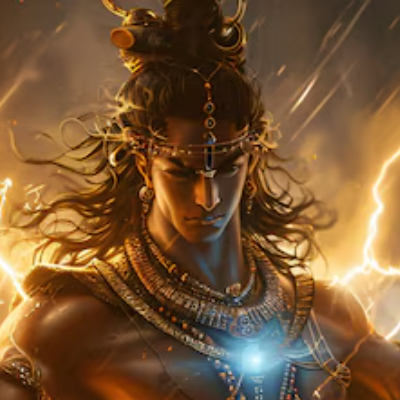
Indra is the king of the gods, the lord of Svarga (the celestial realm), the wielder of the thunderbolt, and one of the twelve Adityas born to the sage Kashyapa and his wife Aditi, daughter of the patriarch Daksha. Among all the Adityas he is the most powerful and the most narratively prominent, and within the Vedic pantheon as a whole he is the deity who receives more hymns in the Rigveda than any other — approximately one quarter of all Rigvedic hymns are addressed to him. His importance spans the entire history of Hindu sacred literature: he is a supreme sovereign deity in the Vedic corpus, a complex and often humbled king in the epics, and a figure of immense narrative energy throughout the eighteen Mahapuranas. He appears in the Mahabharata, the Ramayana, the Vishnu Purana, the Bhagavata Purana, the Brahma Purana, the Matsya Purana, the Padma Purana, the Skanda Purana, and virtually every other major text of the tradition, in roles ranging from the slayer of cosmic demons to the jealous persecutor of human heroes and sages, to the repentant recipient of divine grace. His relationship with the supreme deities Vishnu and Shiva is a recurring structural axis of Puranic narrative, in which Indra's pride is repeatedly humbled and his power shown to be derivative and conditional rather than absolute.
✦ The Name
The name Indra is of ancient Indo-Iranian origin and has been connected by scholars to a root conveying the sense of power or might. The exact etymology is contested, but the name is cognate with Avestan forms and appears in the oldest layers of the Rigveda without explanation, suggesting it was already established before the composition of the earliest hymns. Indra thus denotes fundamentally the mighty one or the powerful lord.
The epithet Shakra means the powerful or the capable one. Maghavan means the bountiful or the generous, reflecting his Vedic character as a god who bestows gifts and wealth upon his worshippers. Purandara means the destroyer of cities or forts, commemorating his Vedic role as the god who shatters the fortresses of his enemies. Vajrapani means the bearer of the vajra, his thunderbolt weapon. Vritrahan means the slayer of Vritra, commemorating his most celebrated exploit. Shatakratu means the performer of a hundred sacrifices, referring to the tradition that Indra performed one hundred ashvamedha — horse sacrifices — to secure and maintain his sovereignty over the gods. Sahasraksha means the thousand-eyed, an epithet referring to the marks that covered his body after a particular curse, discussed below. Vasava means lord of the Vasus, one of the groups of divine beings over whom he presides. Shachipati means lord of Shachi, referring to his wife Shachi (also called Indrani or Paulomi), daughter of the demon Puloman. Gotrabhid means the cleaver of mountains, recalling the episode in which Indra split mountains to release the rivers. Meghavahana means one whose vehicle is clouds.
✦ Lineage
- Father: Kashyapa — one of the seven great primordial sages and the principal progenitor of gods, demons, humans, Nagas, birds, and all orders of living beings; son of Marichi, who was himself one of the mind-born sons of Brahma the creator.
- Mother: Aditi — daughter of the patriarch Daksha; wife of Kashyapa; the boundless mother of the gods; one of the most frequently invoked divine mothers in the Rigveda, from whom all twelve Adityas are born.
- Brothers (the Adityas): Dhata, Mitra, Varuna, Aryaman, Bhaga, Vivasvat (Surya), Pushan, Parjanya, Amsha, Tvashtr, and Vishnu. The canonical Puranic list gives twelve Adityas, though Vedic enumerations are smaller and the composition of the group varies across texts.
- Half-brothers (the Daityas and Danavas): Through Kashyapa's other wives — Diti and Danu — Indra has as half-brothers the entire order of Daityas and Danavas, the divine adversaries whom he and the other gods perpetually combat. These include Hiranyakashipu, Hiranyaksha, and the children of Danu including the demon Vritra in some accounts.
- Spouse: Shachi, also called Indrani and Paulomi — daughter of the demon Puloman, who was slain by Indra before the marriage; a goddess of great beauty and fierce loyalty, celebrated in her own right in the Rigveda and the Puranas.
- Son Jayanta: Born of Shachi; a divine prince who appears in the Ramayana and Puranic literature; he once assumed the form of a crow and wounded the goddess Sita during Rama's exile in the forest, for which he suffered a severe punishment.
- Son Arjuna: The celebrated hero of the Mahabharata, one of the five Pandava brothers, was fathered by Indra upon Kunti — wife of the blind king Dhritarashtra's brother Pandu — through a divine boon. Arjuna is therefore Indra's son in the epic tradition and inherits his father's celestial weapons and martial prowess.
- Son Vali: According to the Ramayana and related Puranic texts, the mighty Vanara (monkey-being) king Vali, who ruled the kingdom of Kishkindha, was the son of Indra. Vali was possessed of extraordinary strength — by a boon, he received half the strength of any opponent who faced him in single combat — and was slain by the divine hero Rama at the request of Vali's brother Sugriva.
- Daughter Devasena: Some Puranic texts name Devasena as a daughter of Indra who became the wife of the war-god Skanda (Kartikeya), son of Shiva.
✦ Indra in the Rigveda
In the Rigveda, Indra is the pre-eminent deity of action and power, the god of storm, rain, and war, the champion of the gods against the cosmic forces of obstruction and darkness. He is described as a figure of enormous physical presence — consuming vast quantities of the sacred drink Soma before battle, growing to fill the cosmos when roused to combat. The Rigvedic Indra is exuberant, boastful, deeply beloved of his worshippers, generous with gifts, and capable of both sublime heroism and morally questionable acts. His relationship with Soma — the sacred ritual drink prepared from a plant of the same name — is intimate and essential: Soma empowers Indra for his cosmic battles, and the Rigveda's hymns frequently describe Indra drinking deeply of the pressed Soma before setting out to fight.
The Rigvedic Indra is also the god who releases the waters, splits the mountains, drives away darkness, and brings rain to the parched earth. His battles against forces that obstruct water — the demon Vritra being the supreme example — are cosmogonic acts that make the world habitable and fertile. He is the lord of the Maruts, the divine storm gods who accompany him as his hosts, and he wields the vajra, the thunderbolt forged for him by the divine craftsman Tvashtr (who is also an Aditya and therefore his brother), as his supreme weapon.
✦ The Slaying of Vritra
The slaying of Vritra is the central exploit of Indra in the Vedic and Puranic tradition and is referred to more frequently than any other single act across the entire corpus of texts in which Indra appears. The narrative exists in several versions with significant variations.
In the Rigvedic account, Vritra is a great serpentine or draconic being — the term vritra means obstruction or enveloper — who has blocked the cosmic waters and holds them captive, causing drought and the cessation of rain upon the world. Indra, empowered by draughts of Soma and accompanied by the Maruts, attacks Vritra with his thunderbolt and shatters him. With Vritra's destruction the waters are released, the rivers flow, and rain returns to the earth. In this version the narrative is a cosmogonic myth of the most fundamental kind: the hero-god defeats the principle of obstruction and restores the conditions of life.
The Shatapatha Brahmana and later the Mahabharata give elaborated versions in which Vritra's identity becomes more complex. In the Mahabharata's account, Vritra is identified as a brahmin or as a being with brahminic qualities, making Indra's killing of him an act of brahminicide — one of the gravest sins in the tradition. After slaying Vritra, Indra is afflicted by the sin of brahminicide and must undergo a period of hiding and purification. In one version he takes refuge in the filament of a lotus in a mountain lake, remaining concealed for many years while the gods struggle without their king. During this period of Indra's absence, another king is appointed to rule Svarga in his place, and disorder spreads. Eventually, through the mediation of Brahma and the performance of appropriate expiatory rites, Indra is purified and restored to his throne.
The Bhagavata Purana gives another version in which Vritra is revealed to be a great devotee of Vishnu — the demon Chitraketu reborn — whose exterior as a terrifying demon conceals an interior of genuine devotion. In this version the battle between Indra and Vritra is accompanied by a philosophical dialogue in which Vritra instructs Indra on the nature of devotion and the supremacy of Vishnu, displaying a spiritual serenity entirely at odds with his monstrous form. Vritra ultimately allows himself to be slain, and his soul ascends to the realm of Vishnu. This version — characteristic of the Bhagavata Purana's devotional orientation — transforms the ancient cosmogonic myth into a theological statement about the supremacy of Vishnu-devotion over all other considerations.
✦ The Churning of the Ocean
The episode of the churning of the cosmic ocean — the Samudra Manthan — is one of the most celebrated narratives in the Puranic tradition and places Indra at the origin of one of the central events in the cosmic history of the gods and demons. The account is given in the Vishnu Purana, the Bhagavata Purana, the Mahabharata, and numerous other texts, with variations in detail.
The narrative begins with a curse laid upon Indra and the gods by the irascible sage Durvasa. Durvasa, a sage renowned throughout the Puranic literature for his short temper and the devastating power of his curses, encountered Indra riding on his elephant Airavata. Durvasa offered Indra a divine garland of flowers given to him as a gift. Indra, displaying the carelessness of pride, placed the garland carelessly on Airavata's head; the elephant, disturbed by its fragrance, flung it to the ground. Durvasa, enraged by this disrespect for a sacred gift, cursed Indra and all the gods, declaring that they would be stripped of their strength, fortune, and sovereignty. The curse took immediate effect: the gods lost their vigour, the demons took advantage of the weakened gods and drove them from the heavens, and Svarga fell under demonic dominion.
The gods, led by Indra, went to Brahma for counsel. Brahma directed them to Vishnu, who advised that the gods should make a temporary alliance with the demons and together churn the cosmic ocean of milk — the Kshirasagara — using the mountain Mandara as a churning rod and the great serpent Vasuki as a rope. From this churning would emerge, among other things, the nectar of immortality — Amrita — which the gods could then seize and consume to restore their strength and defeat the demons.
The churning produced many treasures in succession: the goddess Lakshmi, the divine physician Dhanvantari bearing the pot of Amrita, the celestial horse Uchchaishravas, the divine elephant Airavata, the wish-fulfilling tree Parijata, the goddess Varuni, the Apsaras, the divine bow, the moon, and the terrible poison Halahala which threatened to destroy all existence and was consumed by Shiva to save the cosmos. When the Amrita finally emerged, the demons seized it, but Vishnu assumed the form of the enchantress Mohini, bewitched the demons with her beauty, and distributed the Amrita to the gods alone. One demon — Svarbhanu — disguised himself as a god and received a portion, but Surya and the moon identified him; Vishnu severed his head with the Sudarshana Chakra. The demon's head and body became the celestial beings Rahu and Ketu, who thereafter perpetually pursue the sun and moon in revenge, occasionally swallowing them and causing eclipses. Restored by the Amrita, the gods defeated the demons and Indra recovered his throne.
✦ Indra and the Sage Vishvamitra
The sage Vishvamitra — originally a king of the Kushika dynasty who undertook ferocious austerities to attain the status of a brahmarshi — is a figure whose spiritual ascent repeatedly threatened Indra's sovereignty over the heavens. Indra, whose throne is described in the Puranic literature as perpetually imperilled by the accumulation of spiritual merit by powerful sages and kings on earth, took active measures on several occasions to obstruct Vishvamitra's austerities.
In one celebrated episode, Indra sent the Apsara Menaka — regarded as the most beautiful of the celestial nymphs — to seduce Vishvamitra and break his austerities. Menaka succeeded: Vishvamitra, enchanted by her beauty, abandoned his austerities and lived with her for a period, fathering upon her the daughter Shakuntala, whose story is celebrated in the Mahabharata and in Kalidasa's drama. When Vishvamitra eventually realised that his austerities had been broken, he cursed Menaka and returned to his practice with renewed intensity.
Indra made a second attempt with the Apsara Rambha, sending her to seduce Vishvamitra once more. This time Vishvamitra was not deceived; recognising Indra's stratagem, he cursed Rambha to become a stone for ten thousand years. The intensity of his anger at his own momentary distraction drove him to even fiercer austerities, and he ultimately attained the rank of brahmarshi that he sought, accepted finally by the sage Vasishtha who had previously denied it.
✦ Indra and Ahalya
One of the most frequently narrated episodes involving Indra's moral failures in the epic and Puranic tradition is his seduction of Ahalya, the wife of the sage Gautama. The account is given in the Valmiki Ramayana's Bala Kanda and is repeated with variations in the Mahabharata, the Brahma Purana, and other texts.
Ahalya was the wife of the great sage Gautama and was celebrated as one of the most beautiful women of her age. Indra, overwhelmed by desire for her, assumed the form of Gautama and approached Ahalya while Gautama was absent from their hermitage. Ahalya, in some versions of the story, was deceived and in others was not entirely unwilling, knowing that her visitor was not her husband. Their union was discovered by Gautama, who returned unexpectedly. In his fury Gautama cursed both: Indra was cursed to lose his testicles, or in other versions to have his body covered with a thousand marks resembling female genitalia — a humiliation that was later transformed, through propitiation of the gods, into a thousand eyes, giving rise to his epithet Sahasraksha. Ahalya was cursed to become a stone or to become invisible and live on air alone in the forest, without form, until the touch of the dust from the feet of Rama — the divine hero who is an avatar of Vishnu — would restore her.
The episode of Ahalya's liberation by Rama is one of the celebrated encounters of the Ramayana's Bala Kanda. Rama, travelling with his brother Lakshmana and the sage Vishvamitra, passes through the abandoned hermitage of Gautama; his foot touches the stone that is Ahalya, and she is immediately restored to her original form, radiant and purified. The episode is interpreted theologically as an illustration of the liberating grace of Vishnu's avatar and the efficacy of his touch in releasing even those bound by the consequences of transgression.
✦ Indra and the Demon Namuci
The episode of Indra's conflict with the demon Namuci is attested in the Rigveda, the Shatapatha Brahmana, the Mahabharata, and the Bhagavata Purana. Namuci was a demon who had obtained a boon specifying that he could not be killed by anything wet or dry, by day or by night. Indra had previously formed a friendship with Namuci and had pledged not to kill him; but when Namuci grew powerful and dangerous, Indra sought a means of killing him without violating either his pledge or the terms of the boon.
The solution, obtained through divine counsel, was to kill Namuci at twilight — the liminal moment that is neither day nor night — and with foam from the ocean, which is neither wet nor dry in the conventional sense. Indra used the foam of the sea as his weapon at the moment of dusk and severed Namuci's head, thus fulfilling the letter of the boon's conditions while circumventing its protective intent. The episode is used in the tradition as an example of the ingenuity required to defeat demonic power that has made itself invulnerable through boon-protected loopholes, and it also raises questions — addressed differently in different texts — about the ethics of Indra's breach of his prior friendship pledge.
✦ Indra and the Parijata Tree
The Parijata — a divine flowering tree that emerged from the churning of the cosmic ocean and was placed in Indra's paradise Nandana — becomes the subject of a celebrated conflict between Indra and the god Krishna in the Bhagavata Purana and the Vishnu Purana. Krishna's principal wife Satyabhama desired the Parijata tree for herself, having heard of its celestial fragrance and beauty. Krishna, to fulfil her wish, travelled to Svarga and asked Indra for the tree. Indra refused to give up the divine tree that belonged to his heaven.
A battle ensued between Krishna — accompanied by his wife Satyabhama and riding his vehicle Garuda, the divine eagle — and Indra with his full celestial army. Indra hurled his thunderbolt at Garuda; Garuda caught it and was unharmed. The gods of the celestial army were routed by Krishna. Indra himself was defeated and compelled to surrender the Parijata. Krishna brought the tree to Dvaraka, where it bloomed and filled the entire region with its fragrance. After Krishna's eventual departure from the earth, the tree was returned to Svarga. The episode functions in the Puranic literature as a demonstration of Krishna's supremacy over Indra and over all the powers of heaven.
✦ Indra and the Killing of Vishvarupa and Trisiras
The Bhagavata Purana and the Vishnu Purana record an episode in which the gods, having lost their strength through Durvasa's curse, appointed the three-headed being Vishvarupa — also called Trisiras, meaning three-headed — as their priest and preceptor to perform sacrifices on their behalf and restore their vigour. Vishvarupa was the son of Tvashtr, the divine craftsman who is one of the Adityas and therefore Indra's brother. Vishvarupa performed sacrifices for the gods but secretly offered portions to the demons as well, through one of his three heads, out of loyalty to his demon relatives through his mother's lineage.
When Indra discovered this treachery, he killed Vishvarupa with his thunderbolt, severing all three heads. This killing incurred the sin of brahminicide upon Indra, since Vishvarupa was a brahmin by virtue of his priestly function. Tvashtr, enraged at the killing of his son, performed a great sacrifice to generate a being powerful enough to destroy Indra. From this sacrifice was born Vritra — the great demon whom Indra would subsequently have to destroy, incurring a further round of brahminicide. This narrative, given in the Bhagavata Purana's sixth book, thus establishes a chain of cause and consequence in which Indra's acts of killing generate the very threats he must then face.
✦ Indra and the Govardhan Episode
One of the most celebrated episodes of the Bhagavata Purana's tenth book involves the direct confrontation between Indra's authority and Krishna's divine supremacy, and represents the most explicit Puranic statement of Indra's subordination to Vishnu's avatar.
The people of Vrindavana, the pastoral community where Krishna grew up among the cowherd people, traditionally performed an annual sacrifice to Indra to secure rainfall and good pasture for their herds. The young Krishna persuaded the cowherds to discontinue this sacrifice, arguing that Indra was simply doing the job that nature and cosmic order required of him and deserved no special propitiation beyond what was due to the mountains, forests, and cattle that actually sustained their community. He suggested that they worship the Govardhan hill instead, which provided the grass for their cattle and shelter for their community.
Indra, furious at the withdrawal of his worship and what he perceived as a direct challenge to his sovereignty, unleashed a catastrophic storm upon Vrindavana — sending torrential rain, hail, and wind that threatened to destroy the entire community of cowherds, their cattle, and their homes. Krishna responded by lifting the entire Govardhan mountain on the tip of his little finger, holding it aloft like an umbrella for seven days and seven nights while the rain fell, sheltering all the people and animals beneath it. Indra's storm could not touch those beneath the mountain. After seven days, Indra recognised the futility of his assault and withdrew the storm. He then descended from Svarga to Vrindavana in humility, prostrated himself before Krishna, washed the feet of the divine child with water from his divine elephant Airavata's trunk, acknowledged Krishna's supremacy, and begged forgiveness. Krishna forgave him and restored his position as king of the gods. Indra in some versions also conferred upon Krishna the title Govinda — one meaning of which is lord of the cows — in recognition of his protection of the cattle and cowherds of Vrindavana.
✦ Indra and Arjuna
Indra's relationship with his son Arjuna — the third of the five Pandava brothers and the greatest archer of the age — is one of the most developed father-son relationships in the Mahabharata, marked by genuine paternal care, active intervention, and a significant act of deception on Indra's part.
Before the great war of Kurukshetra — the central conflict of the Mahabharata — Arjuna spent a year in the celestial realm of his father Indra, training in divine warfare and receiving celestial weapons. During this sojourn Indra treated Arjuna as his beloved son, hosted him in Svarga, and arranged for him to receive weapons from various gods including the Pashupatastra from Shiva. Arjuna also learned the arts of music and dance from the Gandharva Chitrasena during this period, and encountered the Apsara Urvashi, who cursed him to spend a year as a eunuch when he declined her advances — a curse that Indra converted into a boon by specifying that it would be fulfilled during the thirteenth year of the Pandavas' exile, when anonymity was required, thus turning a punishment into a tactical advantage.
The most significant of Indra's interventions on Arjuna's behalf involved the great warrior Karna — Arjuna's elder brother by the same mother Kunti, though neither knew this during most of their lives. Karna, the son of the sun god Surya and Kunti, had been born with divine natural armour (Kavacha) and earrings (Kundala) fused to his body, which made him virtually invulnerable. These were a gift from his father Surya and constituted his most powerful natural protection. Indra, knowing that Karna's armour and earrings would make it impossible for Arjuna to defeat him in battle, devised a plan to strip Karna of these protections. Indra knew that Karna was celebrated for his extraordinary generosity and his vow never to refuse a brahmin's request during his morning worship. Indra assumed the disguise of a brahmin, approached Karna during his solar worship, and asked for his natural armour and earrings as a gift. Karna, fully aware that this was a stratagem — having been warned by his father Surya in a dream — nevertheless gave freely, cutting the armour from his own body and removing the earrings from his own ears, so that they could be given as requested. In exchange, Indra — moved by Karna's heroic generosity — gave him the Shakti, a divine spear of irresistible power that could kill any one enemy against whom it was directed. Karna reserved this weapon for Arjuna but was compelled to use it against the demon Ghatotkacha during the war, thus expending it before he could use it against Arjuna.
✦ Indra and the Burning of the Khandava Forest
The Mahabharata's Adi Parva contains the episode of the burning of the Khandava forest, in which Indra serves as an antagonist attempting to prevent a great conflagration that the fire god Agni seeks to consume as nourishment. Agni had been weakened by repeated consumption of the sacrificial ghee offered at countless sacrifices and needed the Khandava forest — home of the serpent Takshaka, an ally of Indra — as a restorative feast. Indra had pledged his protection to Takshaka and therefore repeatedly extinguished Agni's fire with rainstorms whenever Agni attempted to burn the forest.
Agni enlisted the help of Arjuna and Krishna. Arjuna received from Varuna the bow Gandiva and two inexhaustible quivers of arrows, and from Agni a divine chariot. Arjuna and Krishna then served as guards around the burning forest, shooting down every creature that attempted to escape and every rainstorm that Indra sent to douse the fire. Indra himself descended and fought Arjuna directly; their battle was fierce and evenly matched. Eventually, the voice of Brahma spoke from the sky, telling Indra to desist — that this burning was fated and that Arjuna's weapons and Krishna's presence made the outcome inevitable. Indra withdrew, acknowledging the divine sanction behind the event and expressing his pride in his son Arjuna's martial prowess. The forest burned completely, and many beings perished; the architect of the gods, Maya Danava, was spared by Arjuna and later built for the Pandavas the magnificent assembly hall of Indraprastha in gratitude.
✦ Indra and Shiva — The Birth of Kartikeya
Indra's relationship with Shiva and the birth of the war-god Kartikeya — also called Skanda, Murugan, and Subrahmanya — is a major narrative in the Mahabharata, the Skanda Purana, and several other Puranic texts. The occasion for Kartikeya's birth was the need to produce a commander for the divine army powerful enough to destroy the demon Tarakasura, who had received a boon specifying that he could only be killed by a son of Shiva. Shiva at this time was immersed in meditation, his divine energy withheld from the world.
Indra, desperate for relief from Tarakasura's depredations, sent the god of love Kama (Manmatha) to disturb Shiva's meditation so that Shiva might unite with the goddess Parvati and beget the required son. Shiva, disturbed from his meditation by Kama's flower arrows, opened his third eye and burned Kama to ash — an event that plunged the world into a period of lovelessness. Eventually, through the mediation of Vishnu and the persistence of Parvati's own austerities, Shiva and Parvati were united, and Kartikeya was born. Kartikeya became the commander of the divine army, defeated Tarakasura, and relieved the gods of their persecution. Indra gave his own daughter Devasena in marriage to Kartikeya. The narrative illustrates both Indra's dependence on powers greater than himself — Shiva's creative energy — and his willingness to set in motion consequences he cannot fully control.
✦ Indra and the Demon Jalandhara
The Shiva Purana and the Padma Purana contain an account of the demon Jalandhara, who was born from the radiance of Shiva's third eye falling into the ocean and who grew to become a demon king of immense power. Jalandhara defeated Indra and the gods, drove them from Svarga, and subjected the three worlds to his rule. He also sent his minister Rahu to demand from Shiva the surrender of the goddess Parvati as his wife. Shiva's confrontation with Jalandhara was a cosmic battle in which Jalandhara was ultimately destroyed only when the goddess Parvati assumed a form identical to Jalandhara's own wife Vrinda and deceived Jalandhara, allowing his powers to be undermined. Only after Jalandhara's defeat could the gods, including Indra, be restored to their rightful places.
✦ Indra and the Demon Bali
The conflict between Indra and Bali — the great demon king and grandson of the devotee Prahlada, himself the son of the Daitya king Hiranyakashipu — is one of the defining narrative situations of Puranic cosmology, culminating in the celebrated episode of Vishnu's Vamana avatar.
Bali performed the Vishvajit sacrifice under the guidance of his preceptor Shukracharya, the divine guru of the demons, and received from it divine armour, celestial weapons, and an inexhaustible supply of resources. With this empowerment he attacked Svarga, defeated Indra and the gods in battle, and took possession of the three worlds. Indra and the defeated gods went to Vishnu for refuge. Vishnu agreed to be born as the dwarf Vamana, the son of the sage Kashyapa and Aditi — making Vamana technically another son of Aditi and therefore a brother of the Adityas including Indra, though the primary tradition does not enumerate Vamana among the twelve Adityas.
Vamana approached Bali during a great sacrifice and begged for three paces of land. Bali, celebrated for his generosity, agreed despite the warnings of Shukracharya. Vamana then expanded to cosmic dimensions: with his first step he covered the entire earth, with his second step he covered all of Svarga and the heavens, and with his third step — there being no space remaining — he placed his foot on Bali's head and pressed him down into the underworld Patala. Bali accepted this with equanimity and devotion, and Vishnu was so pleased with his surrender and his generosity that he granted Bali sovereignty over Patala and promised to stand guard at his door eternally. Indra and the gods recovered possession of Svarga and the three worlds.
✦ Indra and the Sage Dadhichi
The episode of the sage Dadhichi and the creation of the vajra is one of the most celebrated examples of divine sacrifice in the Puranic tradition, and it places Indra in the position of a suppliant who receives the supreme gift of another being's life.
When the gods were threatened by the demon Vritra or, in some versions, by a group of demons that no existing weapon could destroy, they were told by Brahma that only a weapon fashioned from the bones of the sage Dadhichi could overcome the enemy. Dadhichi was a great sage renowned for his austerities, by which his bones had acquired a supernatural hardness and power. The gods, led by Indra, approached Dadhichi and explained their need. Without hesitation, Dadhichi agreed to surrender his life so that his bones could be used as the weapon. He entered a meditative state, released his life force, and his body was left for the gods. From his spine — in particular from his vertebral column — the divine craftsmen fashioned the vajra, the thunderbolt, which Indra then used to defeat the demon and save the gods. The episode is presented across the Puranic tradition as a supreme act of selfless sacrifice, with Dadhichi's voluntary gift of his own life celebrated as greater even than the heroism of warriors.
✦ Indra and the Sage Agastya — The Story of Nahusha
During one of Indra's periods of exile following the guilt of brahminicide incurred in the slaying of Vritra, the gods found themselves without a king. In his absence, the virtuous human king Nahusha — celebrated in the Mahabharata as a king of the lunar dynasty who had performed an extraordinary number of sacrifices — was invited to take Indra's place on the celestial throne. Nahusha accepted and ruled Svarga in Indra's stead.
However, power corrupted Nahusha rapidly. He began to desire Shachi, Indra's wife, and demanded that she come to him. Shachi, devoted to her husband, sought refuge with the preceptor of the gods Brihaspati and prayed to Vishnu. She stalled Nahusha by telling him she would come to him if he arrived carried in a palanquin borne by the seven great sages — an unprecedented act of humiliation for the sages. Nahusha agreed and compelled the seven sages, including Agastya, to bear his palanquin. Impatient at their pace, he struck the sage Agastya with his foot and shouted at him to move faster. Agastya, furious at being kicked and further outraged by the general impiety of Nahusha's demands, cursed Nahusha on the spot to become a serpent and fall from the heavens. Nahusha immediately fell, transformed into a great serpent, and crashed to the earth, where he remained trapped in serpent form until the Pandava Yudhishthira freed him many ages later by correctly answering his philosophical questions. With Nahusha gone, Indra was purified of his sin and restored to his throne.
✦ Indra and Vali in the Ramayana
Vali, the mighty Vanara king of Kishkindha and son of Indra, appears in the Ramayana's Kishkindha Kanda as one of the most powerful beings on earth. He had received from Indra — or, in various versions, from Brahma — a boon by which he gained half the strength of any opponent who faced him directly in combat, making him virtually unbeatable in single combat. He had defeated and imprisoned the demon Mayavi and had fought the demon Dundubhi whose bones he flung to a great distance. He had even briefly grappled with the demon Ravana and held him captive under his armpit.
Vali's conflict with his brother Sugriva — over the kingship of Kishkindha and over Sugriva's wife Ruma, whom Vali had taken — brought Vali into the narrative of the Ramayana when Sugriva allied himself with Rama. Rama, concealed behind a tree, shot Vali with an arrow while Vali and Sugriva were engaged in what appeared to be single combat. Vali fell mortally wounded and challenged Rama for the manner of his killing — from concealment, without facing Vali directly. Rama's justification involved several arguments, none of which fully satisfied Vali or all subsequent readers of the text. Vali died and attained a noble afterlife, his great strength and lineage as Indra's son acknowledged in the tradition.
✦ Indra as One of the Twelve Solar Adityas
Within the Puranic framework of the twelve Adityas as monthly solar manifestations, Indra is assigned the month of Shravana — broadly corresponding to July and August, the height of the monsoon season in the Indian subcontinent. This assignment is given in the Vishnu Purana and broadly confirmed by the Mahabharata's Anushasana Parva. The association with the rainy season is consistent with Indra's ancient identity as the god of rain and storms: as the Aditya of Shravana he presides over the months when the monsoon is fullest and when rain is most abundant, an assignment that links the ancient Vedic Indra of the thunderstorm to the later Puranic solar monthly system.
✦ Textual Variants and Inconsistencies
The textual tradition surrounding Indra is exceptionally large and contains numerous inconsistencies that span many centuries of composition and redaction. Several of the most significant deserve explicit acknowledgment.
The nature and identity of Vritra varies significantly across texts. In the Rigveda, Vritra is a draconic or serpentine being representing cosmic obstruction without clear brahminic identity. In the Mahabharata and Bhagavata Purana, he is retrospectively identified as a brahmin or brahmin-like being, which transforms Indra's killing of him from a cosmogonic heroic act into a sin requiring expiation. The Bhagavata Purana further identifies Vritra as the devotee Chitraketu reborn, giving the demon an interior spiritual life entirely absent from the Vedic account. These are not minor variations but represent fundamentally different theological framings of the same narrative.
The story of Ahalya shows significant variation in the crucial question of whether Ahalya was deceived or knowing. The Valmiki Ramayana's Bala Kanda states that Ahalya knew Indra was not her husband but yielded from curiosity or desire; other versions insist that she was entirely deceived. The moral evaluation of both Indra and Ahalya shifts considerably depending on which version is followed.
The nature of Indra's curse from the Gautama episode also varies: some texts give the loss of his testicles, others the thousand marks of female genitalia, and others the thousand eyes that became his epithet. The Mahabharata and the Puranas give different versions, and none of the major texts fully agrees with another on the precise form and resolution of this curse.
The parentage of Vritra in the episode involving Tvashtr also requires care. In some accounts Vritra is produced from a sacrifice performed by Tvashtr in revenge for the killing of Vishvarupa; in others Vritra exists independently and Tvashtr's role is different or absent. The Bhagavata Purana's account of Vritra as Chitraketu reborn does not involve Tvashtr at all.
✦ Theological Significance
Indra's theological significance operates on multiple levels across the tradition. In the Vedic period he is the supreme deity of active power — the champion of order against chaos, the releaser of rain, the patron of warriors and sacrificers. His importance to the Vedic sacrificial system was fundamental: Soma was pressed and offered to Indra above all other gods, and his heroic exploits were the central mythological narratives that legitimised and charged the sacrificial system with meaning.
In the Puranic period, Indra's theological role shifts profoundly. He becomes primarily a foil for the supremacy of Vishnu and Shiva — his pride is repeatedly humbled, his power shown to be conditional and dependent, and his sovereignty restored only through the grace of a deity greater than himself. This structural use of Indra as the proud but limited king whose humiliation demonstrates the supremacy of the Puranic supreme deity is one of the most consistent features of Puranic narrative across sectarian boundaries. Shaiva texts humble Indra before Shiva; Vaishnava texts humble him before Vishnu and his avatars. In both cases the theological message is the same: no cosmic power, however great, is sovereign in an ultimate sense except the supreme deity of the sectarian tradition.
Nevertheless, Indra retains genuine dignity and importance throughout the tradition. He is never simply villainous; his failings are the failings of power and pride, not of malice, and he is consistently portrayed as capable of genuine heroism, genuine paternal love for Arjuna, genuine humility when the situation demands it, and genuine gratitude when aided by powers greater than his own. His position as king of the gods and lord of Svarga remains structurally important to the cosmos throughout all the texts, and his role as the father of Arjuna gives him a direct and honourable presence in the central narrative of the Mahabharata.
✦ Iconography and Worship
Indra is depicted in the iconographic tradition as a regal figure of golden complexion, seated on or standing beside his white elephant Airavata — who emerged from the churning of the cosmic ocean and is the king of all elephants. He holds his primary attribute, the vajra, the thunderbolt weapon, in one hand. He is also depicted with a thunderbolt-shaped sceptre, and sometimes with a bow. His vehicle Airavata is described as a magnificent four-tusked white elephant of cosmic dimensions. Indra is sometimes depicted wearing the divine crown and ornaments appropriate to his status as king of the gods, with his thousand eyes — representing his omniscient surveillance — sometimes indicated iconographically.
As one of the eight directional guardians (Ashtadikpalas), Indra presides over the eastern direction and is invoked in temple consecration rites, in the establishment of sacred spaces, and in rituals requiring the blessings of the directional sovereigns. His heaven Svarga — also called Amaravati or the city of the gods — is described across the epics and Puranas as a realm of surpassing beauty, filled with divine trees, celestial nymphs, music, and the constant performance of sacrifice. Svarga is the destination of warriors who die heroically in battle and of sacrificers who have accumulated sufficient merit.
As an object of independent worship, Indra's prominence in living religious practice diminished after the Vedic period, as the great Vedic gods in general gave way to the devotional traditions centred on Vishnu, Shiva, and the goddess. Nevertheless, Indra is invoked in Vedic ritual contexts and continues to be honoured as the lord of rain, whose blessing is sought in agricultural communities during times of drought.
✦ Connection to the Wider Genealogy
As a son of Kashyapa and Aditi, Indra belongs to the supreme tier of the divine lineage in Puranic cosmology. His brothers among the Adityas include Varuna, the lord of cosmic law and the waters; Mitra, the deity of covenant; Vivasvat (Surya), the sun god proper and the progenitor through his son Vaivasvata Manu of the human race, and through his son Yama of the lord of death; and Vishnu, the supreme deity of the Vaishnava tradition. Through Kashyapa's other wives, Indra has as his half-brothers the Daityas and Danavas, the divine adversaries who form the opposing pole of cosmic order.
Through his son Arjuna — fathered upon Kunti through a divine boon — Indra is the grandfather of Abhimanyu, the heroic young warrior of the Mahabharata who entered the Chakravyuha formation and was killed there; and the great-grandfather of Parikshit, the king who survived the Kurukshetra war's aftermath and in whose presence the Bhagavata Purana was recited. Through his son Vali — the Vanara king of Kishkindha — Indra is the grandfather of Angada, the valiant Vanara prince who served as an emissary to Ravana's court in the Ramayana. Through his daughter Devasena, Indra is the father-in-law of the war-god Kartikeya, son of Shiva and Parvati and commander of the divine army. These genealogical connections make Indra not merely a cosmic sovereign but an ancestor of some of the tradition's most significant heroic and divine figures.
✦ References
- Primary Sources
- Rigveda, Books I–X (approximately one quarter of all hymns): The foundational and most extensive source for the Vedic Indra; establishes his character as supreme deity of storm, rain, battle, and the cosmic defeat of obstruction; contains the Vritra-slaying hymns, the Soma hymns, and invocations of Indra as the champion of the gods.
- Atharvaveda (various hymns): Contains additional invocations and mythological material relating to Indra supplementing the Rigvedic corpus.
- Shatapatha Brahmana (various books): Ritual and cosmological material elaborating the Vritra myth, the Namuci episode, and Indra's role in Vedic sacrifice.
- Valmiki Ramayana, Bala Kanda; Kishkindha Kanda; Yuddha Kanda: The Bala Kanda contains the Ahalya episode and material on Vishvamitra; the Kishkindha Kanda contains the narrative of Vali as Indra's son; the Yuddha Kanda contains various invocations and episodes involving Indra's weapons and celestial beings.
- Mahabharata, Adi Parva (Book I); Sabha Parva (Book II); Vana Parva (Book III); Udyoga Parva (Book V); Drona Parva (Book VII); Anushasana Parva (Book XIII); Shanti Parva (Book XII): The most extensive epic source; contains the burning of the Khandava forest, Arjuna's sojourn in Svarga, the story of Nahusha, the episode of Karna's armour, the enumeration of the Adityas, and numerous other episodes involving Indra across its books.
- Vishnu Purana, Books I, II, III, V: Enumerates the Adityas; contains the Samudra Manthan, the Vamana avatar and Bali episode, the Parijata episode, and genealogical material on Indra and his lineage.
- Bhagavata Purana, Skandha VI (Vritra episode, Namuci, Vishvarupa); Skandha VIII (Vamana avatar, Samudra Manthan); Skandha X (Govardhan episode, Parijata episode): The richest single Puranic source for Indra narratives; gives the most theologically developed versions of the Vritra, Govardhan, Bali, and Parijata episodes.
- Skanda Purana (relevant Kandas on Kartikeya's birth): Contains the extended narrative of Tarakasura, the destruction of Kama, and the birth of Kartikeya as Indra's response to demonic threat.
- Shiva Purana (Rudra Samhita and related sections): Contains the Jalandhara episode and additional material on Indra's relationship with Shiva.
- Matsya Purana, Chapters 6, 47, and related sections: Genealogical and cosmological material on Indra and the Adityas; variant accounts of several episodes.
- Padma Purana (various Kandas): Contains additional material on the Adityas, the Samudra Manthan, and Indra's relationships with other deities.
- Brahma Purana (relevant chapters): Contains the Ahalya episode in one of its variant forms and other Indra-related material.
- Secondary Sources
- Macdonell, A. A. Vedic Mythology (1897): Comprehensive scholarly analysis of the Vedic Indra, his hymns, his mythology, and his relationship to other Vedic deities; fundamental for understanding the Rigvedic dimension of the figure.
- Mani, Vettam. Puranic Encyclopaedia (1975): Entries on Indra, Shachi, Arjuna, Vali, Ahalya, Nahusha, Vritra, and related figures; invaluable for cross-referencing textual sources and variant accounts across the full Puranic corpus.
- Hopkins, E. W. Epic Mythology (1915): Detailed treatment of Indra's role and narratives in the Mahabharata and Ramayana; identifies variant accounts across the epic texts.
- O'Flaherty, Wendy Doniger. Women, Androgynes, and Other Mythical Beasts (1980): Contains scholarly analysis of the Ahalya episode, the Vritra and brahminicide complex, and Indra's erotic mythology, with attention to variant textual accounts.
- O'Flaherty, Wendy Doniger. The Rig Veda: An Anthology (1981): Translated selections with commentary relevant to the Vedic Indra hymns and their mythological content.
- Wisdomlib (wisdomlib.org), entries on Indra, Shakra, Vajrapani, Vritrahan, Purandara, Adityas, and related figures: Aggregates verse references from digitised Puranic and epic texts; useful for locating variant readings and cross-textual comparisons across the primary corpus.