
About
Priyavrata — Eldest Son of Svayambhuva Manu, King of the Earth, Establisher of the Seven Islands
Priyavrata · Priyavrata Svayambhuveya · Priyavrata Maharaja
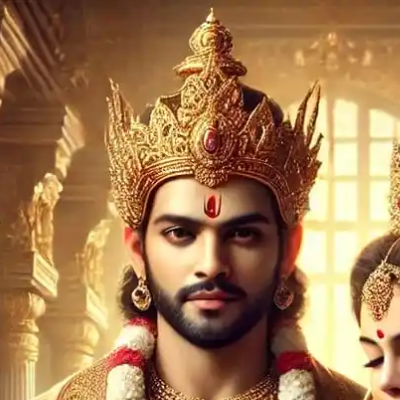
Priyavrata is one of the most cosmographically significant figures of the Puranic tradition, identified as the eldest son of Svayambhuva Manu — the first Manu and mind-born son of Brahma — and his wife Shatarupa. He is the brother of Uttanapada, whose son Dhruva is celebrated for his exceptional devotion to Vishnu. Priyavrata appears most extensively in the Bhagavata Purana, Canto 5, with parallel accounts in the Vishnu Purana, the Devi Bhagavata Purana, the Agni Purana, the Kurma Purana, the Markandeya Purana, the Linga Purana, and the Vayu Purana. He is remembered in the tradition primarily for three things: his initial renunciation and deep devotion cultivated under the sage Narada, his eventual acceptance of kingship under the direct instruction of Brahma, and the cosmic act by which his chariot's repeated circumambulation of the earth created the seven oceans and established the seven dvipas — the great island-continents of the Puranic geographical system. Through his sons he became the progenitor of the royal lineages that governed the entire earth during the Svayambhuva Manvantara, and through two of those sons the lineage of three Manvantaradhipatis — the presiding figures of the third, fourth, and fifth cosmic epochs.
✦ The Name
The name Priyavrata is a compound of priya, meaning dear, beloved, or pleasing, and vrata, meaning vow, sacred observance, or religious practice, yielding the meaning of one whose vows or religious observances are dear to him, or one who delights in sacred vows. The name reflects his essential character as presented throughout the Puranic tradition: a prince and later a king whose deepest inclination was toward spiritual renunciation and devotional practice rather than toward royal power and worldly governance. His vow of renunciation, his study under Narada, and his eventual return to renunciation after a long reign are all consistent with the meaning embedded in his name. The patronymic Svayambhuveya — meaning descendant of Svayambhuva — identifies him by his father's lineage from the first Manu.
✦ Lineage
- Paternal grandfather: Brahma — the creator deity, first of the Trimurti, from whose mind Svayambhuva Manu was born.
- Father: Svayambhuva Manu — the first Manu of the present cosmic cycle, mind-born son of Brahma and husband of Shatarupa; progenitor of humanity and the first ruler appointed by Brahma to govern the created world.
- Mother: Shatarupa — wife of Svayambhuva Manu, born from Brahma's own body; her name means she of a hundred forms.
- Brother: Uttanapada — the younger son of Svayambhuva Manu; father of Dhruva, the celebrated child-devotee of Vishnu who was granted an immovable position as the Pole Star, and of Uttama.
- Sisters: Akuti — given in marriage to the Prajapati Ruci, through whom Yajna an avatar of Vishnu was born; Devahuti — given in marriage to the sage Kardama, through whom Kapila an avatar of Vishnu and nine daughters were born; and Prasuti — given in marriage to Daksha, whose daughters became the mothers of the gods, demons, and all living beings.
- First wife: Barhishmati — daughter of Vishvakarma the Prajapati; through her Priyavrata begot ten sons and one daughter in the Bhagavata Purana account.
- Second wife: Surupa — also a daughter of Vishvakarma, and sister of Barhishmati; the Devi Bhagavata Purana and Puranic Encyclopaedia attribute the ten sons and the daughter Urjasvati to Surupa rather than Barhishmati; through the second wife Priyavrata begot three sons who became Manvantaradhipatis.
- Sons (principal, from the Bhagavata Purana): Agnidhra — king of Jambudvipa; Idhmajihva — king of Plaksadvipa; Yajnabahu — king of Shalmalidvipa; Mahavira — renounced the world; Hiranyareta — king of Kushadvipa; Ghritaprishtha — king of Krauncadvipa; Savana — renounced the world; Medhatithi — king of Shakadvipa; Vitihotra — king of Pushkaradvipa; and Kavi — renounced the world. Of the three who renounced, Kavi, Mahavira, and Savana are described as spiritual giants who, remembering experiences from prior existences, chose the life of contemplation over kingship.
- Sons (Manvantaradhipatis, by second wife): Uttama — who became the third Manu; Tamasa — who became the fourth Manu; and Raivata — who became the fifth Manu. These three presided over three successive Manvantaras, making Priyavrata the progenitor of a majority of the Manvantaradhipatis of the present cosmic cycle.
- Daughter: Urjasvati — the youngest child, who married Shukracharya, the preceptor of the Asuras.
- Spiritual preceptor: Narada — the divine sage and son of Brahma, who initiated Priyavrata into Brahmavidya and whose instruction formed the basis of Priyavrata's initial renunciation and his lifelong orientation toward devotion.
✦ Initiation by Narada and the Conflict Between Renunciation and Duty
The Bhagavata Purana, Canto 5, Chapter 1 narrates that Priyavrata, from his youth, was drawn toward the life of spiritual renunciation. He sought out and received instruction from the divine sage Narada, who taught him the nature of the soul and the path of devotion to Vishnu. Having received this knowledge and having dedicated himself through uninterrupted meditation to the Lord Vasudeva, Priyavrata had no desire for kingship, householder life, or worldly power. He foresaw clearly that accepting the duties of governance would obscure his realisation of the self, even though the duties themselves were not ultimately real.
However, when Svayambhuva Manu, advanced in years and preparing to retire to the forest for his own austerities, approached Priyavrata and requested that he accept the kingship, Priyavrata was placed in the position of conflict between the duty of obedience to his father and his own deep inclination toward renunciation. This conflict was resolved by the direct intervention of Brahma himself, who descended from Satyaloka to the place where Priyavrata, Narada, and Manu were gathered. Brahma addressed Priyavrata with affection and explained that the will of the supreme Lord governs all beings — that even Brahma, Marichi, Rudra, Narada, and Manu himself are all instruments of that will and must carry out their assigned duties. He instructed Priyavrata that his duty at this stage of existence was the governance of the earth, and that this could be performed without abandoning devotion if it was done as an offering to the Lord. Persuaded by Brahma's instruction and unwilling to disobey so senior an authority, Priyavrata accepted the charge of kingship.
✦ The Creation of the Seven Oceans and Seven Islands
The most cosmographically significant act attributed to Priyavrata in the Bhagavata Purana is the creation of the seven oceans and the consequent establishment of the seven dvipas — the great island-continents of the Puranic geographical system. The narrative records that Priyavrata, after accepting kingship, governed the entire earth with great power and splendour. Dissatisfied that half the earth was always in darkness while the sun illuminated only one side at a time, he resolved to counter this by driving his chariot around the earth, following the sun's path, so that his chariot's radiance might illuminate the darkened half. He circumambulated the earth seven times in this manner.
The ruts left by the wheels of his chariot in these seven circuits became the beds of the seven great oceans, dividing the surface of the earth into seven great island-continents surrounded and separated by those seas. These seven dvipas — Jambudvipa, Plaksadvipa, Shalmalidvipa, Kushadvipa, Krauncadvipa, Shakadvipa, and Pushkaradvipa — are the fundamental geographical divisions of the Puranic cosmological earth, and their existence is traced directly to this act of Priyavrata. He then distributed each of the seven dvipas to one of his seven kingship-accepting sons: Agnidhra received Jambudvipa, Idhmajihva received Plaksadvipa, Yajnabahu received Shalmalidvipa, Hiranyareta received Kushadvipa, Ghritaprishtha received Krauncadvipa, Medhatithi received Shakadvipa, and Vitihotra received Pushkaradvipa.
✦ Priyavrata's Reign and Final Renunciation
The Bhagavata Purana records that Priyavrata ruled the earth for an immense period — the Puranic Encyclopaedia citing eleven Arbuda years, where one Arbuda is ten crores — during which time he maintained the practice of constant meditation on the feet of the Lord alongside the performance of his royal duties. The primary sources present his reign as that of an ideal king — powerful, just, and spiritually grounded — who never lost his inner orientation toward devotion even while immersed in the full responsibilities of governance. He married Barhishmati and Surupa, daughters of Vishvakarma, begot his eleven children through his principal wife and three more sons through his second wife, and saw his kingdom established on a firm and enduring footing.
When the time came, Priyavrata divided his kingdom among his sons and renounced householder life entirely, returning to the path of devotion and contemplation that had been his first inclination. The Bhagavata Purana concludes his narrative by stating that through his constant meditation on the supreme Lord and the purification of his heart by that devotion, Priyavrata achieved final liberation. His story is presented in response to King Parikshit's wondering question to the sage Shukadeva Gosvami — how could a great devotee, so oriented toward renunciation and the Lord's feet, have become so thoroughly immersed in family and kingdom? Shukadeva's answer is that devotional service, being transcendental, cannot ultimately be diverted by material circumstances, and that Priyavrata's engagement with the world was itself an expression of the Lord's will and ultimately did not bind him.
✦ Textual Variants and Inconsistencies
The most significant inconsistency across the primary sources concerns the identity of Priyavrata's wife or wives and the names of his sons. The Bhagavata Purana names Barhishmati as his principal wife and gives the ten sons Agnidhra, Idhmajihva, Yajnabahu, Mahavira, Hiranyareta, Ghritaprishtha, Savana, Medhatithi, Vitihotra, and Kavi, plus daughter Urjasvati, as her children. The Vishnu Purana, supported by the Agni, Kurma, Markandeya, Linga, and Vayu Puranas, gives a substantially different list of Priyavrata's sons — Agnidhra, Agnibahu, Vapushmat, Dyutimat, Medha, Medhatithi, Bhavya, Savala, Putra, and Jyotishtman — and names his wife as Kamya or Kanya, daughter of the patriarch Kardama rather than of Vishvakarma. The commentarial tradition on the Vishnu Purana acknowledges this discrepancy and notes that the Bhagavata Purana's account differs substantially. The Devi Bhagavata Purana introduces Surupa as the first wife responsible for the ten sons, with Barhishmati bearing the Manu sons — reversing the Bhagavata Purana's assignment.
The Vishnu Purana commentator H. H. Wilson observes that the genealogical traditions of Priyavrata appear to be older than the Manvantara chronological system into which they have been placed, and that the distribution of Priyavrata's descendants across different Manvantaras creates inconsistencies — Daksha, a descendant of Uttanapada's line, gives his daughters to Kashyapa in the seventh Vaivasvata Manvantara, yet the lineage originates in the first Svayambhuva Manvantara, creating a chronological tension the texts do not resolve. The Bhagavata Purana is generally regarded as the most detailed and authoritative account of Priyavrata specifically, while the other Puranas agree on the broad outlines of his cosmographic significance without concurring on the genealogical details.
✦ Theological Significance
Priyavrata's story is one of the Bhagavata Purana's most sustained meditations on the relationship between worldly duty and spiritual devotion. The central theological question his narrative raises — whether a devotee can engage fully in the world without spiritual loss — is answered by the Bhagavata Purana affirmatively and with nuance: Priyavrata's immersion in kingship was not a failure of his devotion but an expression of the Lord's will, performed without the ego of a worldly king and sustained throughout by inner contemplation. His story is thus a model of what the tradition calls karma yoga in the broad sense — action in the world performed as an offering to the supreme, without attachment to its fruits, and without abandonment of the inner life.
His cosmographic act — the creation of the seven oceans by his chariot wheels — is theologically significant as an illustration of the principle that the actions of a great devotee, even those that appear to be ordinary exercises of royal power, have cosmic consequences that reshape the structure of the universe itself. The seven dvipas established by his circumambulations remain the foundational geographical framework of the Puranic earth throughout all subsequent Puranic cosmological literature.
✦ Connection to the Wider Genealogy
Priyavrata sits at one of the most generatively significant nodes in the entire Puranic genealogical tree. As the eldest son of Svayambhuva Manu and grandson of Brahma, he stands at the very beginning of the human royal lineage tradition. Through his son Agnidhra and grandson Nabhi, the lineage descends to Rishabha — regarded as the first Tirthankara in the Jain tradition and as an avatar of Vishnu in some Vaishnava sources — and thence to Bharata, the king after whom the Indian subcontinent is named Bharatavarsha in the Puranic tradition. This descent from Priyavrata through Agnidhra, Nabhi, Rishabha, and Bharata is one of the most celebrated genealogical sequences of the Puranas, connecting the first royal generation descended from Brahma directly to the naming of the land itself. Through his sons Uttama, Tamasa, and Raivata — the three Manvantaradhipatis born of his second wife — Priyavrata is also the progenitor of the presiding figures of the third, fourth, and fifth Manvantaras, making his family responsible for the governance of the cosmos across multiple cosmic epochs. Through his daughter Urjasvati's marriage to Shukracharya, Priyavrata is the father-in-law of the preceptor of the Asuras, connecting his lineage to the Asura tradition as well.
✦ References
- Bhagavata Purana, Canto 5, Chapter 1: The primary and most detailed source for Priyavrata's life, his initiation by Narada, Brahma's intervention, his marriage to Barhishmati, the names and destinies of his ten sons and daughter Urjasvati, the creation of the seven oceans and seven dvipas by his chariot wheels, and his final renunciation and liberation.
- Bhagavata Purana, Canto 5, Chapter 1, verse 28: Names Uttama, Tamasa, and Raivata as his sons by a second wife, all of whom became Manvantaradhipatis.
- Vishnu Purana, Book II, Chapter 1: Parallel account of Priyavrata's descendants and the seven dvipas, with a substantially different list of sons' names and identifying his wife as Kamya daughter of Kardama rather than Barhishmati daughter of Vishvakarma; the principal source for the variant genealogical tradition.
- Devi Bhagavata Purana, Ashtama Skandha: Attributes the ten sons and Urjasvati to Surupa as first wife rather than Barhishmati; names both daughters of Vishvakarma as Priyavrata's wives.
- Agni Purana, Kurma Purana, Markandeya Purana, Linga Purana, Vayu Purana: Concur broadly with the Vishnu Purana's genealogical account of Priyavrata's descendants and the seven dvipas.
- Vettam Mani, Puranic Encyclopaedia (1975), Priyavrata entry: Comprehensive secondary source consolidating Priyavrata's narrative and genealogical data across multiple Puranic traditions.
- H. H. Wilson, Vishnu Purana translation and notes (1840): Scholarly commentary identifying and explaining the principal textual discrepancies between the Bhagavata Purana and the Vishnu Purana accounts of Priyavrata's family.