
About
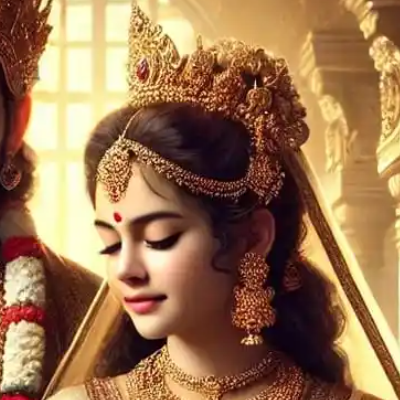
Barhishmati — Daughter of Vishvakarma, Wife of Priyavrata, Mother of the Island-Kings and Three Manus
Barhishmati · Barhishmati Priyavrata-patni · Varhishmati
Barhishmati is identified in the Bhagavata Purana, Canto 5, as the wife of Priyavrata — the eldest son of Svayambhuva Manu, the first Manu of the present cosmic cycle, and grandson of Brahma — and as the mother of ten sons and one daughter born to him. She is the principal wife of Priyavrata, and her children include the seven kings who became lords of the seven islands of the earth, three who renounced the world for spiritual life, and a daughter who became the wife of the preceptor Shukracharya. The Bhagavata Purana identifies her father as Vishvakarma, the divine craftsman and Prajapati. The identification of her father as Tvashtr — which is the basis of the question — arises from the well-attested partial identification in the tradition between Tvashtr and Vishvakarma as two names or aspects of the same divine craftsman figure, a textual relationship discussed below. Barhishmati does not appear as a protagonist in any independent narrative episode beyond her role in the genealogy of Priyavrata's family; her significance in the tradition is primarily genealogical.
✦ The Name
The name Barhishmati derives from the Sanskrit word barhis, which denotes the sacred grass — specifically the kusa or darbha grass — spread as a seat or mat at Vedic sacrifices for the gods and the ancestors to sit upon, and which is a fundamental element of the Vedic sacrificial apparatus. The suffix -mati, forming a feminine adjective, yields the meaning of she who possesses or is endowed with the barhis — the one associated with or characterised by the sacred sacrificial grass. The name thus carries an inherently ritual and sacred connotation, linking the bearer to the world of Vedic sacrifice. It is also the name of the capital city of the Svayambhuva Manvantara in certain Puranic geographical accounts — a homonymous usage that is distinct from this personal name and refers to a place rather than a person.
✦ Lineage
- Father: Vishvakarma — the divine craftsman and Prajapati, named as her father in the Bhagavata Purana Canto 5 and in the Puranic Encyclopaedia; Vishvakarma is the divine architect of the gods, credited in the tradition with crafting the celestial weapons, chariots, and palaces of the divine order, and is identified in many sources with Tvashtr, the Vedic craftsman deity who is one of the twelve Adityas. The relationship between Tvashtr and Vishvakarma is discussed further below.
- Husband: Priyavrata — eldest son of Svayambhuva Manu and Shatarupa; grandson of Brahma through Manu; a great devotee who had sought renunciation after receiving instruction from the sage Narada but was persuaded by Brahma to accept the duties of kingship; he ruled the entire earth for many thousands of years, and his chariot wheel-tracks created the seven oceans and seven islands of the Puranic geography.
- Sons by Priyavrata: Ten in number — Agnidhra, Idhmajihva, Yajnabahu, Mahavira, Hiranyareta (also named Rukmasukra in some accounts), Ghritaprishtha, Savana, Medhatithi, Vitihotra, and Kavi. Of these, three — Kavi, Mahavira, and Savana — renounced the world and pursued spiritual life, remembering experiences from prior existences. The remaining seven became the lords of the seven islands or dvipas of the Puranic earth: Agnidhra over Jambudvipa, Idhmajihva over Plaksadvipa, Yajnabahu over Salmalidvipa, Hiranyareta over Kushadvipa, Ghritaprishtha over Krauncadvipa, Medhatithi over Shakadvipa, and Vitihotra over Pushkaradvipa.
- Daughter by Priyavrata: Urjasvati — the youngest child of Barhishmati and Priyavrata; she was given in marriage to Shukracharya, the preceptor of the Asuras, who is one of the most prominent divine teachers of the Puranic tradition.
Priyavrata also had a second wife through whom he begot three sons — Uttama, Tamasa, and Raivata — all of whom became Manvantaradhipatis, presiding over the third, fourth, and fifth Manvantaras respectively. The identity of this second wife is not consistently named across the primary sources consulted, and she is distinct from Barhishmati.
✦ Barhishmati's Role in the Priyavrata Narrative
The Bhagavata Purana, Canto 5, Chapter 1 narrates that after Priyavrata was persuaded by Brahma to accept kingship, he entered household life and married Barhishmati, the daughter of Vishvakarma. Through her he begot the ten sons and one daughter enumerated above, and lived with his family for many thousands of years. The primary texts describe Barhishmati in terms that emphasise her virtue, modesty, and good nature — she is presented as an ideal consort for a king of Priyavrata's spiritual stature. The Bhagavata Purana Canto 5 does not narrate any independent episode in which Barhishmati herself takes a prominent role; she is present in the narrative as the mother through whom the great genealogy of island-kings is established, and her significance lies in the cosmic consequences of her union with Priyavrata — the seven sons who became lords of the seven earthly divisions, and the daughter who married Shukracharya.
✦ Textual Variants and Inconsistencies
The identity of Barhishmati's father — Vishvakarma, Tvashtr, or Kardama: This is the most significant inconsistency in the primary sources relating to Barhishmati. The Bhagavata Purana, Canto 5, Chapter 1, verse 24 identifies her father as Vishvakarma, the divine craftsman and Prajapati. The Devi Bhagavata Purana, Ashtama Skandha, likewise names Vishvakarma Prajapati as her father, as does the Puranic Encyclopaedia of Vettam Mani in its principal entry. However, the Vishnu Purana presents a different account in which the wife of Priyavrata is named Kamya or Kanya and identified as the daughter of Kardama Prajapati — not Vishvakarma — and their children are named differently from those in the Bhagavata Purana account. The Vishnu Purana's own commentarial tradition notes this discrepancy and acknowledges the Bhagavata Purana's identification of Barhishmati as daughter of Vishvakarma as a distinct tradition. The identification of her father as Tvashtr rather than Vishvakarma arises from the well-documented partial identification in the tradition between these two figures: Tvashtr is the Vedic craftsman deity and Aditya, while Vishvakarma is the Puranic divine architect and Prajapati, and they are treated as the same figure in several texts — most explicitly in the Vamana Purana, which states that when Tvashtr is identified with Vishvakarma, the son Vishvarupa and the daughter Saranyu belong to that combined figure. On this basis, Barhishmati as daughter of Vishvakarma can legitimately be described as a daughter of the Tvashtr-Vishvakarma figure, though strictly the Bhagavata Purana names her father as Vishvakarma rather than Tvashtr by the Aditya designation.
The names of Priyavrata's sons: The Bhagavata Purana and the Devi Bhagavata Purana give a list of ten sons by Barhishmati that differs modestly from the list given in the Vishnu Purana, which names the sons of Priyavrata differently and does not specify which wife bore which sons in the same way. The name Hiranyareta appears in the Bhagavata Purana while Rukmasukra appears in some Devi Bhagavata Purana recensions for what appears to be the same son. These variations reflect the typical fluidity of Puranic genealogical lists across different textual traditions.
Barhishmati and Surupa: The Puranic Encyclopaedia of Vettam Mani states that Priyavrata married both Barhishmati and Surupa, both daughters of Vishvakarma Prajapati — making them sisters — and attributes the ten sons and daughter Urjasvati to Surupa rather than Barhishmati in that account, reserving for Barhishmati the three sons Uttama, Tamasa, and Raivata who became Manus. The Bhagavata Purana Canto 5, verse 24 and its summary, by contrast, attribute the ten sons and Urjasvati to Barhishmati and assigns the second wife the three Manu sons without naming her. This represents a genuine inconsistency between the Puranic Encyclopaedia's synthesis and the Bhagavata Purana's direct account regarding which wife bore which children. The Bhagavata Purana, as the primary source, assigns the ten sons and Urjasvati to Barhishmati.
✦ Connection to the Wider Genealogy
Barhishmati occupies a critical position in the Puranic genealogical system through her marriage to Priyavrata and the children she bore him. Her husband Priyavrata is the eldest son of Svayambhuva Manu — the first Manu and the progenitor of humanity in the present cosmic cycle — and thus a grandson of Brahma, the creator deity. Through their union, Barhishmati becomes the mother of the seven island-kings whose rule divides the terrestrial geography of the Puranic world into its seven great regions, a cosmographic act of fundamental importance in the Puranic understanding of the earth's organisation. The genealogy that proceeds from her sons populates the entire Puranic earth: Agnidhra's nine sons receive the nine regions of Jambudvipa, and from Agnidhra's son Nabhi descends Rishabha, who in turn begets Bharata — the king after whom the subcontinent is named Bharatavarsha in the Puranic tradition. Through her daughter Urjasvati's marriage to Shukracharya, Barhishmati is also connected to the lineage of the Asura preceptor and through him to the Asura traditions of the Puranic universe. Her father Vishvakarma — identified in substantial portions of the tradition with Tvashtr the Aditya — connects her to the Kashyapa-Aditi solar lineage from which the Adityas descend.
✦ References
- Bhagavata Purana, Canto 5, Chapter 1, verse 24 and Chapter 1 summary: The primary and most explicit source for Barhishmati as wife of Priyavrata and daughter of Vishvakarma; names her ten sons and daughter Urjasvati and records the cosmic consequences of Priyavrata's reign.
- Devi Bhagavata Purana, Ashtama Skandha: Corroborating source identifying Barhishmati and Surupa as two daughters of Vishvakarma Prajapati married to Priyavrata; attributes the three sons Uttama, Tamasa, and Raivata to Barhishmati in this account.
- Vishnu Purana, Book II, Chapter 1: Presents a partially divergent account of Priyavrata's wife and offspring; names the wife as Kamya or Kanya, daughter of Kardama Prajapati rather than Vishvakarma; the commentarial notes acknowledge the Bhagavata Purana's differing identification.
- Vamana Purana: Identifies Vishvakarma with Tvashtr and notes that when so identified, the daughters of Vishvakarma include figures from the Tvashtr tradition; provides the textual basis for understanding Barhishmati as a daughter of the Tvashtr-Vishvakarma combined figure.
- Vettam Mani, Puranic Encyclopaedia (1975): Records Barhishmati as wife of Priyavrata and daughter of Vishvakarma Prajapati; provides the genealogical data on her children across Puranic sources, though with a different assignment of children to the two wives than the Bhagavata Purana account.
- Wisdomlib, Barhishmati definition entry: Modern consolidation of Puranic references for Barhishmati, including the Puranic Index references and the Puranic Encyclopaedia data.