
About
Haha — Gandharva Musician, Cursed to Animal Form and Liberated by Vishnu
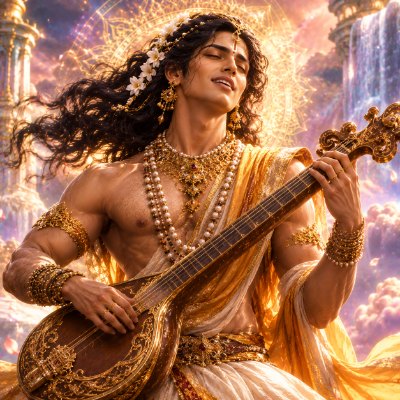
Haha · Hāhā · celestial gandharva singer
Haha is a gandharva celebrated across the Mahabharata, the Bhagavata Purana, the Skanda Purana, and the Vishnudharmottara Purana as one of the foremost celestial musicians of the divine realm. He is paired in nearly all his scriptural appearances with the gandharva Huhu as a famous duo of musicians who perform in the courts of Indra and Brahma. His most significant independent narrative episode is his transformation into an elephant as a consequence of a curse by the sage Devala, and his eventual liberation when Vishnu intervened to save the elephant king Gajendra — an episode central to the Gajendra Moksha narrative of the Bhagavata Purana. Haha is described as a son of the sage Kashyapa in sources that give his parentage, with his mother identified as Pradha in these accounts. The user's designation of Arishta as his mother reflects the general Puranic classification of gandharvas as children of Kashyapa and Arishta; this variant is noted under Textual Variants.
✦ The Name
The name Haha is an exclamatory Sanskrit form, a repetition of the syllable ha, which functions in Sanskrit as an interjection of surprise, wonder, or exclamation. As a personal name for a gandharva, it may reflect a musical or sonic identity — an association with the expressive exclamations of celestial performance. The Google Groups discussion on Haha and Huhu notes that the names carry similarity to laughter sounds and considers the possibility that they served as divine jesters or comedians, though concludes there is no scriptural evidence for such a role and that they are simply renowned musicians. The names appear together in numerous Puranic and epic lists of distinguished gandharvas, functioning as a recognized pair of celestial singers.
✦ Lineage
- Father: Kashyapa — the great sage, one of the Saptarishis, regarded as the progenitor of all living beings through his multiple wives, daughters of Daksha.
- Mother (per Tumburu Wikipedia and associated sources): Pradha — one of Kashyapa's wives listed in the Vettam Mani Puranic Encyclopaedia synthesis; Haha, Huhu, Tumburu, and Bahu are identified as sons of Kashyapa and Pradha in these accounts.
- Mother (general Puranic class genealogy): Arishta — a daughter of Daksha and one of Kashyapa's wives, named in the Vishnu Purana as the mother of the gandharva class collectively. The distinction between Arishta as the mother of gandharvas as a class and Pradha as the mother of specific named individuals including Haha may reflect different levels of Puranic genealogical specificity rather than a genuine contradiction.
- Brothers: Huhu — fellow gandharva musician and inseparable companion in textual references; Tumburu — the foremost singer among the gandharvas, courtier of Kubera and Indra, celebrated as the lord of song; Bahu — named as a fourth gandharva brother in the same group.
✦ As Celestial Musician
Haha and Huhu are listed repeatedly in the Mahabharata alongside other prominent gandharvas as performers in the divine courts. The Bhagavad Gita chapter 10 famously names Chitraratha as the foremost among the gandharvas, while Haha and Huhu appear in supporting lists of the divine musical community. The Google Groups samskrita discussion on the two names notes that they are mentioned in several Puranic contexts as singing divine melodies in Brahmaloka and in celestial assemblies, and that their music is considered to partake of a quality of divine beauty that would later be surpassed, according to one narrative, by Krishna's flute. The Tamil and Vedas blog post on Haha and Huhu categorises them as among the most famous of the mythological gandharvas and notes their repeated citation in the scriptural record as exemplars of celestial musical excellence.
✦ The Curse of Devala and the Gajendra Moksha Connection
The Vishnudharmottara Purana provides the most detailed account of Haha's curse. According to this text, Haha and Huhu were both renowned for their singing and entered into a dispute about which of them possessed superior talent. They sought out the sage Devala to adjudicate between them. When the sage did not render a judgment favourable to them, both gandharvas insulted him, saying he had the ears of a donkey as far as knowledge of music was concerned. Devala, enraged by this irreverence, cursed both of them to be transformed into animals. Haha became an elephant and Huhu became a crocodile. The two cursed beings continued to live out their animal existences, their prior musical greatness entirely obscured.
The liberation of Haha from his curse is bound up with the Gajendra Moksha episode, one of the most celebrated salvation narratives of the Bhagavata Purana. In his elephant form, Haha led a herd on the Trikuta mountain. One day the elephant entered a lake to drink and play, and was seized by the leg by a powerful crocodile — which in the Vishnudharmottara Purana account is identified as Huhu in his cursed form. The struggle between the elephant and the crocodile continued for a great length of time. Eventually, the elephant, exhausted and unable to free himself, called out to Vishnu with a lotus flower held in his trunk as an offering. Vishnu descended immediately, drove away the crocodile with his Sudarshana Chakra, and liberated both the elephant and the crocodile from their cursed animal forms. In the Vishnudharmottara Purana variant it is specifically Huhu who is the crocodile, while Haha is the elephant. In the Bhagavata Purana the identity of the cursed crocodile as Huhu is explicitly confirmed.
✦ Textual Variants
The Bhagavata Purana's Gajendra Moksha episode, at Skandha 8, Chapter 4, identifies Huhu as the cursed crocodile who was freed when Vishnu slew the crocodile and saved Gajendra. In this account, the elephant king Gajendra is a former pious devotee transformed into an elephant through a different curse — he was a Pandya king named Indradyumna cursed by the sage Agastya for neglecting his duties — and is not identified with Haha. The Vishnudharmottara Purana variant, however, specifically identifies both Haha and Huhu as the elephant and the crocodile respectively, directly linking both to the Gajendra Moksha episode. These two accounts differ in whether Haha is the elephant king (Vishnudharmottara Purana) or whether the elephant is the former king Indradyumna (Bhagavata Purana). The Skanda Purana version specifically names the crocodile as Huhu without addressing Haha's identity. The present profile follows the Vishnudharmottara Purana identification since it is the only source that names both gandharvas in connection with the episode; the Bhagavata Purana's account is noted as the primary textual parallel.
✦ References
Primary Sources
- Bhagavata Purana, Skandha 8, Chapter 4 — records the liberation of Huhu from the crocodile form in the context of the Gajendra Moksha episode; establishes the curse-and-liberation framework.
- Vishnudharmottara Purana — the most detailed account of the dispute between Haha and Huhu before the sage Devala, their mutual insult of the sage, and the specific assignment of Haha as the elephant and Huhu as the crocodile.
- Skanda Purana — records Huhu as the crocodile in the Gajendra Moksha episode; places the events on the Trikuta mountain.
- Mahabharata — cites Haha and Huhu repeatedly among famous gandharvas in divine assemblies.
- Vishnu Purana — establishes the class genealogy of gandharvas as descended from Kashyapa and Arishta.
Modern Reference Works
- Talkingmyths.com, "Gajendra Moksha" — provides the Vishnudharmottara Purana account of Haha and Huhu's curse by Devala and their respective animal forms.
- Vedabase.io, Bhagavata Purana 8.4 — direct translation of the Bhagavata Purana passage liberating the gandharva Huhu from the crocodile form.
- Wikipedia, "Tumburu" — identifies Haha and Huhu as brothers of Tumburu and sons of Kashyapa and Pradha.
- Tamil and Vedas blog, "Haha and Huhu — Famous Musicians" — records the general class genealogy attributing gandharvas to Kashyapa and Arishta and discusses the textual references to Haha and Huhu as celebrated musicians.
- Google Groups, samskrita discussion on Haha and Huhu — records scholarly discussion on the names and notes they are identified as children of Kashyapa and Pradha in the texts.