
About
Bhimasura — Son of Kumbhakarna and Karkati, Destroyer of Bhimashankar
Bhimasura · Bheema · Bhima · son of Kumbhakarna · Bhimashankar legend
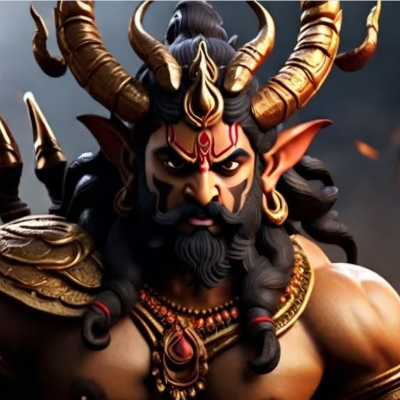
Bhimasura is a son of Kumbhakarna — the enormous younger brother of Ravana and one of the most celebrated warriors of the Ramayana — born not of Kumbhakarna's principal wife Vajrajwala but of a second wife named Karkati, described as a princess of the Sahyadri mountain region. His existence is attested primarily in the Shiva Purana, where his narrative forms the aetiological legend explaining the origin of the Bhimashankar Jyotirlinga — one of the twelve sacred Jyotirlingas of Shiva distributed across the Indian subcontinent. He is distinct from Kumbhakarna's sons Kumbha and Nikumbha by Vajrajwala, who fought and died in the Lanka war of the Valmiki Ramayana. Bhimasura's story belongs to the Shaiva Puranic tradition rather than to the epic tradition, and its geographical setting — the Sahyadri mountains of the Deccan, identified with the region of present-day Maharashtra — places it in the western regional landscape rather than the Lanka-centred world of the Ramayana.
✦ The Name
The name Bhimasura is a Sanskrit compound of two elements. The first, bhima, means "terrible," "formidable," "frightful," or "of awesome power" — a word of strong and fearsome connotation used widely in Sanskrit to describe beings, forces, and phenomena of overwhelming power. It is a common element in names of powerful warriors and demons throughout the tradition. The second element, asura, means "demon" or "powerful being opposed to the divine order" — the class of beings ranged in cosmic opposition to the Devas in the Puranic cosmological scheme. The compound name thus means "the terrible asura" or "the formidable demon," encoding a description of his essential character and his opposition to the divine order as fundamental aspects of his identity. The name is also rendered as Bheema or Bhima in various sources, these being phonetic variants of the same Sanskrit word.
✦ Lineage
- Father: Kumbhakarna — the younger brother of Ravana, son of Vishrava and Kaikesi. He is renowned as a warrior of colossal size and genuine moral complexity, who recognised the wrongness of Ravana's actions and tried to dissuade him but chose to fight out of fraternal loyalty. He was slain by Rama using the Indrastra during the Lanka war. His first wife Vajrajwala bore him Kumbha and Nikumbha; his wife Karkati bore him Bhimasura.
- Mother: Karkati — described as a princess of the Sahyadri mountain region, also rendered as Karkadi in some sources. She met Kumbhakarna and married him in the Sahyadri mountains. When Kumbhakarna departed for Lanka, Karkati did not follow him but remained in the mountains, where she gave birth to Bhimasura after Kumbhakarna's departure. When Kumbhakarna was killed in the Lanka war, Karkati concealed her son's identity and whereabouts to protect him from the gods who had been arrayed against his father and uncle.
- Half-brothers: Kumbha and Nikumbha — sons of Kumbhakarna by his first wife Vajrajwala, the daughter of Bali and granddaughter of Virochana. Both fought in the Lanka war and were killed — Kumbha by Sugriva and Nikumbha by Hanuman.
- Paternal uncle: Ravana — the ten-headed demon-king of Lanka, whose abduction of Sita precipitated the war in which Bhimasura's father Kumbhakarna was killed.
- Paternal uncle: Vibhishana — Ravana's righteous younger brother who defected to Rama's cause and was crowned king of Lanka after Ravana's defeat.
- Paternal grandfather: Vishrava — a celebrated sage, son of Pulastya and Manini, daughter of Trinabindu, a king of the solar dynasty.
- Paternal great-grandfather: Pulastya — one of the Saptarishis, a mind-born son of Brahma the creator.
✦ The Birth and Early Years
Bhimasura was born in the Sahyadri mountains after his father Kumbhakarna had departed for Lanka. His mother Karkati raised him in the mountain region, concealing his identity and lineage after Kumbhakarna's death in the Lanka war. When Bhimasura grew to maturity and came to know the truth of his origin — that his father had been a great Rakshasa warrior who had been killed by Rama with the support of the gods — he was filled with grief for his father's death and with a determination to avenge it and to overcome the divine order that had been arrayed against his father's family.
✦ The Austerities and the Boon
Motivated by his resolve to avenge his father and to acquire the power to overcome even the gods, Bhimasura undertook intense and prolonged tapas directed toward Brahma. The austerities are described as being of extraordinary severity — consistent with the tradition's characterisation of the great asuras as beings willing to undergo extreme self-mortification to acquire supernatural power. Brahma, moved by the intensity of Bhimasura's austerities, appeared before him and offered him a boon.
Bhimasura requested boons of great destructive power — specifically, invincibility against his enemies and the ability to overcome divine beings. Brahma granted these boons. Empowered by the boons he had received, Bhimasura became enormously powerful and began a campaign of aggression against both the divine order and against ordinary living beings. The Shiva Purana's account presents him as having declared himself a god and having begun to harass and terrorise all creatures — both divine and mortal — disrupting the sacred order and preventing the performance of religious rites.
✦ The Conquest of the Three Worlds and the Persecution of Kamrupeshvara
Emboldened by his boons, Bhimasura conquered the three worlds and displaced their rulers. He sent the gods into hiding and established himself as the supreme lord of creation — a pattern of Puranic narrative familiar from the careers of Ravana, Hiranyakashipu, and other great asura conquerors who obtained boons from Brahma and used them to overturn the cosmic order. Under his reign all dharmic activity was suppressed, sacrifices were prohibited, and the sacred order of the universe was disrupted.
The Shiva Purana's account specifically centres on a king named Kamrupeshvara — described as a devoted worshipper of Shiva — who continued to perform his devotions in secret despite Bhimasura's conquest and his prohibition of all religious activity. Bhimasura, learning of Kamrupeshvara's continued worship of Shiva, came to confront him personally. He found the king worshipping a Shivalinga and was enraged by this act of defiance against his authority. He raised his sword to destroy both the king and the Shivalinga.
✦ The Manifestation of Shiva and the Origin of the Bhimashankar Jyotirlinga
At the moment Bhimasura raised his sword against the king and the Shivalinga, Shiva himself manifested from the Shivalinga in a form of blazing divine power and confronted Bhimasura directly. The confrontation between Shiva and Bhimasura was decisive and brief — Shiva destroyed Bhimasura with the fire of his own divine energy, reducing the demon to ash. The Shiva Purana records that the gods, who had been observing from above and had been prevented from assisting Kamrupeshvara by their own displacement at Bhimasura's hands, rejoiced at the demon's destruction and showered flowers upon the scene.
Following Bhimasura's destruction, the assembled gods and sages petitioned Shiva to remain present at that location for the benefit of all devotees. Shiva agreed and manifested himself permanently at the site of the battle in the form of the Bhimashankar Jyotirlinga — one of the twelve Jyotirlingas, the sacred self-manifested forms of Shiva distributed across the sacred geography of India. The Jyotirlinga is located in the Sahyadri mountains of what is now the Pune district of Maharashtra. The site is called Bhimashankar — a compound of Bhima, the demon whose destruction gave rise to the linga, and Shankar, a name of Shiva — encoding the legend of the demon's defeat permanently in the name of the sacred place itself.
The Bhima river — one of the major rivers of the Deccan plateau, a tributary of the Krishna river — is said in some traditions to have originated from the sweat of Shiva during his battle with Bhimasura, giving the river its name and connecting the geographical landscape of the region permanently to the legend. This river-origin tradition further embeds Bhimasura's story in the sacred geography of the Deccan.
✦ Theological Significance
Bhimasura's narrative belongs to a well-established category of Shaiva Puranic legend — the aetiological myth explaining the origin of a sacred Jyotirlinga through the destruction of a demon by Shiva. Similar narratives surround several other Jyotirlingas, each presenting a demon whose persecution of devotees or disruption of the cosmic order prompts Shiva's manifestation and the demon's destruction, with the Shivalinga remaining at the site as a permanent form of divine presence accessible to worshippers.
In Bhimasura's case the theological function of the narrative is particularly explicit: his story connects the Bhimashankar Jyotirlinga directly to the lineage of the Ramayana's most celebrated family of antagonists, embedding the origin of a major pilgrimage site within the genealogy of Lanka's royal house. The story simultaneously honours the faithfulness of Kamrupeshvara as a Shiva devotee — his continued worship despite Bhimasura's prohibition is presented as the act that draws Shiva's direct intervention — and demonstrates the ultimate insufficiency of even the most formidable boons from Brahma when Shiva's devotee is threatened.
✦ Textual Base and Source Honesty
Bhimasura's story is attested in the Shiva Purana, specifically in the Koti Rudra Samhita section which deals with the twelve Jyotirlingas and their origin legends. This is the principal primary source for the narrative. The connection to Kumbhakarna as his father is preserved in this Puranic tradition and is consistent with the secondary sources consulted. The Valmiki Ramayana does not mention Bhimasura, as his story belongs to the post-Ramayana period and to the Shaiva Puranic tradition rather than to the epic narrative. His profile is accordingly a Puranic one rather than an epic one, and the textual base for his genealogy — specifically the identification of Karkati as his mother and of the Sahyadri setting — rests on the Shiva Purana and on secondary compilations drawing from it.
✦ Connection to the Wider Genealogy
Bhimasura's genealogical position connects him to the same lineage streams as his half-brothers Kumbha and Nikumbha on the paternal side. Through his father Kumbhakarna and grandfather Vishrava he descends from Brahma through the Pulastya sage line. Through his paternal uncle Ravana he is connected to the central narrative of the Ramayana. His mother Karkati's lineage as a princess of the Sahyadri mountains is not elaborated upon in the available primary sources beyond this identification. His destruction by Shiva and the Jyotirlinga that manifested at his death connect him permanently to the sacred geography of the Deccan and to the Shaiva tradition's network of pilgrimage sites. He leaves no descendants recorded in the primary sources.
✦ References
- Primary Sources
- Shiva Purana, Koti Rudra Samhita: The principal primary source for Bhimasura's narrative — his parentage as the son of Kumbhakarna and Karkati, his austerities and boons from Brahma, his conquest of the three worlds, his persecution of the devotee Kamrupeshvara, his confrontation with Shiva, his destruction, and the origin of the Bhimashankar Jyotirlinga at the site of his death.
- Secondary Sources
- Mani, Vettam. Puranic Encyclopaedia. Motilal Banarsidass, 1975: Provides an entry on Bhimasura noting his parentage as a son of Kumbhakarna by Karkati and summarising the Shiva Purana narrative of his destruction by Shiva.
- Wisdomlib (wisdomlib.org): Offers cross-referenced citations of Bhimasura across digitised Sanskrit texts, confirming his attestation in the Shiva Purana and identifying him as the offspring of Karkati and Kumbhakarna whose prowess led to his conflict with devotees of Shiva.
- Hindu Blog (hindu-blog.com) and Religion Wiki (religion.fandom.com): Provide secondary accounts of the Bhimasura legend consistent with the Shiva Purana tradition, including the detail of Karkati as mother and the Sahyadri mountain setting, used to supplement the profile with contextual detail while the primary Shiva Purana text remains the authoritative source.