
About
Mulakasura — Rakshasa Demon of Post-War Lanka
Mulakasura · Mulaka · Kumbhakarna-putra
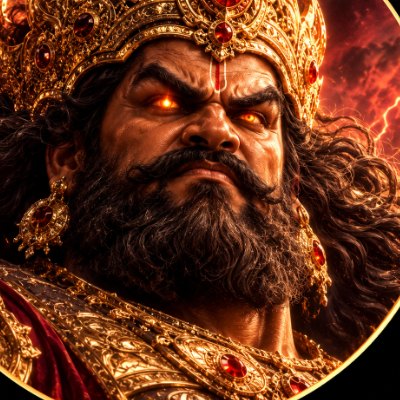
Mulakasura is a rakshasa demon whose narrative appears in the Ananda Ramayana, a Sanskrit text composed in approximately the fourteenth or fifteenth century CE and attributed by tradition to the sage Valmiki, though widely regarded by scholars as a later composition. He is identified in that text as the son of Kumbhakarna, the colossal rakshasa warrior and younger brother of the demon king Ravana of Lanka. Mulakasura's episode is set in the period after the principal events of the Ramayana — the defeat of Ravana and the installation of Vibhishana as king of Lanka — and centres on his conquest of Lanka, his expulsion of Vibhishana, his boon-granted invincibility against men, and his ultimate slaying at the hands of Sita, wife of Rama. The figure does not appear in the Valmiki Ramayana, the Adhyatma Ramayana, or in any of the eighteen Mahapuranas in accessible secondary scholarship. His textual base is narrow, being attested with confidence only in the Ananda Ramayana.
✦ The Name
The name Mulakasura is a Sanskrit compound. The element mulaka derives from the root mula, meaning root, foundation, or origin. The suffix asura denotes a class of powerful supernatural beings in Hindu tradition who stand in opposition to the devas, broadly rendered as demon or anti-god in English. The compound name thus identifies the figure as a demon of foundational or root-like quality, though in demon nomenclature the first element may also function as a simple proper designation. The name is structurally consistent with other rakshasa compound names in the extended Ramayana tradition. No ancient commentary offering a specific secondary etymology for the first element is traceable in available scholarship.
✦ Lineage
- Father: Kumbhakarna — a rakshasa of immense physical power and the younger brother of Ravana, king of Lanka. Kumbhakarna is celebrated in the Valmiki Ramayana as a warrior of extraordinary might and unusual moral clarity; though he recognised Ravana's abduction of Sita as wrongful, he chose to fight for his brother out of fraternal loyalty and was slain in battle by Rama. His own parentage traces to the sage Vishrava and the rakshasi Kaikasi.
- Mother: Named in the user-supplied contextual note as Taritamala. This name is not independently corroborated in the secondary scholarship consulted for this profile. The Ananda Ramayana is not fully digitised and the identification of Taritamala as Kumbhakarna's wife in this lineage cannot be confirmed against a directly accessible primary-text passage at this time. The major Puranic sources identify Kumbhakarna's principal wife as Vajrajwala, daughter of the demon king Bali, by whom he fathered the rakshasas Kumbha and Nikumbha; a further son named Bhima is ascribed by the Shiva Purana to a wife named Karkati.
- Paternal grandfather: Vishrava — a brahmarshi, son of the sage Pulastya and a descendant of Brahma.
- Paternal grandmother: Kaikasi — a rakshasi, daughter of Sumali, and the mother of Ravana, Kumbhakarna, Vibhishana, and Shurpanakha.
- Paternal uncles: Ravana — the ten-headed demon king of Lanka, principal antagonist of the Ramayana; Vibhishana — the righteous brother of Ravana who joined Rama's cause and was installed as king of Lanka after Ravana's defeat; Shurpanakha — the rakshasi whose disfigurement at Lakshmana's hands precipitated the Lanka war.
✦ The Conquest of Lanka and War with Rama
According to the Ananda Ramayana, the events involving Mulakasura unfold after Rama has returned to Ayodhya and Vibhishana has been established as the rightful ruler of Lanka. Mulakasura, grown to full power as the son of the slain Kumbhakarna, wages war against Vibhishana and after a prolonged conflict lasting six months succeeds in driving Vibhishana out of Lanka entirely, seizing the kingdom for himself. This conquest presents Rama — now ruling in Ayodhya as the dharmic king — with an urgent obligation, since Vibhishana had been his ally and Lanka his gift.
Rama marshals the forces of Sugriva — the vanara king of Kishkindha who had been the chief ally of Rama's army during the original Lanka campaign — and leads them to Lanka. The battle between Rama and Mulakasura is fierce and extends over seven days. At this point the god Brahma intervenes and reveals to Rama a critical obstacle: Mulakasura holds a boon that renders him incapable of being slain by any man. This divine disclosure explains why Rama, despite his status as an avatar of Vishnu, has been unable to kill the demon through seven days of combat.
Brahma further discloses, however, that Mulakasura is subject to a countervailing curse pronounced by a rishi, which decrees that he will meet his death at the hands of Sita, Rama's wife. Sita, daughter of King Janaka of Mithila and regarded in the tradition as an earthly manifestation of the goddess Lakshmi, had remained in Ayodhya. Rama sends Garuda — the great eagle vehicle of Vishnu — to bring Sita to the battlefield. Upon her arrival, Sita undergoes a transformation into Chandi, a fierce martial form of the goddess. In this form she engages Mulakasura in single combat for seven days and ultimately kills him, liberating Lanka and enabling the restoration of Vibhishana to his throne.
✦ Theological and Narrative Significance
The Mulakasura episode is consistent with a pattern found across several extended Ramayana texts in which a demon possesses a boon of invincibility against men or against Rama specifically, and in which the resolution requires the intervention of a goddess — most commonly Sita acting in a fierce form. This narrative device serves the theological purpose of asserting that Sita is not merely a passive figure rescued by Rama but an active cosmic power without whose Shakti Rama's own divine mission cannot be fully completed. The transformation of Sita into Chandi in particular aligns this episode with the broader Shakta theological tradition, in which the supreme feminine power is understood to be ultimately beyond even the reach of male divine agency.
The structure of Mulakasura's boon and curse — invincible to men, vulnerable to a specific individual on account of a rishi's pronouncement — is also a standard mechanism in Puranic and epic demonology. It mirrors the logic governing figures such as Ravana himself, who was invincible to gods and demons but left himself exposed to humans, and Mahishasura, who was invincible to men but destroyed by the goddess Durga. Mulakasura thus functions within a well-established literary and theological paradigm, though his specific episode is found only in the Ananda Ramayana rather than in any of the core canonical texts.
✦ Textual Variants and Inconsistencies
The principal textual issue concerning Mulakasura is his complete absence from the Valmiki Ramayana and from the Puranic genealogies of Kumbhakarna's children. The Valmiki Ramayana, which is the earliest and most authoritative text of the Rama narrative, records Kumbhakarna's sons as Kumbha and Nikumbha, both born of his wife Vajrajwala and both killed in the Lanka war by Sugriva's vanara forces. The Shiva Purana introduces a further son, Bhima, born of a wife named Karkati. No Puranic source in the accessible scholarly record introduces Mulakasura into this genealogy.
The Ananda Ramayana, as a text of the fourteenth or fifteenth century, belongs to a category of Ramayana literature specifically noted for expanding the narrative with episodes and characters not found in Valmiki. Scholars have observed that the Ananda Ramayana received relatively limited attention from commentators compared to texts such as the Adhyatma Ramayana or the Ramacharitamanasa, and that several of its distinctive episodes — including the post-coronation adventures involving sons and descendants of the Lanka war's major demons — have no parallel in the mainstream textual tradition. The Mulakasura narrative belongs to this category of episodes unique to the Ananda Ramayana. Regarding his mother's name: the name Taritamala, supplied as contextual information, has not been independently confirmed in any secondary or digital scholarly source consulted for this profile, and this detail should be treated as requiring verification against the primary Sanskrit text of the Ananda Ramayana.
✦ Connection to the Wider Genealogy
Mulakasura belongs to the lineage of Pulastya, one of the seven primordial sages born of Brahma. From Pulastya descended the sage Vishrava, and from Vishrava by his rakshasi wife Kaikasi came the principal demons of the Ramayana: Ravana, Kumbhakarna, Vibhishana, and Shurpanakha. Mulakasura, as the son of Kumbhakarna within the Ananda Ramayana, occupies the third generation of this descent — the grandson of Vishrava and the great-grandson of Pulastya. His half-uncles by the mainstream Puranic genealogy of Kumbhakarna are Kumbha and Nikumbha. His episode in the Ananda Ramayana places him in direct opposition to Vibhishana, his paternal uncle, whom he defeats and displaces, and ultimately to Sita and Rama, representatives of the solar dynasty of Ayodhya and avatars of Vishnu and Lakshmi respectively.
✦ References
Primary Sources
- Ananda Ramayana (attributed to Valmiki; composed c. 14th–15th century CE) — the sole primary source for the Mulakasura episode, including his identity as Kumbhakarna's son, his conquest of Lanka, his invincibility boon, his curse of death by Sita, and Sita's transformation into Chandi to slay him.
- Valmiki Ramayana, Yuddha Kanda — provides the primary account of Kumbhakarna's parentage, character, and death in battle; names Kumbha and Nikumbha as Kumbhakarna's sons; contains no reference to Mulakasura.
- Shiva Purana — records Bhima as an additional son of Kumbhakarna by a wife named Karkati; does not mention Mulakasura.
- Nilamata Purana — identifies Nikumbha, son of Kumbhakarna and Vajramala, as lord of the Pisacas; does not mention Mulakasura.
Modern Reference Works
- Wikipedia, "Kumbhakarna" — summarises the canonical genealogy of Kumbhakarna's sons (Kumbha and Nikumbha by Vajrajwala) and provides the standard Puranic account of Kumbhakarna's character and death; no mention of Mulakasura.
- Wikipedia, "Ananda Ramayana" — describes the textual character, approximate date, and distinctive narrative content of the Ananda Ramayana, noting its inclusion of episodes absent from Valmiki and its comparatively limited scholarly reception.
- Wisdomlib, "Kumbhakarna: 23 definitions" — collates Puranic and epic references to Kumbhakarna across Sanskrit texts including the Saurapurana and Bhagavata Purana; no entry for Mulakasura.
- India Forums discussion thread, "Playing Rakshasa's Advocate" (2009) — a secondary synthesis that summarises the Mulakasura episode from the Ananda Ramayana, identifying him as Kumbhakarna's son, describing the six-month war against Vibhishana, Rama's seven-day battle, Brahma's revelation, and Sita's transformation into Chandi; used here to corroborate the narrative outline pending direct access to the primary Sanskrit text.
- Shanti Lal Nagar (trans.), Ananda Ramayana (Parimal Publication, 2006) — the published English translation of the Ananda Ramayana; cited as the principal modern reference edition, though specific chapter and verse numbers for the Mulakasura episode could not be verified through digitally accessible passages.