
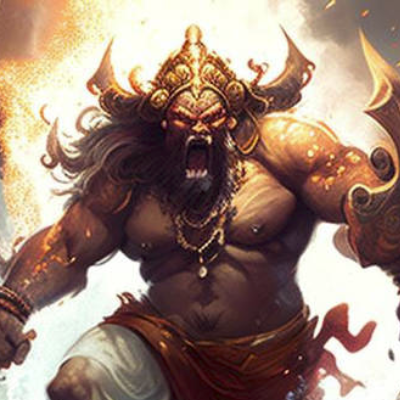
About
Vidyutjihva — Husband of Shurpanakha; and the Sorcerer of Ravana's Court
Vidyutjihva · Vidyujjihva · Vidyut Jihva · Dushtabuddhi (parallel name for the husband)
The name Vidyutjihva appears in the Ramayana tradition attached to two entirely distinct characters, operating in different textual strata and performing entirely different narrative functions. The first — the one most commonly referenced in secondary literature on the Pulastya genealogy — is Shurpanakha's husband, the Danava prince of the Kalakeya clan, whose marriage to Ravana's sister and subsequent death at Ravana's hands forms part of the backstory preserved in the Uttara Kanda. This character has no presence in the core six books of the Valmiki Ramayana. The second is a sorcerer in Ravana's service who appears in a specific episode of the Sundara Kanda, within the core epic, and who is explicitly attested by name in a primary-text passage preserved in the Sarama Wikipedia article's summary of the Sundara Kanda. Both characters share the same Sanskrit name; the Hindu Blog article on the husband explicitly flags this, noting "there is another character named Vidyut Jihva in Ramayana." The profile below treats both figures in sequence, giving each its proper textual location and the limits of what is actually recoverable about each.
✦ The Name
Vidyutjihva is a Sanskrit compound of vidyut (lightning) and jihva (tongue), meaning "lightning-tongued" or "he whose tongue is like lightning." This is a name with a strongly martial and supernatural register: lightning as the weapon of Indra and a metonym for divine destructive power; and tongue as the instrument of speech, spells, and sorcery. The name carries appropriate associations for both a Danava warrior-prince and a court sorcerer. The form Vidyujjihva (with the standard Sanskrit sandhi between vidyut and jihva) is found in the Wisdomlib definitions entry and in formal transliteration. The parallel name Dushtabuddhi — meaning "evil-minded" or "he whose intellect is crooked" — is given in some secondary accounts as either an alternative name or a secondary epithet for Shurpanakha's husband. The dollsofindia.com source uses both names, noting "She was married to Dushtabuddhi. Sometimes, he is also referred to as Vidyutjihva." Whether these are genuinely different names for the same person or two different textual traditions applying different names to the character is not established by any surviving primary passage.
✦ Figure I — Vidyutjihva, Husband of Shurpanakha
Lineage and identity: Vidyutjihva (in this identification) was a Danava prince of the Kalakeya clan. The Danavas are a race of supernatural beings descended from the union of the sage Kashyapa and his wife Danu, who is the mother of the Danavas as Aditi is the mother of the Adityas. The Kalakeyas are a specific sub-group among the Danavas, known in the tradition as fierce warriors. The Hindu Blog account of Vidyutjihva states that he was "the brother of Kalakeyas" — meaning he was kin to the Kalakeya clan leadership — and that he "fought several battles along with Ravana." This places him as an ally in Ravana's military campaigns against the gods, which is consistent with the pattern of Ravana assembling supernatural warriors from multiple races under his banner during his conquest of the three worlds. His given position in the tradition as a Danava prince is notable because the Danavas and the Rakshasas were traditional enemies: Ravana's fury at Shurpanakha's marriage is explicitly attributed to this enmity across all accounts.
Marriage to Shurpanakha: When Shurpanakha came of age, she fell in love with Vidyutjihva and married him secretly, without informing Ravana. The covert nature of the marriage is mentioned by the Wikipedia article on Shurpanakha ("secretly married"), the dollsofindia.com source, and by the creedthinker.blogspot summary. Ravana's reaction on discovering the marriage was fury: a Danava had married into the Rakshasa royal family, violating the line between two enemy races. He wished to punish Shurpanakha or dissolve the union. However, his wife Mandodari intervened, arguing that he should respect the wishes of his only sister. Kumbhakarna and Vibhishana also appealed for Shurpanakha's life, according to the Shurpanakha Wikipedia article. Ravana, overruled by these appeals, accepted the marriage and Vidyutjihva was tolerated as a member of the family — though the underlying hostility between Rakshasa and Danava remained.
Participation in Ravana's campaigns: The Hindu Blog account records that Vidyutjihva fought alongside Ravana and that "once aided by Vidyut Jihva, Ravana defeated Indra, the king of the Devas." This places Vidyutjihva as a military ally of practical value to Ravana's expansionist campaigns — the defeat of Indra was one of Ravana's most celebrated conquests. He was thus, briefly at least, a genuine asset to the Lanka war-machine despite the circumstances of the cross-lineage marriage that had produced the relationship.
Death at Ravana's hands: The circumstances of Vidyutjihva's death vary across the sources and are internally inconsistent. Three distinct accounts exist.
The first and most detailed account, drawn upon by the dollsofindia.com and detechter.com sources, states that during Ravana's conquest of Rasatala (the underworld), he visited his newly married sister and in her absence discovered that Vidyutjihva harboured a secret intention to kill him. Ravana attacked and killed Vidyutjihva in a deliberate act of self-preservation or pre-emption.
The second account, preserved in the manojbaitha.blogspot source, gives a different sequence: Ravana and Vidyutjihva began arguing during the visit, the argument escalated into a fight, and Ravana killed Vidyutjihva during that fight — making it a killing in anger or self-defence rather than a calculated pre-emptive act.
The third account, also in the Hindu Blog article, states that Vidyutjihva was accidentally killed during the campaign against Indra — that when Ravana defeated and killed the Kalakeyas who attempted to stop him on his return from heaven, Vidyutjihva, as the brother of the Kalakeyas, was killed in that engagement.
No primary-text passage has been identified that establishes which of these three variants represents the Uttara Kanda's actual account. All three belong to secondary sources of varying reliability. The common element across all versions is the fact of the death, the identity of the killer (Ravana), and the consequence (Shurpanakha's widowhood and her resulting grievance against her brother).
Aftermath: On learning of her husband's death and its cause, Shurpanakha was devastated. Multiple sources record that she could not forgive Ravana and spent extended periods away from Lanka, in the forests of southern India, living with her relatives Khara and Dushana at Janasthana. According to the vedicfeed.com account, Ravana, to console Shurpanakha after causing her widowhood, gave her permission to find another husband and promised that if anyone refused her proposal he would forcibly arrange the marriage — a promise with direct implications for the Panchavati episode. She had a son by Vidyutjihva, named Shambhri (or Shambhu Kumara), before his death.
Textual location: The entire backstory of this Vidyutjihva — his marriage to Shurpanakha, his role in Ravana's campaigns, his death, and his son Shambhri — belongs to the Uttara Kanda tradition. The Quora source on the killing of Vidyutjihva confirms that this episode is not found in the first six Kandas. The Uttara Kanda is regarded by scholars including Hermann Jacobi as a later addition to the core poem. No passage from a surviving primary text has been independently verified by citation in scholarly or critical editions.
✦ Figure II — Vidyutjihva, Sorcerer of Ravana's Court
The second Vidyutjihva is directly attested in the core Sundara Kanda. The Sarama Wikipedia article provides the clearest account, drawn from the Sundara Kanda's Maya-shirsha (illusory head) episode: "After Rama with his vanara army lands on Lanka, Ravana asks his magician Vidyujihva to create an illusory severed head of Rama and his bow to convince Sita of Rama's death. The magician complies and presents the head and bow to Sita in the Ashoka Vatika, where she is imprisoned. Sita laments in presence of Ravana seeing the head of her 'dead' husband." The deception is then exposed by Sarama, who had secretly witnessed the trickery and comes to console Sita after Ravana leaves, telling her that the head was a product of illusion and that Rama is in fact alive and has come to Lanka with his army.
This Vidyutjihva — the magician — performs a single function in the text: the creation of a convincing illusion to break Sita's resistance. He is Ravana's instrument of psychological warfare against his captive. The Hindu Blog article confirms this identification and distinguishes it from the husband of Shurpanakha: "He was a sorcerer and attendant of Ravana. He was deputed to make a head of Sri Rama and show it to Mata Sita at Ashokavana." The episode belongs to the Sundara Kanda, the fifth book of the Valmiki Ramayana and one of the core six books — making this Vidyutjihva, unlike his namesake, directly present in the primary text of the original epic.
Beyond this single episode, nothing is known about the sorcerer Vidyutjihva. He has no lineage stated, no further role in the narrative, and is not named in the Lanka war battles or the aftermath. He appears, performs his deception on Ravana's instructions, and exits the text. The Trijata Wikipedia article notes that in several later recensions and regional retellings of the Ramayana, the illusory head episode is reassigned to different characters — Trijata rather than Sarama becomes the one who comforts Sita and exposes the trickery — but the Sundara Kanda episode itself, with the magician Vidyutjihva, is present in the Valmiki core text. Whether the two occurrences of the name in the tradition — the husband and the sorcerer — reflect a single original figure who has been split into two roles across different textual strata, or whether they are genuinely independent characters who happen to share a name, cannot be determined from the available evidence.
✦ Lineage Summary (Figure I — Husband of Shurpanakha)
- Race: Danava — supernatural beings descended from Danu, the mother of the Danavas; a race in cosmic opposition to the Adityas (gods) and in traditional enmity with the Rakshasas
- Clan: Kalakeya — a specific warlike sub-group of the Danavas; described in the tradition as fierce and militarily capable; they attempted to stop Ravana during one of his campaigns and were destroyed by him
- Relationship to Kalakeyas: "Brother of the Kalakeyas" according to the Hindu Blog; possibly a senior kinsman or member of the same lineage group
- Wife: Shurpanakha — youngest daughter of Vishrava and Kaikesi; full sister of Ravana, Kumbhakarna, and Vibhishana; her birth name was Minakshi
- Son: Shambhri (also Shambhu Kumara) — accidentally killed by Lakshmana at an unspecified point; no further details available
✦ Significance in the Wider Narrative
The husband Vidyutjihva — whether that name is strictly accurate or a conflation with Dushtabuddhi — represents a specific type of figure in the Puranic tradition: the cross-lineage husband whose very existence creates an enmity between formerly allied powers. His marriage to Shurpanakha brought a Danava into the Rakshasa royal family at Lanka, in violation of the established hostility between the two races. His death by Ravana's hand — whatever the exact circumstances — created the wound in Shurpanakha that never healed, the widowhood and resentment that would drive her to the Dandaka forest and, eventually, to the encounter with Rama at Panchavati. In this indirect sense, Vidyutjihva is one of the most consequential background figures in the entire epic: without his death at Ravana's hands, Shurpanakha's approach to Rama has no context of unresolved grief and grievance, and the instigation of Ravana through Shurpanakha's report takes on a different character — pure desire rather than revenge weaponised as desire. The two readings are both present in the tradition, but the revenge-reading depends entirely on the backstory of Vidyutjihva's death.
The sorcerer Vidyutjihva serves a narrower function: he is the mechanism by which Ravana attempts to break Sita's resolve psychologically by making her believe Rama is dead. The attempt fails — Sarama exposes it almost immediately. But the episode reveals the range of weapons Ravana brings to bear against Sita during her captivity, moving from direct coercion to false news of Rama's death. The magician's compliant participation in this deception marks him as a figure of Ravana's court who served the king's wishes without moral compunction.
✦ Textual Variants and Inconsistencies
Vidyutjihva vs Dushtabuddhi: The dollsofindia.com source treats these as two names for the same person, noting the husband is "sometimes referred to as Vidyutjihva." The vedicfeed.com source uses Vidyutjihva consistently; the thehouseofram.com source uses Dushtabuddhi consistently. No source has identified a primary passage that uses both names together for the same character. Dushtabuddhi as a name means "evil-minded" and carries an implicit moral judgment — it may be an epithet applied by later tradition to characterise his plotting against Ravana rather than his birth-name. Vidyutjihva as a name is value-neutral and descriptive.
The three death accounts: As noted above, three mutually inconsistent accounts of the circumstances of the husband's death circulate in secondary literature. They agree on the fact of death and the identity of the killer, but differ on motive (pre-emption of conspiracy vs heat of argument vs accidental killing in battle), location (domestic visit vs battlefield), and agency (deliberate act vs defensive reaction vs mistake). None of these accounts has been verified against a primary-text passage.
Two Vidyutjihvas — same person or coincidental name-sharing: The Hindu Blog note that there are two characters named Vidyut Jihva in the Ramayana is the only source that directly addresses this nomenclatural collision. No scholarly discussion of whether the name was originally shared by a single figure who was later split into two roles, or whether two unrelated characters in different textual strata were independently given the same name, has been identified in the secondary literature surveyed here.
Textual location of the husband figure: The husband is absent from the core six books (Bala through Yuddha Kanda) of the Valmiki Ramayana. His backstory belongs to the Uttara Kanda tradition, which scholars consider a later addition. The sorcerer, by contrast, appears in the Sundara Kanda, one of the core six books and widely regarded as among the oldest and most stable portions of the text.
✦ References
Primary Sources
- Valmiki Ramayana, Sundara Kanda (Maya-shirsha episode): The primary source for the sorcerer Vidyutjihva; the Sarama Wikipedia article summarises the relevant Sundara Kanda passage in which Ravana commissions Vidyujihva to create an illusory head and bow of Rama to deceive Sita, the magician complies, the deception is presented to Sita in the Ashoka Vatika, and Sarama subsequently exposes it. This Vidyutjihva is in the core text.
- Valmiki Ramayana, Uttara Kanda: The presumed primary source for the husband Vidyutjihva, his Kalakeya lineage, his marriage to Shurpanakha, his participation in Ravana's campaigns, and his death at Ravana's hands; the Uttara Kanda is considered a later addition to the core poem by scholars including Hermann Jacobi. No specific sarga reference for the Vidyutjihva passage has been identified in this research.
Secondary and Reference Works
- Hindu Blog — "Story of Vidyujjihva, Husband of Surpanakha": The most substantive secondary source dedicated to the husband figure; records his Kalakeya lineage, his alliance with Ravana against Indra, the three variant accounts of his death, the son Shambhu Kumara, Ravana's consolation of Shurpanakha after the killing, and — critically — the explicit note that a second, unrelated character named Vidyut Jihva exists in the Ramayana as a sorcerer in Ravana's court.
- Wikipedia — Sarama (Ramayana) article: The clearest summary of the Sundara Kanda passage establishing the sorcerer Vidyutjihva; confirms his function as Ravana's magician in the Maya-shirsha episode; names him as Vidyujihva.
- Wikipedia — Shurpanakha article: Confirms the husband's identity as a Danava prince of the Kalakeya clan; records Mandodari's intercession to save the marriage; states that Shurpanakha secretly married him.
- Dollsofindia.com — "Surpanakha — Dreadful Demoness or Wronged Damsel?": Uses both names Dushtabuddhi and Vidyutjihva for the husband and records the detailed account of Ravana discovering the conspiracy and killing him during a visit to Rasatala; notes the son Shambhri.
- Detechter.com — "The Untold Story of Ravana's Sister Surpanakha": Gives the self-defence variant of the death — Vidyutjihva attacked Ravana, who killed him defensively.
- Manojbaitha.blogspot — "Why Did Surpanakha Want to Kill Her Brother Ravana?": Gives the argument-escalation variant of the death.
- Wisdomlib.org — definition of Vidyujjihva: Provides the Jain tradition's usage of the same name for a mountain of the Indras of the Anutvelhadharins in the Lavana Ocean — confirming that the name Vidyujjihva has a range of independent applications in the tradition beyond the two Ramayana figures.
- Quora — "Who was Vidyutjihva in the Ramayana?": Confirms the Kalakeya lineage and the son Shambhu Kumara.