
About
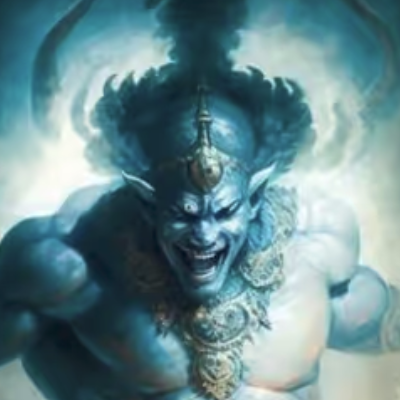
Mura (Danava) — General of Narakasura, Conqueror of the Devas, Slain by Krishna at Pragjyotisha, Whose Death Named Krishna Murari
Mura · Muru · Murāsura · Dānava · Kashyapa-putra · Danu-suta · Narakasura-senapati · Pragjyotisha-rakshaka · Murari-namahetu · Ahilawati-pita
Mura — also called Muru and Murasura — is a Danava of extraordinary power; the son of the sage Kashyapa and his wife Danu; the commander-in-chief (senapati) of the army of Narakasura, the demon king of the kingdom of Pragjyotisha (identified with the region of present-day Assam); and the father of Ahilawati (also known as Maurvi and Kamkanthika) — the wife of the Pandava warrior Ghatotkacha, son of Bhima. He received from Brahma the extraordinary boon of invincibility in battle against all beings including the devas; he defeated the Yakshas, the Gandharvas, and the devas themselves; he descended to Narakasura's service when he learned that Krishna — the incarnation of Vishnu — was about to attack Pragjyotisha; and he died fighting Krishna at the fortress of Pragjyotisha, struck down along with his seven sons by Krishna's bow and the Sudarshana Chakra. His death was the event that earned Krishna the celebrated epithet Murari — the killer of Mura, the enemy of Mura — one of Krishna's most widely used names across the devotional tradition. His story is narrated in the Vishnu Purana (Book 5, Chapter 29), the Bhagavata Purana (Skandha 10, Chapter 59), the Harivamsa (Harivamsha Parva, Chapter 63), the Mahabharata (Udyoga Parva, Chapter 48), and the Skanda Purana (Kaumarika Khanda) — the last of which provides the account of his daughter Ahilawati's subsequent narrative.
✦ The Name and Its Consequence
The Sanskrit name Mura — written Mura — is of uncertain primary etymology in the available sources; it may derive from the root mur or muru, connected with meanings of binding, encircling, or surrounding — consistent with his role as the master of the fortified defences of Pragjyotisha, whose stakes and traps surrounded Narakasura's city. The Wikipedia article on Mura (danava) records that his name is also spelled Muru in some texts. His most consequential legacy is not his own name but the name his death gave to Krishna: Murari — from mura and ari (enemy, foe, killer) — meaning the enemy of Mura, the one who killed Mura. This epithet is one of the most frequently used names of Krishna in devotional literature, Sanskrit hymns, the Vishnu Sahasranama, and in daily puja — making Mura's memory permanently embedded in the most common daily worship of the Vaishnava tradition. The Vishnu Purana and the Bhagavata Purana both use this epithet in their summaries of the Narakasura episode. The Wisdomlib source on the Vishnu Purana's account uses the precise formulation: there was an asura named Muru who had installed many sharp stakes around Naraka's city; and when Muru attacked him, Krishna killed Muru and his seven thousand sons with the chakra.
✦ Lineage
- Father: Kashyapa — the great Prajapati and universal progenitor; the son of the sage Marichi (himself one of Brahma's mind-born sons); who fathered all categories of beings through his many wives including the Daityas through Diti, the Danavas through Danu, the Adityas through Aditi, the Nagas through Kadru, and many others; Mura's birth through Danu makes him a Danava — a member of the clan descended from Danu — as distinct from the Daityas who descended through Diti; both Danavas and Daityas are collectively termed Asuras in the general usage of the tradition
- Mother: Danu — one of the daughters of the Prajapati Daksha and his wife Asikni; the mother of the Danava clan; whose children include Vritra, Namuchi, Shambara, Puloman, and other celebrated demon lords of the Vedic and Puranic tradition; Danu's maternal line makes Mura a Danava by birth in the same lineage as the other great Danavas who fought against the devas across multiple Puranic episodes
- Great-grandfather (paternal line): Marichi — one of the seven Saptarishis (seven great sages); born directly from Brahma's mind as one of his ten mind-born sons; who performed intense penance; from whose son Kashyapa all living beings descended
- Great-great-grandfather (paternal line): Brahma — the Creator; making Mura a descendant of Brahma through the Kashyapa-Marichi lineage; a divine genealogy that did not prevent Mura from becoming one of the most powerful opponents of the devas
- Maternal grandfather: Daksha — the Prajapati son of Brahma; who organised the famous yajna at which Sati self-immolated; the primordial authority from whom Mura's mother Danu received her name and lineage
- Sons: seven sons whose names are not individually recorded in the primary canonical texts; killed by Krishna along with Mura at Pragjyotisha; the Vishnu Purana records seven thousand sons in the conflict (a number that may reflect the entire Danava army under his command rather than individual biological sons); the Bhagavata Purana and the Sadhana Sansar source record seven sons specifically killed in the initial assault
- Daughter: Ahilawati — also called Maurvi (meaning daughter of Mura) and Kamkanthika; who attacked Krishna in grief and rage after her father's death at Pragjyotisha; who was protected by the goddess Kamakhya from Krishna's Sudarshana Chakra; who was persuaded by Kamakhya to surrender her anger; who made a vow to marry only the man who defeated her in intellectual debate and physical combat; who married Ghatotkacha (son of the Pandava Bhima and Hidimbi) after he defeated her in both tests; who became the mother of Anjanaparva, Meghavarna, and in the folk tradition Barbarika
- Liege lord: Narakasura — the demon king of Pragjyotisha; son of Bhudevi (the earth goddess) and the Varaha avatar of Vishnu in the primary tradition; who had stolen the divine umbrella of Varuna, the peak of Mount Mandara, and the earrings of the goddess Aditi; who had imprisoned sixteen thousand one hundred and eight women in his palace; who was killed by Krishna and Satyabhama in the same battle in which Mura died
✦ Mura's Origin and Rise — The Penance and the Boon
The Wikipedia article on Mura (danava) provides the fullest available account of his personal history before the battle of Pragjyotisha. In his youth Mura came across a heap of dead bodies of the Asuras and Danavas who had died in battle against the devas. The sight overwhelmed him — both with grief at the destruction of his people and with fear that he too would one day die in battle. This combination of grief and fear drove him to perform intense penance to propitiate Brahma, who was his great-grandfather through the Kashyapa-Marichi paternal line. Brahma appeared before him and offered a boon. Mura asked for invincibility in battle against all beings including the devas who were immortal — the ultimate protective boon, the same type sought by so many of the great Asuras and Danavas of the tradition. Brahma granted it. Armed with the boon of invincibility, Mura's character underwent the transformation typical of this narrative pattern in the Puranas: he became arrogant, maddened by the power the boon had given him. He defeated the Yakshas and the Gandharvas in battle. The Wikipedia source records: after attaining so much success he became extremely arrogant due to the power of his boons. Maddened with power he then went to Vaikuntha itself to challenge Vishnu — the ultimate statement of his arrogance, going to the source and foundation of all divine power to test his own invincibility against it. Upon arriving at Vaikuntha, however, he discovered that Krishna — the incarnation of Vishnu — had been born on earth and was already preparing to attack Pragjyotisha. Understanding that the confrontation he had sought was approaching regardless of where he went, Mura decided to descend to earth and place himself in Narakasura's service, thereby using his boon-given invincibility to protect Narakasura's kingdom from the imminent divine assault.
✦ The Fortification of Pragjyotisha
The Vishnu Purana's account of the assault on Pragjyotisha — paraphrased by the Wisdomlib source — records Mura's specific role in the fortress's defence. He installed many sharp stakes around Naraka's city. The Bhagavata Purana (Skandha 10, Chapter 59) elaborates this further: Pragjyotisha was described as a marvel of Asura engineering — guarded by mountains, girded with moats of fire and smoke, protected by mystical weapons and spells, and surrounded by a network of razor-sharp stakes installed by Mura. The Sadhana Sansar source, drawing from the Bhagavata Purana, records that the fortress was guarded by mountains of supernatural character, encircled with five layers of protective barriers including fire, water, and the Shataghni (the hundred-bladed weapon). Krishna's assault on this fortress began with the Sudarshana Chakra slicing off the protective stakes as he arrived on Garuda — dismantling Mura's defensive preparations one by one before Mura himself came forward to fight.
✦ The Battle and Death — Krishna's Sudarshana Chakra
When the outer defences of Pragjyotisha had been destroyed, Mura himself came forward with his seven sons to confront Krishna. The Bhagavata Purana (Skandha 10, Chapter 59) records the encounter with precision. The Vishnu Purana's account (paraphrased by Wisdomlib) records: when Muru attacked him, Krishna killed Muru and his seven thousand sons with the chakra. The Bhagavata Purana's more detailed account records that as Narakasura's general, the formidable Mura, rushed to meet him with seven sons at his side, with a sweep of his bow Krishna cut them down. One additional tradition recorded in the Wikipedia article on Mura (danava) states that Krishna slept in a cave to recover strength at one point during the battle; Mura found him sleeping there and attempted to kill him; a divine woman manifested from Krishna's sleeping form and fought Mura, eventually killing him — this variant makes Mura's death more complex than a simple battlefield encounter and is recorded in the Vishnu Purana's retelling. Krishna was so pleased with the divine woman — who had manifested from his own body to defeat the invincible Mura — that he granted her a boon; she asked to be remembered as his sister; Krishna agreed. From that day Krishna was called Murari — the killer of Mura — and the event was established as a cosmic milestone. The Bhagavata Purana and the Vishnu Purana both record the specific detail that gives the battle its theological punch: Mura had a boon of invincibility against all beings including the devas. Krishna — as an incarnation of Vishnu, as the supreme being himself — was not bound by the scope of the boon's protection, because Brahma's boon could not cover invincibility against the very source of all divine authority. The boon that protected Mura from everything else was precisely the thing that could not protect him from Krishna. This is the standard Puranic irony at the heart of all the invincibility-boon episodes: the boon grants protection from everything the recipient can imagine, but the recipient cannot imagine the form the supreme being will take when he comes to end the boon's utility.
✦ The Epithet Murari — Mura's Most Lasting Legacy
The most enduring consequence of Mura's existence in the tradition is not his battle, his boon, or his daughter, but the epithet his death gave to Krishna. Murari — the killer of Mura — is one of the most frequently used names of Krishna in the entire devotional tradition. It appears in the Vishnu Sahasranama, in the Bhagavata Purana's own titles for Krishna, in countless Sanskrit stotra (hymns of praise), in daily temple puja, in devotional poetry across every Indian language, and in the names of Krishna temples, gurukulas, and devotees across the subcontinent. The IndiafFacts source records that from the day of Mura's killing, Krishna earned the name Murari — the enemy of Mura. Every time a devotee calls on Krishna as Murari — which happens millions of times each day across the tradition's living worship — Mura's name is implicitly spoken. A Danava who sought invincibility from death achieved a peculiar immortality instead: his name is remembered every day across the tradition's most common devotional act, permanently attached to the name of the being who killed him.
✦ The Daughter — Ahilawati's Grief and the Story's Continuation
Mura's death is not the end of his family's canonical story — it is the beginning of Ahilawati's. The Skanda Purana (Kaumarika Khanda, Chapters 59–60) records that after Krishna killed Mura and Narakasura, Mura's daughter Kamakantaka (Ahilawati) attacked Krishna in grief and rage at her father's death, fighting valiantly with arrows, cutting off his own and striking even his mount Garuda. The battle continued for three days. When Krishna was about to kill her with the Sudarshana Chakra, the goddess Kamakhya appeared and placed Ahilawati under her divine protection — telling Krishna that this woman was protected and could not be killed. Kamakhya then approached Ahilawati and explained that her father's death had been inevitable and decreed by fate, that the grief of a daughter for a father was natural and honourable but that further fighting was futile. Ahilawati, understanding this, put down her weapons and bowed before Krishna. Krishna consoled her, promised that she would be well married, and kept that promise years later when he arranged her marriage to Ghatotkacha during the visit of the Pandavas to Indraprastha. Through this sequence Mura's story passes from the domain of demonic power and divine combat into the genealogy of the Pandava family: his daughter became the wife of Bhima's son and the mother of the warriors who fought on the Pandava side at Kurukshetra.
✦ References
- Bhagavata Purana (Skandha 10, Chapter 59 — the Narakasura Vadha) — the most detailed canonical account of Mura's role and death: the assault on Pragjyotisha; Mura's formidable defences of stakes and barriers; his coming forward with seven sons; Krishna killing him and his sons; Narakasura's subsequent battle and death at Satyabhama's hands; the epithet Murari
- Vishnu Purana (Book 5, Chapter 29) — the parallel account: Mura installing sharp stakes around Naraka's city; Mura attacking Krishna; Krishna killing Mura and his seven thousand sons with the chakra; the cave-sleeping variant in which a divine woman manifested from Krishna's body and killed Mura; Krishna granting her the boon to be remembered as his sister; the epithet Murari established
- Harivamsa (Harivamsha Parva, Chapter 63) — the earliest major account of the Narakasura episode including Mura's role as senapati; the precursor text to the Vishnu Purana and Bhagavata Purana elaborations
- Mahabharata (Udyoga Parva, Chapter 48) — Krishna killing Naraka recorded in summary; Mura as general confirmed in the broader epic context
- Skanda Purana (Kaumarika Khanda, Chapters 59–60) — Mura's daughter Kamakantaka (Ahilawati) attacking Krishna after her father's death; the goddess Kamakhya protecting her; Ahilawati's surrender; Krishna's promise of marriage; the lineage thread from Mura to Ahilawati to Ghatotkacha to Anjanaparva, Meghavarna, and Barbarika
- Wikipedia — Mura (danava) — the most comprehensive modern reference: Mura's birth through Kashyapa and Danu; his penance and Brahma's boon; his arrogance; his defeat of Yakshas and Gandharvas; his decision to serve Narakasura; the cave episode; the divine woman killing him; the Murari epithet; the daughter Ahilawati
- Wikipedia — Narakasura; Wisdomlib — The Killing of Narakasura (Vishnu Purana Book 5 Chapter 29); Glorious Hinduism — Narakasura; IndiaFacts — Krishna and Narakasura; Sadhana Sansar — The Legend of Narakasura of Pragjyotisha; Think Reload — Narakasura Downfall and the Origin of Diwali; Panjpedia — Narakasura: modern summaries drawing from the above primary sources