
About
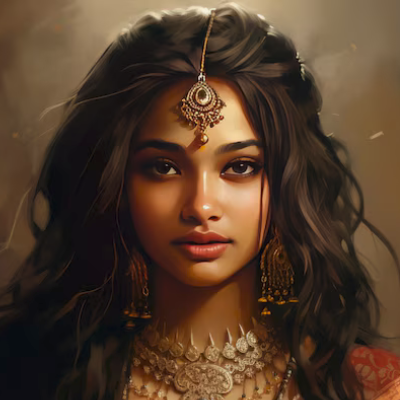
Minakshi — Daughter of Kubera and Bhadra, Princess of the Yaksha Realm
Minakshi · Minaksi · Meenakshi · Daughter of Vaisravana
Minakshi is named in the Puranic and epic tradition as the daughter of Kubera, the god of wealth and lord of the Yakshas, and his wife Bhadra, also known as Kauberi, Yakshi, Riddhi, and Charvi. Kubera is the divine treasurer of the gods, guardian of the northern direction, and sovereign over the semi-divine beings — the Yakshas, Guhyakas, Gandharvas, and Kinnaras — who inhabit the celestial city of Alaka in the Himalayan region. Bhadra is identified as a Yakshi, a female Yaksha, and as the daughter of the demon Mura. Minakshi's brothers are Nalakubara, Manigriva, and Mayuraja. She appears in the primary sources exclusively as a named member of Kubera's royal family. No independent narrative episodes concerning her are recorded in any surviving primary source, and her textual presence is confined to enumerative lists of Kubera's children found in the Puranas and in material associated with the Mahabharata. A significant point of caution applies to this figure: her name Minakshi is shared with the celebrated goddess of Madurai, who is a form of Parvati and the consort of Shiva, and who belongs to an entirely separate mythology and tradition. The two figures are distinct and must not be conflated.
✦ The Name
The name Minakshi is a Sanskrit compound formed from mina, meaning "fish," and akshi, meaning "eye." The name therefore means "she who has eyes like fish" or "fish-eyed," a designation that belongs to a well-established Sanskrit aesthetic convention in which large, wide, gently curved eyes are compared to the form of a fish. The same compound appears as an epithet applied to several female figures across different strata of the Sanskrit literary tradition, and its appearance as the personal name of Kubera's daughter is consistent with the broader Puranic practice of naming female figures of divine or semi-divine birth with names evoking natural beauty. The name does not carry any narrative significance in the surviving sources relating to this figure specifically.
✦ Lineage
- Father: Kubera — god of wealth and divine treasurer, lord of the Yakshas and guardian of the northern direction, son of the sage Vishrava and grandson of the Prajapati Pulastya; also known as Vaisravana, Dhanadhipati, Dhanada, Rajaraja, and Yaksharajan
- Mother: Bhadra — daughter of the demon Mura, a Yakshi and queen of the Yaksha realm; also known as Kauberi, Riddhi, Yakshi, and Charvi
- Brother: Nalakubara — eldest son of Kubera, whose name means "reed-axle"; a figure with an independent narrative tradition, husband of the Apsara Rambha
- Brother: Manigriva — son of Kubera, whose name means "bejewelled neck"; also referred to in some sources as Varna-kavi, meaning "colourful poet"
- Brother: Mayuraja — son of Kubera, whose name means "king of the Kinnaras" or "king of animals resembling men"; his identity as a separate individual from Nalakubara is disputed in certain textual streams
✦ Textual Variants and Inconsistencies
The primary textual issue surrounding this figure is the risk of confusion with the goddess Meenakshi of Madurai, who is worshipped at the great Meenakshi Amman Temple in Madurai, Tamil Nadu, and who is identified in that tradition as a form of Parvati, the consort of Shiva. The Meenakshi of Madurai belongs to a distinct body of Tamil Shaiva legend and is connected to the mythology of the Pandya king Malayadhvaja and his queen Kanchanamalai, who obtained her as a divine child. She has no genealogical connection to Kubera or to the Yaksha lineage. At least one modern secondary reference conflates these two figures by stating that Kubera's daughter Minakshi became a wife of Shiva, but this claim is not corroborated by any primary Puranic text and appears to result from the shared name being misapplied. No primary source supports the identification of Kubera's daughter Minakshi with the Madurai goddess or with any consort of Shiva.
A secondary textual variant concerns the enumeration of Kubera's children. The Mahabharata in certain passages names only Nalakubara as Kubera's son, making no reference to additional children. The fuller family list — including Manigriva, Mayuraja, and Minakshi — appears in the Puranic sources. This divergence reflects the broader pattern whereby the Mahabharata and the Puranas offer different accounts of Kubera's family, with the Puranic accounts generally being more expansive.
✦ Connection to the Wider Genealogy
Through her father Kubera, Minakshi belongs to a lineage descending from the Prajapati Pulastya, one of the mind-born sons of Brahma, the creator god. Pulastya's son Vishrava married Ilavida, also called Devavarnini, daughter of the sage Bharadvaja, and from this union Kubera was born. Vishrava subsequently took a second wife, Kaikesi, a Rakshasa princess, and from this union came four further children: Ravana, Kumbhakarna, Vibhishana, and Surpanakha. Ravana, the great antagonist of the Ramayana, is therefore the half-brother of Kubera and consequently the half-uncle of Minakshi. Through her mother Bhadra, daughter of the demon Mura, Minakshi also carries a descent from the Asura lineage on the maternal side. Her family thus spans the Yaksha, Rakshasa, and Asura orders of being, united through the sage Vishrava on her paternal line and through the demon Mura on her maternal line.
✦ References
Primary Sources
- Mahabharata: Names Kubera's family within the broader tradition of enumerating Yaksha genealogy; certain passages name only Nalakubara as Kubera's son, with the fuller list of children appearing in the Puranic tradition.
- Puranas (general): The fuller enumeration of Kubera's children including Minakshi as his daughter is preserved across several Puranas; the Wikipedia article on Kubera draws on this tradition, citing the Puranas and the Mahabharata as joint sources for the family list.
- Valmiki Ramayana: Does not name Minakshi directly but provides the genealogical and narrative framework of Kubera's family — including the half-sibling relationship with Ravana — that situates her within the wider lineage.
Modern Reference Works
- Wisdomlib (wisdomlib.org), "Minakshi — 13 definitions": Records Minakshi explicitly as the daughter of Kubera and his wife Bhadra; distinguishes her from the Meenakshi of Madurai by contextualising the entry within Vedic and Puranic genealogy.
- Wikipedia, "Kubera": Synthesises Puranic and Mahabharata material on Kubera's family, naming Minakshi as his daughter with the meaning "fish-eyed"; primary reference for the family enumeration used in this profile.
- Wikipedia, "Bhadra": Confirms the pairing of Bhadra and Kubera as parents of Minakshi alongside her brothers; provides information on Bhadra's identity as daughter of the demon Mura and as queen of the Yakshas.
- Vettam Mani, Puranic Encyclopaedia: Provides the Puranic genealogical framework for Kubera's family and lineage within which Minakshi appears as a named child.