
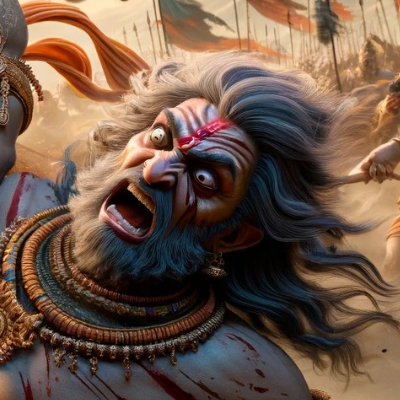
About
Vrishaparvan — Danava King, Son of Danu, Preceptor-Patron of Shukracharya, Father of Sharmishtha and Upadanavi
Vrishaparvan · Vṛṣaparvan · Vrishparva · Vrsaparvan · Danu-putra · Kashyapa-suta · Shukracharya-yajamana · Sharmishtha-pita · Upadanavi-pita · Hayashira-pita · Danava-raja
Vrishaparvan is a Danava king of great power; the son of Kashyapa (the universal Prajapati and father of all species) and his wife Danu (daughter of Daksha and Prasuti) — making him a Danava, not a Daitya; the Danavas being the children of Kashyapa through Danu, distinct from the Daityas who descended through Diti; the father of three daughters — Sharmishtha (who became the second wife of King Yayati and the mother of Druhyu, Anu, and Puru, through the last of whom all Kuru descendants including the Pandavas and Kauravas descended), Upadanavi (who married the king Surodha and bore the sons Dushyanta, Sushmanta, Pravira, and Anagha), and Hayashira; and the principal patron of Shukracharya — the preceptor of the Asuras, son of Bhrigu, the planet Venus — who served as his counsellor and chief priest. His canonical record spans the Mahabharata (Adi Parva), the Vishnu Purana (Book 1, Chapter 21), the Shiva Purana (Chapter 32), the Vayu Purana, and the Harivamsa — all of which confirm his identity as a Danava, son of Kashyapa and Danu, and father of Sharmishtha and Upadanavi. A textual note: Wikipedia and many secondary sources erroneously describe him as a Daitya king — he is correctly a Danava, born of Kashyapa and Danu, not of Kashyapa and Diti.
✦ The Name
The Sanskrit name Vrishaparvan — written Vṛṣaparvan — is a compound of vrisha (bull, the powerful male animal; also righteousness, virtue, rain-giver — from the root vrs, to rain, to pour forth) and parvan (a knot, a joint, a section; also a special occasion, a time of power, a moment of cosmic significance). The compound means the bull-jointed one, the one of the bull's power at the significant moment, or more abstractly the mighty one, the one of powerful joints and occasions. As a Danava king's name it records physical and martial power — the bull being the symbol of supreme force in the Vedic tradition.
✦ Lineage
- Father: Kashyapa — the universal Prajapati and sage; son of Marichi (one of Brahma's ten mind-born sons); who fathered all categories of beings through his many wives — the Adityas through Aditi, the Daityas through Diti, the Danavas through Danu, the Nagas through Kadru, and all other species through his other wives; the most comprehensive progenitor in the tradition
- Mother: Danu — daughter of Daksha (son of Brahma) and Prasuti (third daughter of Svayambhuva Manu); whose sons through Kashyapa are the Danavas — a distinct race from the Daityas (children of Diti) though both groups are collectively called Asuras in the broader tradition; whose children included Dwimurdha, Shambara, Taraka, Swarbhanu, Vrishaparvan, Puloma, Viprachitti, and many others
- Brothers: Dwimurdha, Shambara, Ayomukha, Shankushira, Kapila, Shankara, Ekachakra, Taraka, Mahabala, Swarbhanu, Puloman, and Viprachitti — all named in the Vishnu Purana (Book 1, Chapter 21) and Shiva Purana (Chapter 32) as sons of Danu and Kashyapa; the most celebrated brothers being Swarbhanu (whose daughter was Prabha and whose son Svarbhanu is associated with the eclipse-demon Rahu in some accounts) and Viprachitti (who married Simhika, sister of Hiranyakashipu, producing the Saimhikeyas including Rahu)
- Daughters:
- Sharmishtha — who became the maidservant of Devayani at Shukracharya's insistence after the well-throwing incident; who secretly married King Yayati of the Chandravamsha; who bore him three sons — Druhyu, Anu, and Puru; through Puru the entire Kuru-Paurava dynasty descended including the Pandavas and Kauravas; profiled separately in this series in the earlier Yayati section
- Upadanavi — who married the king Surodha (Santurodha) of the Puru dynasty; who bore him the sons Dushyanta, Sushmanta, Pravira, and Anagha; making Vrishaparvan the maternal grandfather of King Dushyanta — the husband of Shakuntala and the father of Emperor Bharata; profiled separately below
- Hayashira — named in the Vishnu Purana, the Mahabharata (Vyasaonline translation), and the Shiva Purana alongside Sharmishtha and Upadanavi as Vrishaparvan's third daughter; no personal episode or marriage is recorded for her in any primary canonical source
- Chief priest and preceptor: Shukracharya — son of Bhrigu and Kavyamata; the preceptor of the Asuras; possessor of the Mrita Sanjivani Vidya; who served as Vrishaparvan's counsellor, teacher, and sacrificial priest; whose departure threat — when Shukracharya was furious about Sharmishtha throwing Devayani into a well — forced Vrishaparvan to make all the concessions that defined the Devayani-Sharmishtha episode
✦ The Devayani-Sharmishtha Crisis — Shukracharya's Ultimatum
The episode that defines Vrishaparvan's place in the primary narrative is the crisis that followed the quarrel between Sharmishtha and Devayani at the forest pool. When the two young women accidentally exchanged saris and the ensuing argument ended with Sharmishtha throwing Devayani into a well, Devayani sent word to her father Shukracharya. Shukracharya arrived, heard his daughter's account, and declared he would abandon the Danava kingdom entirely — without its preceptor the Danava armies would be destroyed by the devas in every future battle, and the accumulated spiritual power of Shukracharya's protection would be withdrawn. For a king whose armies depended entirely on their priest's Mrita Sanjivani Vidya to revive the dead in battle, the prospect of Shukracharya's departure was existential. Vrishaparvan came to Shukracharya himself, prostrating before the sage and begging forgiveness. He offered whatever Devayani wished as restitution. Devayani demanded that Sharmishtha serve as her personal maidservant for life, together with a thousand other Danava women. Vrishaparvan agreed. He personally conveyed this demand to his daughter. Sharmishtha, recognising that her father's kingdom's survival required her compliance, accepted the humiliation for her people's sake. Vrishaparvan had sacrificed his daughter's royal status and dignity to keep his kingdom's preceptor — the most painful calculation a king can face.
✦ In the Danava Wars — Against Indra
The Mahabharata and the Puranas record Vrishaparvan as one of the principal Danava kings who fought many battles against Indra and the devas with the help of Shukracharya as his military-spiritual commander. With the Mrita Sanjivani Vidya available through Shukracharya — the power to revive Danava dead in battle while the devas' dead remained permanently dead — the Danavas under Vrishaparvan had a significant tactical advantage. The Religion Fandom source confirms: he fought many wars with Indra with the help of his main priest Shukracharya and made many attempts to kill Kacha, the son of Brihaspati. The attempts on Kacha's life were the Danavas' effort to prevent the devas from obtaining the Sanjivani Vidya through Kacha's education under Shukracharya — recognising that if the devas' side acquired the revival power, the Danavas' battlefield advantage would be neutralised.
✦ Genealogical Significance — Ancestor of Two Great Royal Lines
Through his two daughters Sharmishtha and Upadanavi Vrishaparvan became the Danava ancestor of two of the most important royal lineages in the Mahabharata tradition. Through Sharmishtha's sons by Yayati — specifically through Puru — he is the maternal great-grandfather of the entire Kuru-Paurava dynasty: Dushyanta, Shakuntala, Bharata, the Kuru kings, Shantanu, Dhritarashtra, Pandu, the Pandavas, and the Kauravas all carry Vrishaparvan's Danava blood through Sharmishtha's line. Through Upadanavi's son Dushyanta — and through Dushyanta's son Bharata — the same Danava blood flows into the Paurava royal line through a second channel. The Danava king who could not control his daughter's quarrel at a forest pool became, through the chain of events that followed, the ancestor of both great armies at Kurukshetra.
✦ References
- Vishnu Purana (Book 1, Chapter 21 — Wisdomlib translation and Sacred Texts translation) — the primary canonical genealogical source: Vrishaparvan named as a son of Danu and Kashyapa among the renowned Danavas; Sharmishtha, Upadanavi, and Hayashira named as his three daughters
- Shiva Purana (Chapter 32, Verses 29–30) — the parallel account: Vrishaparvan as a son of Danu; his three daughters Sharmishtha, Upadanavi, and Hayashira confirmed
- Mahabharata (Adi Parva — the Devayani-Sharmishtha-Yayati narrative; Vyasaonline translation) — Vrishaparvan as Danava king; Shukracharya his counsellor; the well incident; his prostration before Shukracharya; his concession of Sharmishtha as Devayani's maidservant; Upadanavi and Hayashira named as his daughters alongside Sharmishtha
- Hindupedia — Danava — the Vayu Purana listing of the most prominent Danavas including Vrsaparva; the canonical confirmation of his Danava identity
- Religion Fandom — Vrishparva; Wikipedia — Sharmishtha; Wikipedia — Devayani; Indianpuranas.blogspot — Lineage of Kashyapa's Other Wives; Vishnu-purana.blogspot — Vishnupuran Lineage of Kashyap's Other Wives: modern summaries drawing from the above primary sources