
About
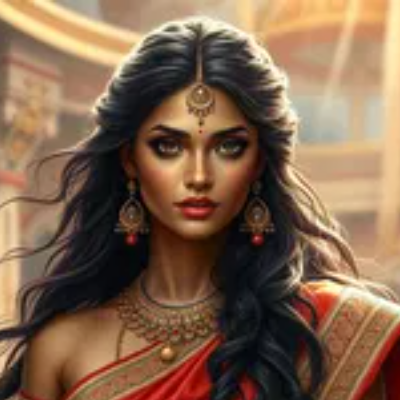
Sharmishtha — Daughter of Vrishaparvan the Danava King, Maidservant Who Became a Wife, Mother of Puru, Ancestor of the Kuru Dynasty
Sharmishtha · Śarmiṣṭhā · Vrishaparvan-putri · Danu-pautrī · Devayani-dasī · Yayati-patni · Druhyu-mata · Anu-mata · Puru-mata · Kuru-vamsha-pitamahi · Pandava-Kaurava-prapitamahi
Sharmishtha is the daughter of Vrishaparvan — the Danava king, son of Kashyapa and Danu — and the sister of Upadanavi (mother of King Dushyanta) and Hayashira; the former princess who became the personal maidservant of Devayani (daughter of Shukracharya) as a consequence of the well-throwing incident; the secret second wife of King Yayati of the Chandravamsha — in violation of Shukracharya's explicit condition — and the mother of Druhyu, Anu, and Puru; and through Puru — who alone gave his youth to his father Yayati and was designated heir-apparent — the ancestral great-grandmother of the entire Kuru-Paurava dynasty from which both the Pandavas and the Kauravas descended. Her story is narrated in the Mahabharata's Adi Parva (Chapters 76–88, the Sharmishthopakhyana and the Yayati narrative) and the Bhagavata Purana (Canto 9, Chapters 18–19). She is one of the tradition's most psychologically layered figures — a princess who accepted humiliation for her father's kingdom, a maidservant who fell in love with her mistress's husband, a mother whose youngest son gave the Kuru dynasty its founding ancestor, and a woman who argued at the moment of discovery that she had acted by dharma and was not ashamed. She accompanied Yayati to the forest at the end of his life and all three — Yayati, Devayani, and Sharmishtha — retired together.
✦ The Name
The Sanskrit name Sharmishtha — written Śarmiṣṭhā — is a compound of sharma (happiness, shelter, protection, bliss) and the superlative suffix ishtha (the most, the greatest). The compound means the most happy one, she of the greatest bliss, the supreme shelter. As a name given to a Danava king's daughter it records her status at birth — the one who was to be the repository of greatest happiness and shelter in her father's household. The arc of her life — from princess to maidservant to secret wife to ancestor of the greatest dynasty — takes the name's superlative quality and subjects it to every possible reversal before ultimately vindicating it: her son Puru's dynasty was indeed the greatest, and her descendants eventually sheltered the entire tradition's central narrative.
✦ Lineage
- Father: Vrishaparvan — Danava king; son of Kashyapa and Danu; patron of Shukracharya; who sacrificed his daughter's royal dignity to keep Shukracharya's protection; profiled separately in this series
- Paternal grandfather: Kashyapa — the universal Prajapati; father of all species
- Paternal grandmother: Danu — daughter of Daksha; mother of the Danava race
- Sisters: Upadanavi — mother of King Dushyanta; profiled separately in this series; and Hayashira — profiled separately below
- Childhood companion turned mistress: Devayani — daughter of Shukracharya and Jayanti; the woman who had Sharmishtha made her maidservant; whose husband Yayati Sharmishtha secretly married; whose discovery of the affair ended the household arrangement and led to Shukracharya's curse on Yayati
- Husband: Yayati — second son of Nahusha; king of the Chandravamsha; who had been forbidden by Shukracharya to share a bed with Sharmishtha as a condition of his marriage to Devayani; who violated that condition; who was cursed with premature old age when the violation was discovered; who recovered his youth through Puru's gift; who ruled for a thousand more years before retiring
- Sons: Druhyu — whose descendants became the Gandharas, the Balhikas, and several north-western peoples; Anu — whose descendants included the Angas, Vangas, Kalingas, and Madras; and Puru — the youngest; who alone gave his youth to Yayati; who was designated heir-apparent; whose dynasty produced Hastin (founder of Hastinapura), Kuru (of Kurukshetra), Shantanu, Dhritarashtra, Pandu, the Kauravas, and the Pandavas
- Genealogical significance: through Puru → Janamejaya → ... → Kuru → Shantanu → Pandu → the five Pandavas; and through Puru → Kuru → Dhritarashtra → the hundred Kauravas; Sharmishtha is the Danava-lineage ancestral mother of every warrior on both sides of the Kurukshetra War
✦ The Quarrel and the Well — The Princess Becomes a Maidservant
Sharmishtha and Devayani were close friends and companions in their fathers' adjoining households — Vrishaparvan the Danava king and Shukracharya his preceptor lived in proximity, and their daughters had grown up together. One day the two young women went to a park with their attendants and bathed in a lake. A strong wind blew their garments from the banks into a heap. In the confusion of retrieving their clothes Sharmishtha accidentally put on Devayani's sari — the princess putting on what belonged to the preceptor's daughter. Devayani was furious and insulted her: like a dog eating the offering meant for the sacred fire, she had taken what was not hers; the daughter of the servant-preceptor had no right to wear the clothes of the king's daughter; her father was a mere hired chanter who lived on the king's charity. Sharmishtha, stung beyond control by the comparison of Shukracharya to a dog-thief, retaliated in kind — she threw Devayani into the well and returned to the palace with her attendants.When Shukracharya learned of this he announced he would leave the Danava kingdom entirely. Without his Mrita Sanjivani Vidya the Danava armies were doomed against the devas. Vrishaparvan came to Shukracharya in person and prostrated before him. Shukracharya said he would stay only if Devayani's demands were met. Devayani demanded that Sharmishtha serve as her personal maidservant for life — a princess enslaved to a preceptor's daughter — together with a thousand Danava women as attendants. Vrishaparvan accepted. He went to Sharmishtha and asked her to comply for the kingdom's sake. The Mahabharata records Sharmishtha's acceptance without drama: she agreed, recognising that the kingdom's welfare required her sacrifice. The princess became a maidservant. The tradition records this as both a humiliation and a statement of character — only a person of unusual self-possession can accept such a reversal with the equanimity Sharmishtha displayed.
✦ The Secret Marriage — Dharma as Justification
After Devayani's marriage to Yayati, Sharmishtha accompanied her to the Chandravamsha palace as her maidservant. Yayati had been explicitly forbidden by Shukracharya from having any nuptial relations with Sharmishtha. For some time the arrangement proceeded without incident. Yayati tended to Devayani's needs, erected a special mansion for Sharmishtha near the Ashoka woods in his gardens, and ensured she had everything she required — but remained faithful to his promise.Then Sharmishtha's own need for a child became urgent. She was watching her youth pass while Devayani bore sons and the prospect of motherhood moved further from her. She approached Yayati in the Ashoka garden and stated her desire directly — she wanted a child. Yayati reminded her of Shukracharya's prohibition. Sharmishtha's response was a precise dharmic argument: a king's duty is to fulfil the needs of those under his protection; she had come to him not out of lust but out of the dharmic need for a child; refusing her would itself be adharma. She also argued that a friend's husband is, by the custom of the time, also in some sense one's own — since she and Devayani had been friends before the quarrel and their relationship was still connected by circumstance. Yayati was moved by the argument and by his own attraction to her. He agreed. They began their relationship. Eventually Sharmishtha bore three sons — Druhyu, Anu, and Puru.When Devayani learned of the affair — by observing her children's affection for Yayati when Devayani encountered them in the park, and then confronting Sharmishtha directly — Sharmishtha did not deny anything. She stated clearly: I told you it was a sage well-versed in the Vedas who granted my wish; I acted in accordance with virtue and do not fear you; when you chose Yayati as your husband I chose him as mine; a friend's husband is one's own husband. The Mahabharata preserves this as Sharmishtha's moment of complete self-possession — the woman who had accepted the role of maidservant without complaint now stated her position with equal clarity: she had acted by dharma and had nothing to apologise for.
✦ Puru's Devotion and the Dynasty
When Shukracharya's curse struck Yayati with premature old age, the king asked each of his five sons to give him their youth. All refused except Puru — Sharmishtha's youngest son — who alone agreed without hesitation. The Mahabharata records Puru's statement: he was fortunate to have this rare chance to repay his father; by pleasing his father he would earn the greatest good. Yayati received Puru's youth and lived another thousand years. At the end of those thousand years he returned Puru's youth, gave him the kingdom and named him heir, and retired to the forest with both Devayani and Sharmishtha. Puru's dynasty — the Paurava vamsha — from which the entire Kuru dynasty descended — was thus the gift of Sharmishtha's youngest son, the product of the forbidden love that Sharmishtha justified by dharmic argument.
✦ References
- Mahabharata (Adi Parva, Chapters 76–88 — the Sharmishthopakhyana and the Yayati narrative) — the primary canonical source: the quarrel and the well-throwing; Shukracharya's threat to leave; Vrishaparvan's prostration; Devayani's demand for Sharmishtha as maidservant; Sharmishtha's acceptance; the marriage with Devayani; the secret meetings with Yayati; Sharmishtha's dharmic argument; the three sons; the discovery; Shukracharya's curse; the youth exchange with Puru; the forest retirement of Yayati, Devayani, and Sharmishtha together
- Bhagavata Purana (Canto 9, Chapters 18–19) — the parallel Puranic account; Sharmishtha's role confirmed; Puru designated as heir
- Vishnu Purana (Book 1, Chapter 21) — Sharmishtha named as a daughter of Vrishaparvan the Danava alongside Upadanavi and Hayashira
- Wikipedia — Sharmishtha; Jatland Wiki — Sharmishtha; VenuPayyanur.com — Yayati, Devayani and Sharmishtha; DivinLeelas — Yayati and Devayani; Medium — Sarmishtha the Other Woman; Wisdomlib — Mahabharata Section LXXXI: modern summaries drawing from the above primary sources