
About
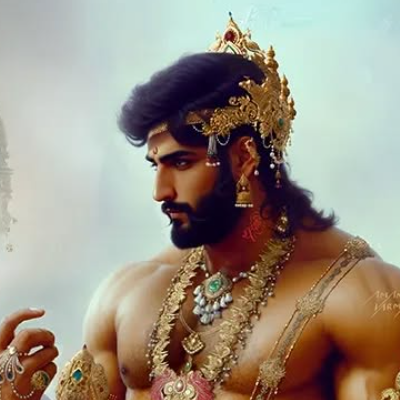
Yayati — Universal Emperor, Progenitor of the Yadavas and Pauravas, King Cursed with Premature Old Age
Yayati · Yayāti · Nahusha-putra · Chakravarti · Devayani-pati · Sharmishtha-pati · Yadu-pita · Puru-pita · Chandravamsha-samrat · Vriddhayauvanasambhogi
Yayati is the second son of Nahusha and Viraja (Harivamsa) or Ashokasundari (Padma Purana); a Chakravarti — a universal emperor who conquered the earth spanning seven continents; the husband of Devayani (daughter of Shukracharya, the divine preceptor of the Asuras) and Sharmishtha (daughter of the Daitya king Vrishaparvan); and the father of five sons — Yadu, Turvasu, Druhyu, Anu, and Puru — who became the founding ancestors of the five great racial branches of the Indian subcontinent. Through Yadu the Yadava dynasty descended — culminating in Krishna, Balarama, and the entirety of the Vrishni and Bhoja clans. Through Puru the Paurava dynasty descended — culminating in Bharata, Kuru, Shantanu, Dhritarashtra, Pandu, and ultimately the Pandavas and Kauravas of the Mahabharata. Through Turvasu descended the Yavanas; through Druhyu the Bhojas, Gandharas, and others; through Anu the Mlechhas and the Madras. Yayati is thus the single genealogical node through whom the entire human history of the Mahabharata — every major dynasty, every protagonist, every antagonist — descends from a common ancestor. His personal story — the love triangle of Devayani, Sharmishtha, and himself; the curse of premature old age; the borrowing of his son Puru's youth; the thousand years of sensory indulgence; and the final recognition of desire's futility and his voluntary renunciation — is the Mahabharata's foundational meditation on the insatiability of sensory desire and the inevitability of detachment as the only path to wisdom. His story is told in the Mahabharata's Adi Parva (Sambhava Parva, Chapters 70–88) and in the Bhagavata Purana (Canto 9, Chapters 18–19).
✦ The Name
The Sanskrit name Yayati — written Yayāti — is ancient and of uncertain ultimate etymology; it appears in the Rigveda and is one of the oldest royal names in the tradition. The Wisdomlib and Wikipedia sources do not record a specific Sanskrit derivation for the name in the available sources. The epithet Chakravarti — the wheel-turner, the universal sovereign — is applied to him throughout the tradition, recording his conquest of the entire earth. In modern usage the term Yayati Syndrome has entered psychological and management vocabulary to describe the exchange of long-term responsibility for short-term gratification — trading conscientious behaviour for external gain — named for Yayati's exchange of old age for his son's youth. V.S. Khandekar's Marathi novel Yayati (1960), which won the Sahitya Akademi Award and the Jnanpith Award (1974), and Girish Karnad's debut play Yayati (1961) are the most celebrated modern literary retellings.
✦ Lineage
- Father: Nahusha — already profiled above; king of Pratishthana; temporary ruler of Svarga; cursed to serpent form by Agastya; released by Yudhishthira
- Mother (Harivamsa tradition): Viraja — mind-born daughter of the Pitrs; also called Su-Swadha
- Mother (Padma Purana tradition): Ashokasundari — daughter of Shiva and Parvati; already profiled in this series
- Elder brother: Yati — who was given the throne first but renounced it entirely to become an ascetic, attaining Brahma-realisation; whose abdication caused Yayati to inherit the kingdom
- Other brothers: Samyati, Ayati, Dhruva (Mahabharata) or Pancika and Suyati (Harivamsa); all described as possessed of Indra-like splendour
- First wife: Devayani — daughter of Shukracharya and Jayanti (daughter of Indra); the Brahmin's daughter who came to Yayati through a remarkable sequence of events involving Sharmishtha, a well, a rescue, and her father's arrangement; mother of Yadu and Turvasu; and in the Mahabharata tradition of Madhavi (a daughter given by Yayati to the sage Galava as dakshina — a deeply ambiguous episode in the text)
- Second wife (unofficial consort first, later acknowledged): Sharmishtha — daughter of the Daitya king Vrishaparvan; who had been Devayani's closest friend before becoming her maidservant as a result of the well incident; who came to live in Yayati's palace as Devayani's servant; who secretly became Yayati's mistress; mother of Druhyu, Anu, and Puru
- Sons and their dynastic significance:
- Yadu (eldest son; by Devayani) — ancestor of the Yadava dynasty; through the line Yadu — Kroshthu — ... — Shura — Vasudeva — Krishna; also ancestor of Sahasrabahu Kartavirya Arjuna and the Haihaya kingdom; cursed by Yayati never to be a king, but granted the boon that the supreme Lord Narayana would be born in his dynasty
- Turvasu (second son; by Devayani) — ancestor of the Yavanas; also the Tusharas, Dravidas, and Sibi-Usinara branches per the Bhagavata Purana and the list of Puru and Yadu dynasties Wikipedia article
- Druhyu (third son; by Sharmishtha) — ancestor of the Bhojas; also the Gandharas (ancestor of Shakuni's people) and the Tripura-Twipra kingdom tradition
- Anu (fourth son; by Sharmishtha) — ancestor of the Mlechhas; also the Madras, Kekayas, Ushinara, and Shibi branches; Shibi is recorded as the son of Usinara who was Anu's descendant
- Puru (youngest son; by Sharmishtha) — who alone gave his youth to his father; who received Yayati's blessing and was made the principal heir; ancestor of the Pauravas; through Puru — Janamejaya — ... — Kuru — ... — Shantanu — Bhishma; and through Pandu — the five Pandavas; and through Dhritarashtra — the hundred Kauravas; the entire central genealogy of the Mahabharata flows from Puru's filial devotion
- Daughter (Mahabharata, Udyoga Parva — Madhavi episode): Madhavi — given by Yayati to the sage Galava as dakshina when Galava asked for eight hundred white horses each with one black ear; Yayati had no such horses and offered his daughter instead; Madhavi was passed to four different kings in succession, each bearing her a son in exchange for two hundred horses each; the four sons she bore — Vasumanas, Pratardana, Shibi, and Ashtaka — became famous kings in their own right; after fulfilling her role Madhavi returned to Galava, who presented her to her father; she then chose the forest over marriage at her own svayamvara
✦ The Devayani Episode — The Well, the Rescue, and the Marriage
The episode that brought Yayati into contact with Devayani began at the court of the Daitya king Vrishaparvan, where Shukracharya served as the royal preceptor. Sharmishtha — the king's daughter and Devayani's closest friend — accidentally wore Devayani's sari when the two young women bathed together in a forest pool and their clothes were scattered by the wind. In the quarrel that followed, harsh words were exchanged; Sharmishtha, stung by Devayani's cutting remarks about their respective fathers, struck her and threw her into an empty well, departing with her retinue and leaving Devayani trapped. Yayati, who happened to be hunting in the forest, came upon the well, discovered Devayani, drew her out, and heard her story. He returned to his kingdom; Devayani sent her maid to her father with the news; Shukracharya was furious; to avoid his departure from the court — which would mean the Daityas losing their most important protector — Vrishaparvan allowed Devayani the remarkable demand that Sharmishtha and a thousand of her maids become Devayani's servants for life. Sharmishtha accepted the humiliation to protect her father's kingdom. She would accompany Devayani wherever she went — including into Yayati's palace after the marriage. Some time after this incident, Yayati met Devayani again in the forest. They fell in love. Yayati asked Shukracharya for her hand; Shukracharya gave his consent readily but imposed one condition as part of the marriage agreement: Yayati was not to take Sharmishtha to his bed. Yayati agreed. The two married. Devayani moved to Yayati's palace; Sharmishtha followed as her maidservant, bringing her thousand companions. Devayani bore Yadu and Turvasu to Yayati.
✦ The Sharmishtha Affair — The Secret Children
Sharmishtha, living as a maidservant in Yayati's palace, saw her former equal — now her mistress — flourishing as queen, bearing royal sons, enjoying the full dignity of married life. She herself was beautiful, a princess by birth, a woman of full human desire. She saw Yayati. She fell in love with him. She went to him and asked him to give her a child, arguing with considerable sophistication that it was a king's duty to address the legitimate needs of the citizens living within his kingdom, and that she too was within his protection. Yayati, attracted to her and weakened by her arguments, was also aware that accepting her request violated his explicit promise to Shukracharya. But the desire was stronger. He began a secret affair with her. Sharmishtha bore him three sons over the years — Druhyu, Anu, and Puru. The secret was maintained for some time. Eventually Devayani discovered it. She left the palace in distress and went to her father.
✦ The Curse — Premature Old Age
Shukracharya, hearing his daughter's account of Yayati's violation of the explicit condition of the marriage, was furious. The violation was not merely personal — it was a direct breach of a promise made to a Brahmin sage, which carried cosmic weight. He cursed Yayati with immediate and premature old age: in an instant the powerful, vigorous universal emperor was transformed into a decrepit old man. Yayati begged for mercy. Shukracharya, moved by his daughter's own partial relenting — she still loved her husband despite his betrayal — agreed to modify the curse rather than revoke it entirely: if Yayati could persuade one of his sons to exchange youth for old age, he would be able to enjoy life for longer before returning to his aged state at the end of the exchange.
✦ The Youth Exchange — The Five Sons and Puru's Gift
Yayati summoned each of his five sons in turn. To each he made the same request: give me your youth and take my old age; rule the kingdom in the interim; when I am done I will return it. Yadu, the eldest, refused — this violated the natural order; a son should not bear the decrepitude of his father's body while the father enjoyed the son's youth. Turvasu refused — he was too attached to his own pleasures. Druhyu refused. Anu refused. Each refusal brought Yayati's curse on the son's dynastic prospects — the descendants of those who refused would not hold sovereign power or would be diminished in the cosmic order. Only Puru — the youngest, born of Sharmishtha — agreed without hesitation. He accepted his father's aged body into himself and gave Yayati his youth. Yayati made him the heir to the central kingdom. With Puru's youth in his body, Yayati lived another thousand years in the full enjoyment of every sensory pleasure available in the three worlds. He had at his disposal everything that a sovereign with unlimited resources could desire — every kind of food, music, dance, fragrance, physical pleasure, wealth, and spectacle. At the end of a thousand years he reached the famous realisation — stated in the Mahabharata with great directness — that desire cannot be satisfied by satisfying it; that each satisfaction generates a greater desire rather than reducing it; that the only resolution of desire is not its fulfilment but its transcendence. He called Puru, returned his youth with his blessings, publicly declared him the legitimate heir to the throne and the continuation of the dynasty, and departed for the forest to perform tapas and penance.
✦ Division of the Empire and Renunciation
The Harivamsa records Yayati's division of the empire with geographic precision. After conquering the earth spanning seven continents, he divided it into five zones for his five sons: Turvasu received the south-eastern province (Agneya); Druhyu received the north; Anu received the west; Yadu received the north-eastern province (Ishanya); and Puru received the central kingdom, which was the most important — the heartland, the zone of sovereignty. This division is the founding act of the five great racial and dynastic branches of the subcontinent. After making these arrangements, Yayati returned Puru's youth, crowned him over the central kingdom, and went to the forest with his two wives. He performed intense tapas on the slope of Brighu (Mount Bhrigu) per the Mahabharata and eventually attained Svarga. The Mahabharata records that he ascended to heaven along with his two wives.
✦ Yayati's Achievements
The Mahabharata records the scale of Yayati's sacrificial achievements in terms of sheer number: he performed a hundred Rajasuyas, a hundred Ashvamedhas, a hundred Vajapeyas, a thousand Atiratras, a thousand Pundarikas, and innumerable Agnishthomas and Chaturmasyas. Wherever he hurled a Shami stick, he performed a sacrifice. He gave away mountains of gold and billions of cows to Brahmins. He was one of the most prolific performers of Vedic ritual in the entire tradition — and yet this extraordinary accumulation of merit was not able to save him from the consequences of his violation of dharmic duty toward Shukracharya, just as his father Nahusha's extraordinary merit had not saved him from the consequences of striking Agastya. The tradition uses the father-son pair of Nahusha and Yayati as mirror images of this principle: extraordinary accumulated merit does not exempt a king from the consequences of a single act of adharma.
✦ Theological and Philosophical Significance
Yayati's story carries several simultaneous layers of theological meaning. At the level of dharma it is a straightforward record of consequence: a broken promise to a Brahmin sage carries cosmic weight regardless of extenuating circumstances, and the consequence — though mitigated by Shukracharya's partial mercy — is not avoided. At the level of desire and renunciation it is one of the Mahabharata's most concentrated statements that desire cannot be satisfied by indulgence — the famous formulation that a fire does not go out when fuel is added to it — and that wisdom comes only from the exhaustion and transcendence of the desire-cycle rather than from its fulfilment. At the genealogical level it is the branching point from which the five races of the subcontinent descend, and at its centre is the episode of filial devotion that determines which branch will carry the tradition's sacred lineage: Puru's willingness to bear his father's burden elevated him morally and historically, making his descendants — the Pauravas — the central dynasty of the Mahabharata while the descendants of the four who refused were pushed to the periphery of the cosmic order. At the literary level, Yayati's story is the Mahabharata's opening philosophical statement — told before the main story of the Pandavas and Kauravas begins — establishing the themes of desire, duty, time, and renunciation that will pervade the entire epic.
✦ References
- Mahabharata (Adi Parva, Sambhava Parva, Chapters 70–88) — the foundational canonical account: Yayati as second son of Nahusha; his accession after Yati's renunciation; the Devayani-Sharmishtha incident and the well; the marriage to Devayani; Shukracharya's condition; the secret affair with Sharmishtha; the birth of the five sons; Devayani's discovery; Shukracharya's curse; the youth exchange; the thousand years; the realisation; Puru's coronation; the forest; the ascent to Svarga; the division of the empire by the five sons
- Mahabharata (Udyoga Parva — the Madhavi-Galava episode) — Yayati giving his daughter Madhavi as dakshina to the sage Galava; the four kings; the four sons born; Madhavi's return and svayamvara; one of the most ethically complex episodes connected to Yayati's lineage
- Bhagavata Purana (Canto 9, Chapters 18–19) — the most complete Puranic retelling of the Yayati story; the philosophical dialogue on desire added; the genealogy of all five sons and their dynastic branches
- Harivamsa (Harivamsha Parva, Chapter 30) — the geographic division of the empire; the five provinces assigned to the five sons; Viraja as Nahusha's wife and mother of Yayati; the full Chandravamsha genealogy from Vishnu to Krishna through this line
- Matsya Purana and Brahmanda Purana — parallel accounts of the Yayati story; the curse; the exchange; the five dynasties
- Wikipedia — Yayati; Wikipedia — Devayani (Hindu mythology); Wikipedia — List of Puru and Yadu Dynasties; Mythlok — Curse of Borrowed Youth Yayati and the Price of Desire; JKYog — Yayati Story of the King and His Insatiable Desire; Amrit Katha — Yayati A Story of Insatiable Lust; HinduTsav — Story of King Yayati; Ankita Sharma Substack — Episode 2 Yayati and His Children; Mahabharata the Story blogspot — Adi Parva Yayati; Sarmishtha the Other Woman (Manjula Tekal Medium): modern summaries drawing from the above primary sources