
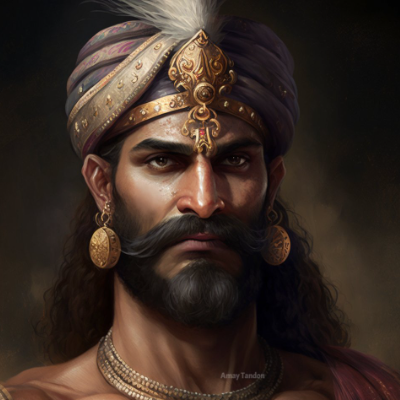
About
Yadu — Founder of the Yadava Dynasty, Eldest Son of Yayati, Forefather of Krishna
Yadu · Yadū · Yaduvansha-sthapaka · Yadava-pitamaha · Devayani-suta · Yayati-putra-jyeshtha · Krishna-purvajanaka
Yadu is the eldest son of Yayati and his first wife Devayani (daughter of Shukracharya); the founder of the Yadava dynasty — the Yaduvansha — the most celebrated lineage of the Chandravamsha after the Paurava-Kuru branch; and the forefather through whom Krishna, Balarama, Sahasrabahu Kartavirya Arjuna, and the entire confederacy of Yadava clans descend. He is one of the five Vedic tribes — the Panchjanya — mentioned in the Rigveda, and his name is so dominant in the tradition's genealogical memory that the entire Lunar Dynasty came, over time, to be popularly called the Yaduvansha in his honour. He married five daughters of the Naga king. His descendants split into two great branches — the Haihaya branch from his eldest son Sahasrajit, and the Vrishni-Satvata branch from his younger son Kroshtu — and from these two branches every major Yadava clan of the tradition: the Haihayas, Bhojas, Chedis, Vidarbhas, Satvatas, Andhakas, Kukuras, and Vrishnis all descend. His personal canonical record is defined almost entirely by his refusal to exchange youth with his father and by his father's consequent curse — and the remarkable boon that transformed the curse's sting into the tradition's greatest genealogical prize.
✦ The Name
The name Yadu is ancient — one of the oldest tribal names in the Rigveda, where the Yadus appear as one of the five Vedic tribes (Panchjanya) who fought in the Dasharajna, the Battle of Ten Kings, against the Bharata king Sudas. He is called Yaduvansha-sthapaka — the establisher of the Yadu dynasty — and Yadava-pitamaha — the great-grandfather of the Yadavas. Because the Lunar Dynasty's most famous descendants flowed through his line — culminating in Krishna — the entire dynasty came eventually to be called Yaduvanshi rather than Chandravanshi or Somavamshi, the older designations. The famous Rajput clans that trace their descent through Krishna's line — the Bhattis of Jaisalmer, the Jadejas of Kutch, the Jhadavas of Devagiri, the Hoysalas, and the Jadons of Karauli — continue to call themselves Yaduvanshi to this day.
✦ Lineage
- Father: Yayati — universal emperor; second son of Nahusha; cursed to premature old age by Shukracharya; already profiled in this series
- Mother: Devayani — daughter of Shukracharya and Jayanti (daughter of Indra); already profiled in this series in the Yayati profile context
- Full brother: Turvasu — born of Devayani; also refused to exchange youth; received the south-eastern province
- Half-brothers: Druhyu, Anu, and Puru — born of Sharmishtha; all profiled separately below
- Wives: five daughters of the Naga king — their names are not individually recorded in the primary canonical sources available
- Sons (Vishnu Purana, Bhagavata Purana, Garuda Purana — four sons): Sahasrajit (eldest; whose grandson Haihaya founded the Haihaya kingdom); Kroshtu (also called Kroshta; the younger son from whom the Vrishni-Satvata branch and ultimately Krishna descend); Nala; and Ripu — the four-son version of the canonical list
- Sons (other Puranas — five sons): Sahasrajit, Kroshtu, Nala, Ripu, and an additional fifth son whose name varies across texts
- Curse from Yayati: that his descendants would not possess the right of sovereign dominion under the Chandravamsha designation — they would not inherit the main Chandravamsha throne
- Boon from Yayati (upon Yadu's apology): that the supreme Lord Narayana himself would be born in his dynasty — the boon that made Yadu's refusal the most consequential act in the entire genealogy of the Mahabharata; the curse denied him a throne, but the boon gave his dynasty the avatar
- Territorial grant: the south-western territories including the Chambal (Charmavati), Betwa (Vetravati), and Keyn (Shuktimati) river regions per the Yadav History source; and Prayag as the Yadava mainland in later tradition
- Descendants of Sahasrajit branch: the five Haihaya clans — Vitihotra, Sharyata, Bhoja, Avanti, and Tundikera — who conquered large parts of western India; Sahasrabahu Kartavirya Arjuna (the thousand-armed king of the Haihayas; whose conflict with Parashurama is one of the most celebrated confrontations in the tradition; who temporarily possessed the divine bow Sharanga and who is recorded as having captured Ravana); Talajangha and his son Vitihotra who occupied Ayodhya; eventually defeated by the Suryavanshi king Sagara
- Descendants of Kroshtu branch — the line to Krishna: Kroshtu — Vrijinavan — ... — Madhu (who ruled Madhuvana on the Yamuna banks, from which the epithets Madhava and Madhu-Yadava come) — Madhu's hundred sons, eldest being Vrishni I — Vrishni I — ... — Satvata — Bhima Satvata (contemporary of Rama; recovered Mathura from the Ikshvakus after Rama's death) — Andhaka — ... — Devamidha — Shura — Vasudeva — Krishna
✦ The Refusal and the Curse-Boon
When Yayati asked Yadu to exchange youth for old age, Yadu refused. The canonical sources give slightly different reasons — the Mahabharata records him simply refusing out of unwillingness to bear decrepitude while young; the Wikipedia article on Yadu notes that he told his father the youth exchange would violate the natural order. Yayati, enraged, cursed him that his descendants would lose the right of Chandravamsha sovereignty. Yadu, recognising the force of the curse, apologised with folded hands. Yayati's anger softened. He added the boon — that Lord Narayana would be born in Yadu's dynasty. The two together constitute one of the most extraordinary paradoxes in the genealogical tradition: the son who was disinherited for self-interest received the greatest possible dynastic honour in exchange for an apology. The Pandavas inherited the Chandravamsha throne through Puru-Kuru. Krishna was born to transform the world through Yadu-Vrishni. The tradition's implicit message is that the lines of royal succession and the lines of divine incarnation need not coincide — and frequently do not.
✦ References
- Rigveda — the Yadus as one of the five Vedic tribes (Panchjanya); the Battle of Ten Kings reference
- Mahabharata (Adi Parva, Chapters 85–88) — Yadu's refusal; the curse; the apology; the boon; the territorial division; the founding of the Yadava dynasty; the statement that Yadu's descendants are Yadavas and Turvasu's are Yavanas
- Bhagavata Purana (Canto 9, Chapters 18–24) — the Yayati-Yadu episode; the four sons of Yadu; the Yadava genealogy through Kroshtu to Krishna
- Vishnu Purana (Book 4) — the four sons of Yadu; the two dynastic branches; the Haihaya branch and the Vrishni-Satvata branch
- Harivamsa — the most comprehensive account of the Yadava genealogy; the full list of clans descending from Yadu; the Satvata-Vrishni-Andhaka-Kukura branches
- Wikipedia — Yadu (legendary king); Wikipedia — Yadava; Wikipedia — List of Puru and Yadu dynasties; Vyasa Mahabharata — Yadu; Yadav History — Origin of Yadav dynasty; JKYog — Yadu Dynasty of Krishna: modern summaries drawing from the above primary sources