
About
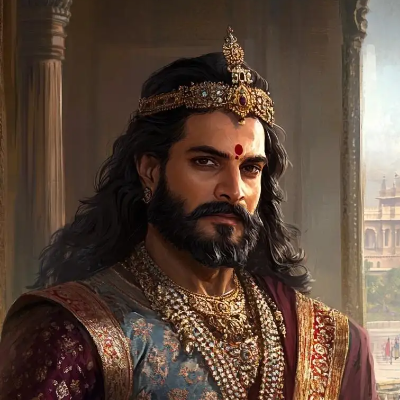
Anu — Fourth Son of Yayati, Ancestor of the Anga, Vanga, Kalinga, and Kekaya Peoples
Anu · Anū · Anudruhyu · Sharmishtha-suta · Yayati-chaturtha-putra · Shibi-purvajanaka · Karna-vamshapurva · Madra-purvajanaka
Anu is the second son of Yayati and Sharmishtha; the full brother of Druhyu and Puru; and the founding ancestor of a remarkably diverse set of peoples and kingdoms — including the Anga, Vanga, Kalinga, Madras, Kekayas, Ushinaras, and Shibi — whose geographic spread extends from the north-western frontier (the Kekaya kingdom) to the eastern coast (the Anga, Vanga, and Kalinga kingdoms of present-day Bihar, Bengal, and Odisha). His most significant Mahabharata connections are through his descendants: Shibi (the model of dharmic self-sacrifice); Karna (the tragic hero of the Mahabharata, who became king of Anga after Adhiratha — an Anga-dynasty charioteer — adopted him as a foundling; making Karna genealogically a distant descendant of Anu through the Anga line); Jayadratha (king of Sindhu and the Kauravas' most important ally after Karna, who played a decisive role in Abhimanyu's death); and Madri (mother of Nakula and Sahadeva, who was a princess of the Madra kingdom).
✦ Lineage
- Father: Yayati; Mother: Sharmishtha
- Full brothers: Druhyu and Puru
- Half-brothers: Yadu and Turvasu
- Alternate name: Anudruhyu — used in the Wikipedia Yayati article alongside Anu as a variant; may represent a textual variant in the Mahabharata manuscripts
- Territorial grant: Kanyakubja (present-day Kannauj in Uttar Pradesh) per the Yadav History source; the western territories per the EverybodyWiki source; a smaller province per the Vishnu Purana as a result of his refusal
- Son: Titikshu — from whom the eastern kingdoms descend; Titikshu ruled the eastern side of Bharatkhanda; his sons Anga, Vanga, Kalinga, Pundra, Suhma, and Odhra each became the founder and namesake of their respective kingdoms on the eastern coast
- Son (separate branch): Usinara (also Ushinar) — from whom the north-western branch descends; Usinara's son Shibi became the most celebrated of all Anu's descendants for his act of self-sacrifice; Usinara also produced the Kekaya kingdom and the Madra kingdom through different sub-branches
- Notable descendants — eastern branch: Anga (founder of the Anga kingdom in present-day Bihar, from whose line the adoptive family of Karna descended; Adhiratha — the royal charioteer who found the infant Karna on the Ganga's bank and raised him — was from the Anga royal house, making Karna the adopted son of an Anu-line dynasty); Vanga (founder of Bengal); Kalinga (founder of the Kalinga kingdom of Odisha; whose later king Mahameghavahana is recorded in the Mahabharata); Pundra (founder of the Pundra kingdom of northern Bengal)
- Notable descendants — north-western branch: Shibi (son of Usinara; the king who offered his own flesh in a balance scale to protect a dove from a hawk — the hawk being Indra and the dove being Agni in disguise, testing his resolve — and who gave his entire body before the gods revealed themselves; one of the most celebrated examples of dharmic self-sacrifice in the tradition); the Kekaya princes (the five Kekaya brothers who supported the Pandavas in the Kurukshetra war); Madra kingdom (whose princess Madri became Pandu's second wife and the mother of Nakula and Sahadeva); Jayadratha (king of Sindhu, descended from the Anu line through Druhyu's connection to the Sindhu kingdom — sources vary on exact lineage; JKYog records Jayadratha as a descendant of Anu); Dantavakra (king of Karusha; an Anu-line descendant and one of the third incarnations of the Vaikuntha gatekeepers — the same Vijaya whose first and second births were Hiranyaksha and Kumbhakarna, already profiled in this series)
✦ The Refusal and the Curse
When Yayati asked Anu to exchange youth for old age, Anu refused. His descendants were cursed to be Mlecchas — people outside the Vedic sacrificial order — and to experience suffering. The Vishnu Purana records that he received a smaller territorial portion as a result. His two dynastic branches — the eastern Titikshu line producing the Anga-Vanga-Kalinga kingdoms, and the north-western Usinara line producing Shibi, the Kekayas, the Madras, and Sindhu — spread across nearly the entire geographic periphery of the Mahabharata's world, providing the majority of the non-Paurava, non-Yadava characters whose fates in the Kurukshetra war constitute the tragedy of the epic's human periphery. Karna — abandoned as an infant, adopted into an Anga-line family, made king of Anga by Duryodhana, and killed by Arjuna on the seventeenth day of the battle — is the most poignant of Anu's distant descendants: the son of Surya raised in the lineage of the sun-god's descent through the Anu branch, killed by Arjuna who is himself the son of Indra and the descendant of Puru.
✦ References
- Mahabharata (Adi Parva, Chapter 85) — Anu's refusal; the curse; his descendants identified as Mlecchas
- Bhagavata Purana (Canto 9) — Anu's descendants: Ushinaras, Sibi, Madras, Kekayas; Titikshu and the eastern kingdoms
- Vishnu Purana (Book 4) — Anu's line; Titikshu and his six sons (Anga, Vanga, Kalinga, Pundra, Suhma, Odhra)
- Harivamsa — the fuller Anu genealogy
- Wikipedia — Turvasu Druhyu and Anu dynasties; EverybodyWiki — Turvasu Druhyu and Anu Dynasties; JKYog — Yadu Dynasty; List of Puru and Yadu Dynasties Wikipedia: modern summaries drawing from the above primary sources