
About
Paushti — Wife of King Puru, Founder's Queen of the Puru Dynasty
Paushti · Kausalya (Vishnu Purana and Bhagavata Purana variant)
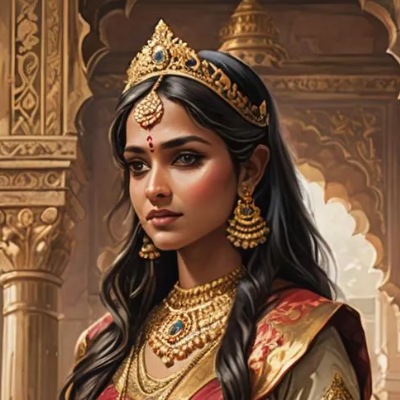
Paushti is the name given in the Mahabharata to the wife of King Puru — youngest son of the Lunar dynasty king Yayati by his wife Sharmishtha, daughter of the Daitya king Vrishaparvan — and mother of his three sons Pravira, Ishvara, and Raudrashva. She stands at the generational foundation of the Puru dynasty — the Puruvamsha — from which the Kuru kings, the Pandavas, and the Kauravas were descended. The Vishnu Purana and the Bhagavata Purana give the name Kausalya for the wife of Puru, and these two texts record a different first son, Janamejaya, rather than the three sons of the Mahabharata account. The Wisdomlib Purana glossary registers Kausalya as one of the multiple distinct figures of that name in the tradition, identifying her specifically as the wife of Puru son of Yayati. Her attestation as Paushti is confined to the genealogical verses of the Mahabharata's Adi Parva.
✦ The Name
The name Paushti is a Sanskrit feminine form derived from Pushti, one of the daughters of the progenitor Daksha and the wife of Dharma — a personification of nourishment, sustenance, and thriving. As a proper name, Paushti therefore carries the connotation of one who is of or akin to Pushti — a being of abundance and flourishing. The name may function as a patronymic or as an epithet rather than as a birth name in the usual sense, though no etymological commentary on the name appears in the Mahabharata text itself.
The alternative name Kausalya, used in the Puranic tradition for the wife of Puru, is also borne by several other major figures in the tradition and these must be distinguished: Kausalya the mother of Rama and chief queen of King Dasharatha of Ayodhya; Kausalya the queen of a king of Kasi whose daughters Amba, Ambika, and Ambalika were taken by Bhishma; and Kausalya the mother of Kesha in the Devi Bhagavata Purana. The Kausalya who is the wife of Puru is a distinct figure from all of these.
✦ Lineage
- Husband: Puru, youngest son of King Yayati and his second wife Sharmishtha; celebrated in Puranic tradition for willingly accepting his father's curse of premature old age so that Yayati could resume his youth; rewarded by Yayati with the succession in preference to his elder brothers Yadu, Turvasu, Druhyu, and Anu, who had refused the exchange; king of the Gangetic plain and founder of the Puruvamsha, which later became the Kuruvamsha.
- Son — Pravira: eldest son of Paushti and Puru; described in the Mahabharata as a mighty chariot-warrior; the perpetuator of the Puru dynasty; his wife was Suraseni, by whom he fathered Manasyu.
- Son — Ishvara (also Isvara): second son of Paushti and Puru; described as a mighty chariot-warrior; no further narrative or descendants are recorded for him in the primary sources.
- Son — Raudrashva (also Kaudrashva or Kaudraswa): third son of Paushti and Puru; described as a mighty chariot-warrior; fathered ten sons by an apsara — the Mahabharata names her as Misrakesi, while some sources name Ghritachi — whose names were Richeyu (known as Anadhrishti), Kaksheyu, Vrikeyu, Sthandileyu, Vaneyu, Jaleyu, Tejeyu, Satyeyu, Dharmeyu, and Sannateyu; of these, Richeyu-Anadhrishti became the sole monarch and continued the main dynastic succession.
✦ Textual Variants and Inconsistencies
The divergence between the Mahabharata's account and the Puranic accounts of Puru's immediate succession is the most significant variant affecting Paushti's place in the genealogy, and it concerns both the name of the wife and the names and sequence of the sons.
The Mahabharata's Adi Parva (Chapter 94, Sambhava Parva) names the wife as Paushti and gives three sons: Pravira, Ishvara, and Raudrashva, with Pravira identified as the perpetuator of the line through his son Manasyu. The Vishnu Purana and the Bhagavata Purana name the wife as Kausalya and record a different first successor to Puru: Janamejaya (not to be confused with the more famous Janamejaya of the snake sacrifice, a much later king), whose son was Prachinvat, whose son was Pravira, whose son was Manasyu. In these Puranic accounts, Pravira stands three generations below Puru rather than one generation below as in the Mahabharata. This constitutes a substantive genealogical divergence: the Mahabharata makes Pravira the son of Puru, while the Vishnu Purana makes Pravira the grandson of Puru's son Janamejaya. These accounts cannot be harmonised.
A secondary variant concerns the mother of Raudrashva's ten sons. The Mahabharata (Adi Parva, Chapter 94) names the apsara as Misrakesi. Other sources including the Ghritachi genealogical references identify the mother of Raudrashva's sons as Ghritachi. Whether these are two names for the same celestial woman or a genuine variant tradition attributing the same sons to different apsaras cannot be resolved from the surviving texts.
A further minor variant concerns the names of Raudrashva's ten sons: the Mahabharata gives Richeyu, Kaksheyu, Vrikeyu, Sthandileyu, Vaneyu, Jaleyu, Tejeyu, Satyeyu, Dharmeyu, and Sannateyu. The Wikipedia article on Ghritachi, drawing from the Puranic tradition, gives the variant names Riteyu, Kaksheyu, Sthandileyu, Kriteyuka, Jaleyu, Sannateyu, Dharmeyu, Satyeyu, Vrateyu, and Vaneyu, with differences in several individual names.
✦ Connection to the Wider Genealogy
Paushti's household stands at the inaugural node of the Puru dynasty within the Chandravamsha — the Lunar dynasty. The Lunar line traces from Brahma through Atri, Chandra the Moon-god, Budha, Pururavas, and Ayus to Nahusha, then to Yayati, and from Yayati to Puru. Through Paushti's son Pravira and his son Manasyu, and then through Raudrashva's son Richeyu-Anadhrishti and his son Matinara and his son Tansu and his son Ilina, the dynasty reached the emperor Dushyanta and then Bharata — after whom Bharatavarsha takes its name — and from Bharata the line continued through successive generations to the Kuru king, from whom the Kuruvamsha derives, and ultimately to the Pandavas and Kauravas of the Mahabharata war.
✦ References
- Mahabharata, Adi Parva, Sambhava Parva, Chapter 94: Primary source. Names Paushti as the wife of Puru and records her three sons Pravira, Ishvara, and Raudrashva as mighty chariot-warriors, with Pravira identified as the perpetuator of the dynasty; also names Misrakesi as the apsara mother of Raudrashva's ten sons. This is the primary source for the name Paushti.
- Vishnu Purana, Amsha 4, Chapter 19: Primary source. Names Kausalya as the wife of Puru and records Janamejaya as Puru's son and successor, diverging from the Mahabharata's account; places Pravira two generations below Puru rather than one.
- Bhagavata Purana, Skandha 9, Chapter 19: Primary source. Parallel Puranic account of the Puru lineage; consistent with the Vishnu Purana in naming Kausalya as Puru's wife and in the generational placement differing from the Mahabharata.
- Wisdomlib — Kaushalya entry (Purana glossary): Modern secondary resource. Documents multiple distinct figures named Kausalya in the tradition; specifically records entry 4 as the wife of Puru, son of King Yayati, with reference to Mahabharata Adi Parva I.90.11.
- Wikipedia — Puru (Hinduism), Ghritachi, and Sharmishtha articles: Modern secondary resources. Confirm the primary source attestation of Paushti in the Mahabharata, the Kausalya variant in the Puranic tradition, and the divergence in the names of Raudrashva's sons and their mother between Mahabharata and Puranic accounts.
- Sacred-texts.com — Mahabharata Book 1, Section XCV (Ganguli translation): Modern secondary resource providing the English translation of the primary genealogical passage confirming the name Paushti and the names of her three sons.