
About
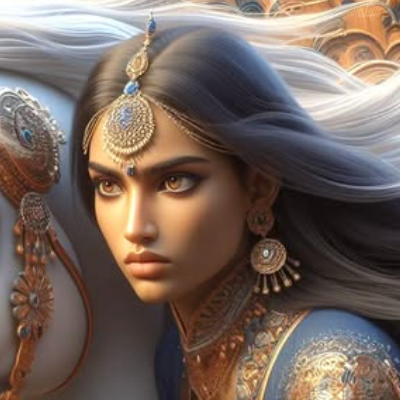
Sauviri — Wife of Manasyu of the Puru Dynasty
Sauviri · Sauviri Paurava
Sauviri is recorded in the Mahabharata as the wife of King Manasyu, a ruler of the Puru dynasty within the Chandravamsha — the Lunar dynasty — and the mother of his three sons Shakta, Sahana, and Vagmi. She appears in the Sambhava Parva of the Adi Parva, where the genealogy of the Puru line is recited by the sage Vaishampayana to King Janamejaya. Her name is a structural ethnonym in Sanskrit, indicating her origin from or connection with the Sauvira people or kingdom. Her attestation in the primary texts is confined to this single genealogical verse; no independent narrative or further biographical detail is recorded for her in any surviving Puranic or epic source.
✦ The Name
The name Sauviri is a Sanskrit feminine form derived from Sauvira, the name of an ancient people and kingdom situated in the lower Indus valley region. As a proper noun it functions as a patronymic or ethnonymic designation — Sauviri meaning a woman of the Sauvira people or a princess of the Sauvira royal house. This naming convention is common in Puranic genealogical lists, where queens are frequently identified by the name of their natal kingdom rather than by a personal birth-name. No etymology or name-commentary is offered in the primary text itself.
✦ Lineage
- Husband: Manasyu, a king of the Puru dynasty within the Chandravamsha; the Mahabharata describes him as having eyes like lotus-petals and as exercising sovereignty over the whole earth bounded by the four seas. His parentage varies across the primary texts and is discussed under textual variants below.
- Son — Shakta (also Sakta): eldest son of Sauviri and Manasyu; described as a hero in battle and a mighty chariot-warrior; no further narrative is recorded for him in the primary sources.
- Son — Sahana (also Samhana or Sanhanana): second son; likewise described as a battle-hero and chariot-warrior; the name varies in spelling across editions.
- Son — Vagmi (also Vagmin): third son; likewise described as a battle-hero and chariot-warrior; the name Vagmin in Sanskrit connotes one who is eloquent in speech.
✦ Textual Variants and Inconsistencies
The principal difficulty with the genealogical placement of Sauviri and her husband Manasyu is that the two major primary sources — the Mahabharata and the Vishnu Purana — give substantially different accounts of the Puru succession, and within the Mahabharata itself two distinct genealogical lists are preserved which differ materially from each other.
In the Mahabharata's first genealogical account (Adi Parva, Chapter 94), Manasyu is the direct grandson of Puru: Puru's wife Paushti bore him three sons, of whom Pravira was the perpetuator of the dynasty; Pravira's wife Suraseni bore Manasyu; and Manasyu's wife Sauviri bore the three sons. In this version, Manasyu is the third generation from Puru and stands very early in the dynasty.
In the Vishnu Purana's account of the Puru dynasty (Book IV, Chapter 19), the line reads: Puru — Janamejaya — Pracinvat — Pravira — Manasyu — Bhayada — and so on through several more generations down to Raudrasva, who had the ten sons Riteyu and others. This makes Manasyu the fifth in descent from Puru rather than the third. The Vishnu Purana itself, in its footnote on this chapter, explicitly acknowledges the Mahabharata's first account as a variant — noting that in that version Pravira is the son of Puru directly, making Manasyu the second in descent; and noting further that in the Mahabharata's first list, the line of Manasyu through Sauviri — Shakta, Sanhanana, and Vagmin — terminates there, with no continuation of the dynasty through those three sons. The continuation of the main Puru dynastic line in both the Mahabharata and the Puranas runs through Raudrasva and his son Richeyu, not through Sauviri's sons.
The Mahabharata's second list within the same Adi Parva gives a completely different and far longer sequence beginning with Puru's son as Janamejaya, continuing through fifteen generations to Matinara, which is a substantially divergent tradition from either the first list or the Vishnu Purana. These variations are characteristic of Puranic genealogical transmission, where parallel recensions preserve different dynastic traditions without harmonisation.
A further minor variant exists in the names of Sauviri's sons: the Mahabharata (Kisari Mohan Ganguli translation of Adi Parva 94) renders them as Sakta, Sahana, and Vagmi; the Wisdomlib Puranic Encyclopaedia entry for Manasyu, drawing from a different verse reference (Adi Parva Chapter 24, stanza 45), gives the names as Shakta, Samhana, and Vagmi; and the Vishnu Purana footnote renders the same three as Shakta, Sanhanana, and Vagmin. These are orthographic and transliteration variants of the same three names rather than substantively different figures.
✦ Connection to the Wider Genealogy
Sauviri belongs to the household of the Puru dynasty, the most prominent branch of the Chandravamsha — the Lunar dynasty — descended from the Vedic ancestor Puru, youngest son of King Yayati by his wife Sharmishtha, daughter of the Daitya king Vrishaparvan. Puru had accepted the old age of his father Yayati and in return received back his own youth when Yayati wished to renounce the world; for this act of filial duty Puru was made the successor. The Puru line eventually produced, through the main succession carried by Raudrasva's son Richeyu (known as Anadhrishti) and subsequent kings, the lineage that led through Matinara, Tansu, Ilina, Dushyanta, and the emperor Bharata — after whom the land of Bharatavarsha was named — and ultimately to the Kuru kings, the Pandavas, and the Kauravas. Sauviri's own sons Shakta, Sahana, and Vagmi are not recorded as ancestors in this main continuation; they represent a collateral branch of the Puru line whose further descendants are not named in the surviving texts.
✦ References
- Mahabharata, Adi Parva, Sambhava Parva, Chapter 94 (Ganguli numbering; also cited as Chapter 89 in BORI critical edition referencing): Primary source. The sole text in which Sauviri is named; records her marriage to Manasyu, the names of her three sons, and their characterisation as heroes and chariot-warriors. The verse is recited by Vaishampayana to King Janamejaya as part of the Puru dynastic genealogy.
- Mahabharata, Adi Parva, Chapter 24, verse 45: Primary source. A second verse reference in the Mahabharata citing the sons of Manasyu by Sauviri under the names Shakta, Samhana, and Vagmi; provides a minor orthographic variant to the names in Chapter 94.
- Vishnu Purana, Book IV, Chapter 19: Primary source. Places Manasyu in the Puru succession as the fourth in descent, differing from the Mahabharata's first list which makes him the third; the Wilson translation's footnote explicitly documents the Mahabharata variant and notes that Sauviri's sons form a branch where the line terminates in that account. Does not name Sauviri directly in the main text but references the three sons Shakta, Sanhanana, and Vagmin in the footnote apparatus.
- Wisdomlib — Manasyu entry (Puranic Encyclopaedia and Mahabharata name index): Modern secondary resource. Confirms Manasyu's parentage as son of Pravira and grandson of Puru, and names Sauviri as his wife with the three sons, drawing from Adi Parva sources.
- Wisdomlib — Vagmin entry: Modern secondary resource. Confirms Vagmi as a son of Manasyu by Sauviri with reference to Mahabharata Adi Parva Chapter 24, stanza 45; provides the name-meaning of Vagmin as eloquent in speech.
- Sacred-texts.com — Mahabharata Book 1, Section XCV (Ganguli translation): Modern secondary resource providing the English translation of the primary genealogical passage; confirms the full dynastic context from Puru through Pravira, Manasyu, Sauviri, and her sons.