
About
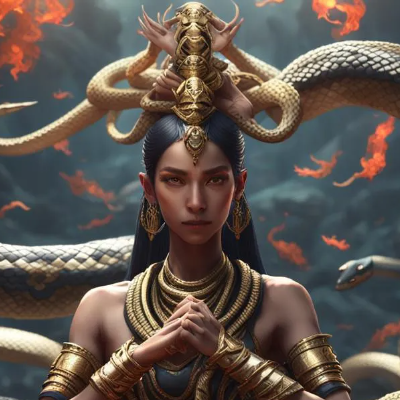
Jvalana — Naga Princess, Daughter of Takshaka, Wife of Richeyu
Jvalana · Jvala · Ivalana · Ilavana · Ivilina · Nagakanya · Takshaka-putri
Jvalana is a Naga princess, the daughter of Takshaka, one of the foremost kings of the Naga race in the Mahabharata tradition, and the wife of Richeyu, also known as Anadhrishti, a king of the Puru dynasty of the lunar lineage. She is the mother of Matinara, a celebrated king of the Puru line who performed the Rajasuya and the Ashvamedha sacrifices. Her primary significance in the tradition is genealogical: through her union with Richeyu, she introduces the ancestry of Takshaka and the Naga world into the Paurava branch of the lunar dynasty, producing a line of descent that eventually reaches the Bharata kings — the founders of the dynasty from which both the Pandavas and the Kauravas spring. She is named in the Harivamsha Purana's account of the Puru dynasty, and her identification as Takshaka's daughter and Richeyu's wife is confirmed in both the Sanskrit text of the Harivamsha and in several allied genealogical traditions. Her name appears in variant forms across different texts and translations, a matter addressed fully in the section on textual variants below.
✦ The Name
The name Jvalana is the full Sanskrit form of the name, deriving from the root jval, meaning to blaze, to burn brightly, or to shine. Jvalana as a noun denotes a flame or a blazing fire. The shortened form Jvala carries the same meaning and is the form used in certain translations of the Mahabharata's genealogical passages. Both forms refer to the same figure. The variant forms Ivalana, Ilavana, and Ivilina, which appear in some English translations — most notably in Manmatha Nath Dutt's prose rendering of the Harivamsha — arise from a mistranscription or misreading of the Sanskrit jvalana, in which the initial consonant cluster jv was rendered as iv or il, producing a superficially different name from the same original Sanskrit word. This has led some modern reference works and genealogical compilations to treat Jvala and Ivalana as two separate daughters of Takshaka, which the Sanskrit primary source does not support. The Sanskrit of Harivamsha 1.32.1 reads jvalana unambiguously. The patronymic Takshaka-putri, meaning daughter of Takshaka, and the descriptive epithet Nagakanya, meaning maiden of the Naga race, are designations applicable to her by virtue of her birth rather than personal names.
✦ Lineage
- Father: Takshaka — one of the foremost Naga kings in the Mahabharata, counted among the greatest of all serpent chiefs. Takshaka dwelt in the Khandava forest and at Kurukshetra and is associated with the city of Takshasila, which bears his name. He is the Naga who delivers the fatal bite to Parikshit, the grandson of Arjuna and son of Abhimanyu, an act that precipitates the great serpent sacrifice of Janamejaya and provides the narrative occasion for the Mahabharata to be recited. All Nagas trace their cosmological ancestry to Kashyapa, one of the seven primordial sages, and Kadru, a daughter of the progenitor Daksha, who is regarded as the mother of all serpent beings.
- Brother: Ashvasena — a Naga warrior, son of Takshaka, who was present in the Khandava forest when Arjuna and Krishna burned it at the behest of the fire god Agni. Ashvasena escaped the burning, though his mother perished in the fire. He later sought revenge against Arjuna during the Kurukshetra war.
- Husband: Richeyu — also known as Anadhrishti and Anvagbhanu, the eldest and most powerful of the ten sons born of Raudrashva, a king of the Puru dynasty, and the Apsara Ghritachi. Richeyu became the paramount monarch among his brothers and was celebrated for his unassailable prowess in war, from which his epithet Anadhrishti — meaning one who cannot be assailed — derives.
- Son: Matinara — born of Jvalana and Richeyu, Matinara became a celebrated king of the Puru line, known for performing the Rajasuya and the Ashvamedha sacrifices. Through his son Tansu and subsequent descendants including Ilina, Dushmanta, and the great emperor Bharata, Matinara stands as a key ancestor of the Bharata dynasty from which the Mahabharata takes its name.
✦ Narrative Presence in the Primary Sources
Jvalana does not feature as an agent in any extended narrative episode. Her presence in the primary sources is entirely genealogical. The Harivamsha Purana, in its thirty-second chapter devoted to the family of Richeyu, names her as Richeyu's wife and the mother of Matinara in a single verse that also establishes her Naga identity and paternal origin. She is not given speech, characterisation, or individual narrative development in any surviving primary source. The genealogical lists of the Mahabharata's Adi Parva reference the same marriage in their account of the Puru dynastic line, though they do not always name her explicitly, referring instead to the king who married the daughter of a Naga of Takshaka's race. Her significance is entirely constituted by her position at the junction of the Naga world and the Paurava royal lineage.
✦ Textual Variants and Inconsistencies
The most significant textual issue surrounding this figure is the proliferation of variant name-forms across different translations and genealogical compilations. The Sanskrit Harivamsha text names her consistently as jvalana. The Manmatha Nath Dutt English prose translation of the Harivamsha renders this name as Ivalana, a form that appears to result from misreading the Sanskrit jv cluster as iv. This rendering has been reproduced in several secondary works, including online encyclopaedic compilations, which have further compounded the issue by treating Ivalana and Jvala as two distinct daughters of Takshaka — one the wife of Richeyu and mother of Matinara, the other the wife of a king named Riksha. The Mahabharata's Adi Parva, in its second genealogical list of the Puru dynasty, names a king Riksha as the husband of a daughter of Takshaka named Jvala, and identifies Matinara as their son. However, as the Vishnu Purana's commentary on this passage and a careful reading of the Harivamsha together make clear, the Mahabharata contains two separate genealogical accounts of the Puru dynasty that differ materially in their construction, and the king named Riksha in the second list occupies the same position in that list as Richeyu does in the first list and in the Harivamsha account. These are therefore variant names for the same king across two different textual traditions of the same lineage, not two separate kings with two separate wives. Jvalana, Jvala, and Ivalana are all names for the same person in the primary sources.
✦ Connection to the Wider Genealogy
Through her father Takshaka, Jvalana belongs to the Naga lineages that trace their cosmological origin to Kashyapa and Kadru, the progenitors of all serpent beings. Through her husband Richeyu, she enters the Paurava branch of the lunar dynasty, which descends from Manu, the progenitor of humanity, through Soma the moon god, Budha, Pururavas, Ayus, Nahusha, Yayati, and Puru. Her son Matinara's line proceeds through Tansu, then through a union with the goddess Sarasvati in one textual strand, to Ilina, Dushmanta, and the great emperor Bharata — the ancestor from whom the Bharata dynasty and the Mahabharata itself take their name. Through this chain, Jvalana's Naga ancestry is present in the lineage of all the royal houses that the Mahabharata places within the Bharata dynasty, including the Kuru kings, the Pandavas, and the Kauravas.
✦ References
- Primary Sources:
- Harivamsha Purana, Harivamsha Parva, Chapter 32, verse 1 — The principal and most explicit source for Jvalana's identity, naming her as the daughter of Takshaka and wife of Richeyu, and recording the birth of Matinara from this union. The Sanskrit text names her as jvalana unambiguously.
- Mahabharata, Adi Parva, Section XCIV (Sambhava Parva) — Identifies Richeyu, also called Anadhrishti, as the father of Matinara within the first genealogical account of the Puru dynasty, consistent with the Harivamsha account.
- Mahabharata, Adi Parva, Section XCV (Sambhava Parva) — Contains the second genealogical account of the Puru dynasty in which a king named Riksha is described as marrying the daughter of Takshaka and begetting Matinara — the account that has generated confusion between Jvala and Ivalana as names.
- Mahabharata, Adi Parva, Astika sub-parva — Provides the foundational genealogical account of the Naga lineages from Kashyapa and Kadru, establishing the cosmological ancestry within which Takshaka and his daughter Jvalana are situated.
- Secondary Sources:
- Harivamsha Purana, English translation by Manmatha Nath Dutt (1897) — The translation responsible for the variant name Ivalana, through its rendering of jvalana, and the source from which this confusion has propagated into secondary literature.
- Vishnu Purana, Book IV, Dynasty of Puru, with commentary by H. H. Wilson — Notes the existence of two materially different genealogical accounts of the Puru dynasty in the Mahabharata and identifies the points at which they diverge, providing the scholarly basis for reconciling the Riksha and Richeyu accounts.
- Puranic Encyclopaedia by Vettam Mani — Provides entries for Takshaka, Richeyu, and Matinara that allow the genealogical position of Jvalana to be cross-referenced.
- Mahabharat-Puran Kosh, entry on Richeyu, by Nrisinha Prasad Bhaduri — Confirms Richeyu's identity as Anadhrishti, establishes Matinara as his son, and clarifies the alternative names and epithets associated with this king.