
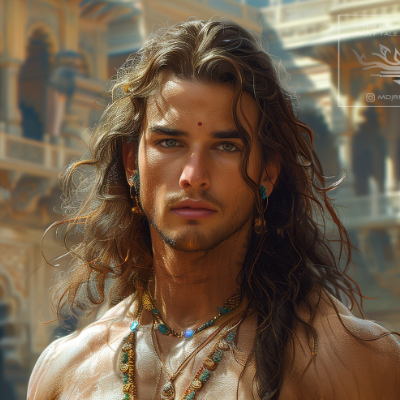
About
Richeyu — King of the Puru Dynasty, Son of Raudrashva, Father of Matinara
Richeyu · Riceyu · Riteyu · Richeshu · Anadhrishti · Anvagbhanu · Auceyu
Richeyu is a king of the Puru dynasty of the lunar lineage, the eldest and foremost of the ten sons born of Raudrashva, a Paurava king, and the celestial Apsara Ghritachi. He is celebrated in the Mahabharata and the Harivamsha Purana as the paramount sovereign among his brothers, a king who attained sole rulership over the whole earth and was renowned for an unassailable martial prowess that earned him the epithet Anadhrishti — he who cannot be overpowered. He married Jvalana, the daughter of Takshaka, the Naga king, and through this union became the father of Matinara, one of the celebrated kings of the Puru lineage. Richeyu stands in the Paurava genealogy as a figure of considerable dynastic importance: from him descends the line that runs through Matinara to the Bharata dynasty, the royal house from which both the protagonists and the antagonists of the Mahabharata ultimately spring. He appears in the Mahabharata's Adi Parva and in the Harivamsha Purana's account of the Puru dynasty, and is named in related Puranic genealogical lists.
✦ The Names and Epithets
The name Richeyu is the standard rendering in English translations of the Mahabharata; variant forms Riceyu, Riteyu, and Richeshu appear in different texts and recensions and refer to the same figure. The epithet Anadhrishti is a compound of the Sanskrit prefix an, meaning not, and adhrishti, derived from the root dhris meaning to be bold, to overpower, or to assault — giving Anadhrishti the meaning one who cannot be assailed or one who is invincible. The Mahabharata states that among all the sons of Raudrashva, Richeyu alone attained the sovereignty of the entire earth under this name. The epithet Anvagbhanu is explained in the Puranic tradition as meaning one after whom even the sun follows, a name given to him on account of his extraordinary radiance and glory. The form Auceyu appears in the Matsya Purana's version of the same genealogy as a variant of the same name. The Bhagavata Purana names the eldest son of Raudrashva as Riteyu, which is another orthographic variant of the same figure.
✦ Lineage
- Paternal grandfather: Puru — the eponymous ancestor of the Paurava branch of the lunar dynasty, fifth son of Yayati and Sharmishtha, who accepted his father Yayati's old age in exchange for his own youth and was rewarded with the kingdom.
- Father: Raudrashva — a king of the Puru dynasty, son of Ahanyati in one textual tradition and placed at varying removes from Puru depending on the text consulted. He is consistently identified as the father of the ten Raudrashveyas, the group of princes of which Richeyu is the eldest.
- Mother: Ghritachi — a celebrated Apsara, a divine celestial woman of the heavenly realm, who became the consort of Raudrashva and bore him ten sons and ten daughters. The Harivamsha names the Apsara as Ghritachi in its Sanskrit text; the Mahabharata's Adi Parva names the same figure as Misrakeshi in some passages. Whether these are two names for the same Apsara or represent a textual variant is a matter of inconsistency between sources, addressed below.
- Brothers: Nine brothers born of the same parentage, named variously across texts as Kaksheyu, Vrikeyu, Sthandileyu, Vaneyu, Jaleyu, Tejeyu, Satyeyu, Dharmeyu, and Sannateyu in the Mahabharata; the Harivamsha and Bhagavata Purana provide somewhat different enumerations of the same group.
- Wife: Jvalana — daughter of Takshaka, one of the foremost Naga kings, and a princess of the serpent world. Her Naga ancestry through Takshaka traces ultimately to Kashyapa and Kadru, the progenitors of all serpent beings.
- Son: Matinara — born of Richeyu and Jvalana, Matinara became a celebrated Paurava king, performer of the Rajasuya and the Ashvamedha, and the ancestor of the Bharata dynasty through his son Tansu.
✦ Richeyu as Paramount King Among the Raudrashveyas
The Mahabharata's Adi Parva, in Section XCIV, records that all ten sons of Raudrashva grew into heroes who performed numerous sacrifices in honour of the gods, were learned in all branches of knowledge, and were devoted to virtue. Among all of them, Richeyu rose above his brothers to become the sole monarch of the whole earth, an achievement that distinguished him from his equally accomplished siblings. His martial supremacy was of such a degree that it was impossible for any opponent to overcome him in battle, which is the basis of his epithet Anadhrishti. The Mahabharata compares his prowess to that of Vasava — that is, Indra, the king of the gods — among the celestials, establishing him as the martial peer of the highest divine warrior. This comparison situates him among the most formidable human kings in the Paurava genealogical tradition.
✦ Textual Variants and Inconsistencies
The principal textual inconsistency surrounding Richeyu concerns his mother's name. The Harivamsha Purana's Sanskrit text identifies the Apsara consort of Raudrashva as Ghritachi, while the Mahabharata's Adi Parva names the same figure as Misrakeshi in certain passages. These may be two names for the same celestial being — Apsaras frequently bear multiple names across different texts — or they may represent a divergence between the Harivamsha and the Mahabharata's respective traditions. The primary sources do not explicitly reconcile this discrepancy. A secondary inconsistency concerns his name itself: the Bhagavata Purana gives the eldest son of Raudrashva the name Riteyu, and lists the other nine sons under different names from those in the Mahabharata and Harivamsha, suggesting that the Bhagavata Purana preserves a variant tradition of this same generation of Paurava princes. A further inconsistency, discussed fully in the profile of Jvalana, concerns the alternative Mahabharata genealogical account in which a king named Riksha is placed where Richeyu stands in the first account, and identified as the father of Matinara — a divergence that reflects the existence of two materially different genealogical traditions of the Puru dynasty within the Mahabharata itself.
✦ Connection to the Wider Genealogy
Richeyu belongs to the Paurava branch of the lunar dynasty, which the Mahabharata and the Puranas trace from Manu through Soma, Budha, Pururavas, Ayus, Nahusha, Yayati, and Puru to the line of Paurava kings. Through his father Raudrashva, he is a descendant of Puru's direct line. Through his marriage to Jvalana, he introduces the ancestry of Takshaka and the Naga world — itself tracing to Kashyapa and Kadru — into the Paurava royal bloodline. His son Matinara perpetuates the Paurava line through Tansu, who in one strand of the tradition is born of the goddess Sarasvati, and through subsequent generations reaches Ilina, Dushmanta, and the great emperor Bharata. The Kuru dynasty — which gives rise to both the Pandavas and the Kauravas — is itself a branch of the Bharata dynasty, making Richeyu a remote but direct paternal ancestor of all the principal figures of the Mahabharata narrative.
✦ References
- Primary Sources:
- Mahabharata, Adi Parva, Section XCIV (Sambhava Parva) — The principal Mahabharata source for Richeyu's identity as the foremost son of Raudrashva, his attainment of sole sovereignty over the earth, his epithet Anadhrishti, and his fathering of Matinara.
- Harivamsha Purana, Harivamsha Parva, Chapters 31 and 32 — Chapter 31 names Richeyu as the first son of Raudrashva born of the Apsara Ghritachi; Chapter 32 names Jvalana as his wife and records Matinara's birth, establishing the full lineage of Richeyu in that text.
- Bhagavata Purana, Skandha IX, Chapter 20 — Provides the Bhagavata Purana's version of the same lineage, naming Riteyu as the eldest son of Raudrashva and presenting a variant list of the ten Raudrashveya brothers.
- Vishnu Purana, Book IV, Chapter XIX — Contains the Vishnu Purana's genealogy of the Puru dynasty and the commentary that identifies the divergence between the two Mahabharata accounts of the same lineage.
- Secondary Sources:
- Puranic Encyclopaedia by Vettam Mani — Provides a consolidated entry for Richeyu covering his identity, epithets, parentage, and his position in the Paurava genealogy.
- Mahabharat-Puran Kosh, entry on Richeyu, by Nrisinha Prasad Bhaduri — The most detailed secondary source on the etymology of Richeyu's epithets, the identity of the Apsara mother, and the variant name-forms across different texts.
- The Mahabharata, critical edition published by the Bhandarkar Oriental Research Institute — The authoritative critical text against which the genealogical details of Richeyu's lineage have been verified.