
About
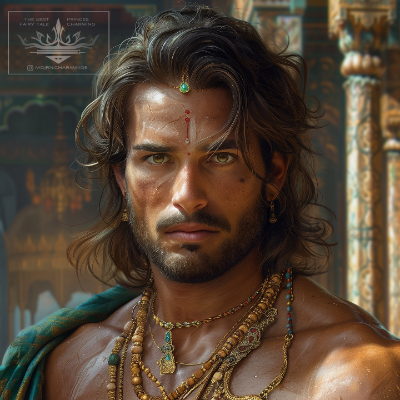
Matinara — Paurava King, Son of Richeyu and Jvalana, Ancestor of the Bharata Dynasty
Matinara · Matinatha · Antinara · Rantinara · Rantibhara
Matinara is a king of the Paurava branch of the lunar dynasty, the son of Richeyu — also known as Anadhrishti — a celebrated Paurava sovereign, and Jvalana, a Naga princess who was the daughter of Takshaka, the foremost of Naga kings. He appears in the Mahabharata's Adi Parva and in the Harivamsha Purana as a virtuous and accomplished king who performed the Rajasuya — the royal consecration sacrifice — and the Ashvamedha — the horse sacrifice — establishing his sovereignty and his pious character within the tradition. He is the ancestor through whom the line of Richeyu descends to the Bharata dynasty: his son Tansu perpetuates the Paurava royal line, and through Tansu's descendants Ilina and Dushmanta, and through Dushmanta's son the great emperor Bharata, Matinara stands as a pivotal ancestor in the genealogy from which the Mahabharata's principal royal houses ultimately emerge. He is attested in the Mahabharata, the Harivamsha, and in the Vishnu Purana's account of the Puru dynasty, though his name and the number of his children vary somewhat across these sources.
✦ The Name
The name Matinara is a Sanskrit compound of mati, meaning mind, intellect, or wisdom, and nara, meaning man or hero. The compound carries the sense of a man of great intelligence or wisdom, or a hero endowed with mental excellence. The variant form Matinatha, meaning lord of wisdom or lord of intellect, is an alternative form of the same name. The forms Antinara and Rantinara appear in some Puranic texts as variant names for the same figure. The Bhagavata Purana uses the form Rantibhara for a figure in the same genealogical position, which most scholars treat as a variant of Matinara in the Bhagavata's distinct recension of the Paurava lineage. The primary sources do not provide an explicit etymological gloss for the name within the narrative text.
✦ Lineage
- Father: Richeyu — also known as Anadhrishti and Anvagbhanu, the eldest and most powerful of the ten sons of Raudrashva, a Paurava king, and the Apsara Ghritachi. Richeyu attained sole sovereignty over the whole earth among his brothers and was celebrated for his invincible martial prowess.
- Mother: Jvalana — a Naga princess, daughter of Takshaka, one of the foremost Naga kings, whose cosmological ancestry traces through Kashyapa and Kadru, the progenitors of all serpent beings. Through his mother, Matinara carries the ancestry of the Naga world in his lineage.
- Sons (Mahabharata account): Tansu, Mahan, Atiratha, and Druhyu — four sons of immeasurable prowess, of whom Tansu became the perpetuator of the Puru dynastic line.
- Sons (Harivamsha account): Tansu, Pratiratha, and Subahu — three sons, all described as well-read in the Vedas, conversant with the knowledge of Brahman, truthful, accomplished in arms, powerful, and skilled in warfare.
- Daughter (Harivamsha and Matsya Purana): Gauri — a daughter of Matinara who is identified in the Harivamsha and the Matsya Purana as the mother of Mandhata, the celebrated solar dynasty king of the Ikshvaku line. This connection, if accepted, makes Matinara the maternal grandfather of one of the most famous kings of the solar dynasty, extending his genealogical significance beyond the lunar lineage.
- Grandson (through Tansu): Ilina — son of Tansu, a renowned conqueror who brought the whole world under his subjection. Ilina begat five sons upon his wife Rathantara, of whom Dushmanta was the eldest.
- Great-grandson (through Tansu and Ilina): Dushmanta — the king who married the sage Vishvamitra's daughter Shakuntala and begat upon her the great emperor Bharata, from whom the Bharata dynasty and the Mahabharata take their name.
✦ Matinara's Sacrifices and Reign
The Mahabharata records that Matinara became a famous and virtuous king who performed the Rajasuya and the Ashvamedha sacrifices. The Rajasuya was the great royal consecration sacrifice that asserted a king's claim to paramount sovereignty; its performance marked Matinara as a king of the highest political and ritual standing in the Paurava tradition. The Ashvamedha, the horse sacrifice, was similarly a mark of imperial ambition and sacrificial largesse. These two performances together characterise Matinara as a king of exceptional virtue, power, and religious observance in the terms by which the Mahabharata evaluates its royal figures. The Harivamsha adds that Matinara's sons were all well-read in the Vedas and skilled in arms, suggesting a court of both martial and scholarly distinction.
✦ Tansu and the Sarasvati Tradition
One of the most significant episodes attached to the generation immediately following Matinara is the tradition, preserved in the Mahabharata's second Paurava genealogical account in Section XCV, that Matinara performed a twelve-year sacrifice on the banks of the Sarasvati river, and that at its conclusion the goddess Sarasvati herself appeared before him and chose him as her husband, bearing him a son named Tansu. This tradition, in which Tansu is presented as the son of Matinara by the goddess Sarasvati rather than by a human wife, adds a further divine dimension to the already distinguished lineage of Matinara. The Harivamsha's account does not include the Sarasvati episode in its description of Matinara, naming his sons without ascribing them to the goddess. Whether the twelve-year sacrifice is assigned to Matinara or to his son in a given text depends on the recension, and the Vishnu Purana commentary notes that the Harivamsha makes errors in the construction of this passage. The tradition of the Sarasvati marriage, however it is attributed, reflects the consistent emphasis in the Paurava genealogical texts on the divine connections of this particular branch of the lunar dynasty.
✦ Textual Variants and Inconsistencies
The number and names of Matinara's sons differ between the Mahabharata and the Harivamsha. The Mahabharata's Section XCIV gives four sons: Tansu, Mahan, Atiratha, and Druhyu. The Harivamsha's Chapter 32 gives three sons — Tansu, Pratiratha, and Subahu — and adds a daughter, Gauri. These are not catastrophic discrepancies, as both traditions agree that Tansu was the eldest and the perpetuator of the dynastic line; the variation concerns the number and identity of the younger siblings. The name of Matinara himself varies across texts: Antinara in the Matsya Purana, Rantinara and Rantibhara in the Bhagavata Purana. The question of Matinara's father is the most historically complex variant, arising from the two divergent genealogical accounts within the Mahabharata itself — one placing Richeyu as his father, the other placing a king named Riksha in the same position — a discrepancy that reflects two distinct textual traditions of the Paurava genealogy rather than a simple scribal error, and which is addressed fully in the profile of Jvalana. The Sarasvati episode, assigned to Matinara in some texts and relocated or attributed differently in others, is a further source of variant treatment across the tradition.
✦ Connection to the Wider Genealogy
Matinara stands at one of the most consequential genealogical junctions in the Paurava tradition. Through his father Richeyu, he is descended from Raudrashva, and through Raudrashva from Puru, Yayati, Nahusha, Ayus, Pururavas, Budha, Soma the moon god, and ultimately from Manu, the progenitor of humanity. Through his mother Jvalana, he carries the ancestry of the Naga world, tracing through Takshaka to the cosmological progenitors Kashyapa and Kadru. Through his son Tansu, whose own son Ilina fathers Dushmanta, and through Dushmanta's union with Shakuntala, Matinara is the great-great-grandfather of the emperor Bharata. All subsequent Bharata kings — the Kuru monarchs, the Pandavas, the Kauravas, and the royal lines associated with Hastinapura — descend from Bharata, and through Bharata from Matinara. Additionally, if the Harivamsha's statement that Matinara's daughter Gauri was the mother of Mandhata is accepted, then Matinara also stands as the maternal grandfather of one of the most celebrated kings of the solar Ikshvaku dynasty, making him a figure of genealogical significance that crosses the boundary between the lunar and solar royal lines.
✦ References
- Primary Sources:
- Mahabharata, Adi Parva, Section XCIV (Sambhava Parva) — Names Matinara as the son of Anadhrishti (Richeyu), records his performance of the Rajasuya and Ashvamedha, and lists his four sons: Tansu, Mahan, Atiratha, and Druhyu.
- Mahabharata, Adi Parva, Section XCV (Sambhava Parva) — The second Paurava genealogical account, which presents the Sarasvati sacrifice tradition in connection with Matinara and records Tansu as the perpetuator of the line leading to Dushmanta and Bharata.
- Harivamsha Purana, Harivamsha Parva, Chapter 32, verses 1 to 4 — Names Matinara as the son of Richeyu and Jvalana, lists three sons and a daughter Gauri, and provides the Sanskrit text that is the primary basis for reconstructing the correct genealogy of this figure.
- Vishnu Purana, Book IV, Chapter XIX — Contains the Vishnu Purana's genealogy of Matinara and the critical commentary identifying variant names across texts, including Antinara in the Matsya Purana.
- Bhagavata Purana, Skandha IX, Chapter 20 — Presents the Bhagavata's version of the same lineage under the name Rantibhara, providing the variant tradition against which the Mahabharata and Harivamsha accounts may be compared.
- Matsya Purana — Records Gauri, daughter of Matinara, as the mother of Mandhata, extending his genealogical significance into the solar Ikshvaku dynasty.
- Secondary Sources:
- Puranic Encyclopaedia by Vettam Mani — Provides a consolidated entry for Matinara covering his parentage, sacrifices, sons, and variant names across the primary texts.
- The Mahabharata, critical edition published by the Bhandarkar Oriental Research Institute — The authoritative critical text against which the genealogical details of Matinara's lineage have been verified.
- Wisdomlib.org, definition entry for Matinara — Aggregates references to Matinara across eleven primary and secondary sources, noting the variant name forms and the differing genealogical positions assigned to him across texts.