
About
Gauri — Princess of the Puru Line, Daughter of Matinara, and Mother of Mandhata
Gauri · Gori · Daughter of Matinara · Wife of Yuvanashva · Mother of Mandhata
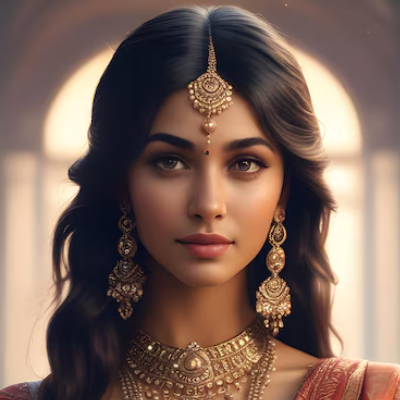
Gauri was a princess of the Puru dynasty, recorded in the Matsya Purana and the Harivamsha as the daughter of Matinara, a king of the Puru line descended from Raudrasva through Richeyu and several intermediate generations. She became the wife of Yuvanashva, a king of the Ikshvaku solar dynasty of Ayodhya, and through this marriage she forms a significant inter-dynastic link between the lunar Puru line and the solar Ikshvaku line. The Harivamsha and certain Puranic accounts name her as the mother of Mandhata, one of the most celebrated kings of the Ikshvaku dynasty, renowned across the Mahabharata, the Ramayana, and the Puranas as a universal emperor who conquered the three worlds. Gauri's profile in the primary sources is genealogical rather than narrative in character — no episode, speech, or personal history is recorded for her beyond her identity as daughter of Matinara and mother of Mandhata. Her significance lies in the textual dispute over Mandhata's birth, in which she appears as his natural mother in one stream of the tradition while another stream suppresses her role entirely in favour of the miraculous birth narrative.
✦ The Name
The name Gauri is one of the most common auspicious feminine names in the Sanskrit tradition, derived from the root gaura, meaning white, bright, fair, or golden. It is among the principal names of the goddess Parvati, the consort of the god Shiva, in her fair-complexioned form, and its use as a personal name for royal women throughout the Puranic tradition reflects the auspicious associations the name carries. In some sources the name appears in the slightly variant form Gori, which is a vernacular or Prakrit-influenced rendering of the same Sanskrit root. The Matsya Purana specifically notes that Gauri was very beautiful, associating the name's etymological meaning of brightness and fairness with her physical appearance.
✦ Lineage
- Dynasty: Puru — the lunar dynasty founded by Puru, the youngest son of King Yayati; Gauri belongs to a collateral branch of the Puru line through the descendants of Raudrasva and Richeyu, not the main line that leads to the Kuru kings
- Father: Matinara — a king of the Puru line descended from Raudrasva through Richeyu and Anadhristi; celebrated in the Mahabharata's Adi Parva as a king who performed the Rajasuya and horse sacrifice and who received the goddess Sarasvati as his wife according to one account; the Vishnu Purana names him as Antinara while the Mahabharata and other Puranas consistently use the form Matinara, reflecting a scribal or orthographic variant rather than a distinct figure
- Husband: Yuvanashva — a king of the Ikshvaku solar dynasty of Ayodhya, descended through many generations from the solar line; father of Mandhata; his marriage to Gauri represents an alliance between the solar Ikshvaku line and the lunar Puru line
- Son: Mandhata, also written Mandhatri — one of the most celebrated kings of the Ikshvaku dynasty; described in the Mahabharata, the Ramayana, and the Puranas as a universal emperor of extraordinary power who conquered the earth and portions of the heavens; married Bindumati, the daughter of the Yadava king Shashabindu; father of Purukutsa, Ambarisha, and Muchukunda, and of fifty daughters
✦ Textual Variants Concerning Gauri's Role as Mother of Mandhata
The most significant textual issue concerning Gauri is the direct contradiction between two streams of the Puranic tradition regarding her role in Mandhata's birth. The Harivamsha and certain Puranic accounts, including material in the Matsya Purana, record that Gauri was the natural mother of Mandhata — that she conceived and bore him in the ordinary manner as the wife of Yuvanashva. In this version, Gauri's role as mother is straightforward and her presence in the genealogy is essential to understanding Mandhata's ancestry on both the paternal and maternal sides.
The Vishnu Purana and the Bhagavata Purana, however, tell an entirely different story of Mandhata's birth, in which Yuvanashva accidentally drank sacred water that had been consecrated by sages and set aside to be given to his wives so that they might conceive. Having consumed this water, Yuvanashva himself became pregnant, and Mandhata was born from the king's body — from his right side in some versions, from his abdomen in others. In this account, Indra declared himself to be the child's nurse, saying the words that gave Mandhata his name. This miraculous birth narrative, being the more remarkable account, received wider circulation and greater elaboration in the tradition, and in many later retellings Gauri's role as natural mother is entirely absent. The two accounts are irreconcilable and represent distinct regional or sectarian traditions about the same figure. The Harivamsha and Matsya Purana versions that record Gauri as mother should be understood as representing the older or alternative genealogical tradition, while the miraculous birth story of the Vishnu Purana and Bhagavata Purana serves a theological purpose of emphasising Mandhata's divine origins.
✦ Connection to the Wider Genealogy
Through her father Matinara, Gauri is connected to the Puru dynastic line that descends from Raudrasva and Richeyu — a collateral branch of the main Puru succession that leads to the Kuru kings. Through her husband Yuvanashva and her son Mandhata, she is connected to the solar Ikshvaku dynasty of Ayodhya, one of the most celebrated royal lines of ancient Bharatavarsha. Mandhata's own descendants through Purukutsa eventually connect to the line that produces the celebrated solar king Harishchandra, and through later generations the line continues toward the birth of Rama, the avatar of Vishnu and the hero of the Ramayana. Gauri's marriage to Yuvanashva thus represents one of the inter-dynastic alliances that the Puranic tradition uses to weave the great royal houses of both the lunar and solar lines into a connected genealogical fabric.
✦ References
- Matsya Purana, chapters 12 and 49–50: Names Gauri as the daughter of Matinara and records her as the mother of Mandhata; describes her as very beautiful; represents one of the two primary textual traditions regarding Mandhata's birth.
- Harivamsha (appendix to the Mahabharata): Records Gauri as the daughter of Matinara who became the natural mother of Mandhata by Yuvanashva; provides the genealogical basis for Gauri's inclusion in the Puru dynastic line.
- Vishnu Purana, Book 4, chapters 2–3: Gives the miraculous birth account of Mandhata from Yuvanashva's body; does not name Gauri as mother in this version; this account is explicitly identified by H. H. Wilson in his commentary as in tension with the Matsya Purana and Harivamsha versions.
- Bhagavata Purana, Skandha 9, chapter 6–7: Also gives the miraculous birth story consistent with the Vishnu Purana account; does not record Gauri as Mandhata's mother.
- Mahabharata, Adi Parva (Book 1), Section XCIV: Records Matinara in the Puru dynastic list as a king who performed the Rajasuya and horse sacrifice; provides the Puru genealogical context for Gauri's paternal line without naming Gauri specifically.
- H. H. Wilson, translation and commentary on the Vishnu Purana (1840): Notes the variant between the Matsya Purana and Harivamsha accounts naming Gauri as natural mother of Mandhata and the Vishnu Purana miraculous birth account; this commentary remains the most precise scholarly identification of the textual inconsistency concerning Gauri's role.
- Vettam Mani, Puranic Encyclopaedia (1975): Entry on Gauri identifies her as the daughter of Matinara and the mother of Mandhata according to the Harivamsha and Matsya Purana tradition.