
About
Yuvanashva — King of Ayodhya and Father of Mandhata
Yuvanashva · Yuvanasva · King of the Ikshvaku Dynasty · Father of Mandhata · Yauvanashvin
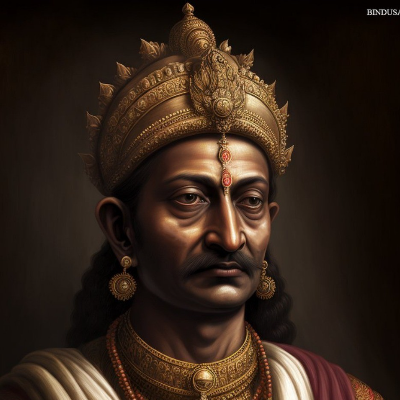
Yuvanashva was a king of the Ikshvaku solar dynasty, ruling from Ayodhya, and the father of Mandhata, one of the most celebrated universal emperors of ancient Bharatavarsha. He belonged to the solar line descended from Manu through Ikshvaku, and he is placed in the tradition many generations before the time of the Kurukshetra war. He married Gauri, the daughter of Matinara, a king of the Puru lunar dynasty, forming a notable inter-dynastic alliance. Yuvanashva is principally remembered in the tradition not for any independent deed of kingship but for the remarkable story of how Mandhata came to be born — a narrative preserved in differing forms across the Vishnu Purana, the Bhagavata Purana, the Harivamsha, and the Matsya Purana. In the more widely circulated Puranic version, Yuvanashva accidentally drank sacred water consecrated by sages for his wives, and as a consequence himself became pregnant, eventually giving birth to Mandhata. He appears in the Ramayana, the Mahabharata, and the major Puranas, always in connection with his son's extraordinary origin.
✦ The Name
The name Yuvanashva is a Sanskrit compound of yuvana, meaning young, youthful, or vigorous, and ashva, meaning horse. The compound thus carries the sense of one who possesses young or vigorous horses, or one who is as young and swift as a horse — a name of the type common among the warrior kings of the solar dynasty in which names compounded with ashva frequently appear. The patronymic Yauvanashvin, meaning son of Yuvanashva, is applied to Mandhata in several texts as a standard identifier of his paternal origin. The name is also spelled Yuvanasva in some transliteration systems, reflecting the Sanskrit sibilant.
✦ Lineage
- Dynasty: Ikshvaku — the solar dynasty of Ayodhya, founded by Ikshvaku, the son of Manu who was born when Manu sneezed; one of the two great royal lines of ancient Bharatavarsha alongside the lunar dynasty; the Ramayana traces the ancestry of Rama through this line through many generations
- Ancestor: Kakutstha — one of Yuvanashva's ancestors in the solar line, a king who fought a great war against the Asuras while seated upon Indra in the form of a bull, from whose shoulder — kakut — he took his name; from Kakutstha the Ikshvaku line descends through several generations to Yuvanashva
- Wife: Gauri — daughter of Matinara, a king of the Puru lunar dynasty descended from Raudrasva and Richeyu; named in the Harivamsha and Matsya Purana as the natural mother of Mandhata; her role in Mandhata's birth is suppressed in the miraculous birth accounts of the Vishnu Purana and Bhagavata Purana
- Son: Mandhata, also written Mandhatri — the most celebrated king of the Ikshvaku line before the time of Harishchandra and Rama; described as a universal emperor who conquered the earth, the underworld, and portions of the heavens; married Bindumati Chaitrarathi, daughter of the Yadava king Shashabindu; father of Purukutsa, Ambarisha, and Muchukunda, and of fifty daughters who became the wives of the sage Soubhari
✦ The Birth of Mandhata: The Miraculous Account
The Vishnu Purana and the Bhagavata Purana record the following account of how Mandhata came to be born. Yuvanashva was without a son and was greatly grieved by this. He approached a group of sages and requested their assistance. The sages undertook a special sacrificial rite — identified in some versions as the Indradaivata yajna — intended to bestow progeny upon Yuvanashva's wives. As part of the rite, the sages consecrated a vessel of water with sacred mantras, endowing it with the power to produce a son in whichever wife drank from it. The vessel was placed upon the altar for the night, to be given to Yuvanashva's principal wife in the morning.
During the night, Yuvanashva awoke consumed by thirst. Finding no other water available, he drank from the consecrated vessel without knowing its sacred purpose. When the sages discovered in the morning that the water had been consumed and learned that the king himself had drunk it, they understood what would follow. Yuvanashva had swallowed the sacred potency intended for his wives, and the consequence was that the king himself became pregnant. In due course, after ten lunar months in some accounts or a longer period in others, the child was born from Yuvanashva's body — from his right side according to some texts, from the left side of his abdomen according to others. The Mahabharata version set in the Vana Parva states the child burst through the king's right side.
When the child was born, the question arose as to how the infant would be nourished, having no mother to nurse him. The god Indra, king of the heavens, declared his intention to nurse the child himself, saying in Sanskrit words that gave the child his name — mam dhata, meaning I will be the nurse or I will sustain him — and the child was thus named Mandhata. Indra provided nourishment by allowing the child to suck divine sustenance from his finger, and the child grew with extraordinary speed. Yuvanashva himself did not die from the birth, though the cutting of his body would ordinarily have been fatal — in some versions divine intervention preserved his life.
✦ The Alternative Account: Natural Birth from Gauri
The Harivamsha and the Matsya Purana preserve a distinct and irreconcilable account in which Mandhata was born naturally from his mother Gauri, the daughter of Matinara. In this version, Yuvanashva is the father in the ordinary sense and Gauri is the mother, and no miraculous pregnancy or unusual birth is described. The Matsya Purana notes that Gauri was very beautiful and records her straightforwardly as the mother of Mandhata. The two accounts — the miraculous birth from the father's body and the natural birth from the mother Gauri — cannot be harmonised and represent distinct traditions. H. H. Wilson's commentary on the Vishnu Purana explicitly identifies this conflict between the Matsya Purana and Harivamsha on one side and the Vishnu Purana on the other, and notes that the miraculous account is likely a later elaboration built upon an etymological derivation of Mandhata's name from the words mam dhata. Both accounts are recorded in this profile and neither is suppressed.
✦ Connection to the Wider Genealogy
Yuvanashva stands at a pivotal point in the Ikshvaku solar dynastic succession as the father of Mandhata, whose own reign is regarded in the tradition as one of the high points of the solar line's power and glory. Through his marriage to Gauri, daughter of Matinara of the Puru lunar line, Yuvanashva's household brought together two of the most prominent dynastic streams of ancient Bharatavarsha. Mandhata's descendants through Purukutsa continue the Ikshvaku line through several more generations, eventually connecting to Harishchandra, Sagara, Bhagiratha, and ultimately to Dasharatha and his son Rama, the avatar of the god Vishnu and the hero of the Ramayana. Yuvanashva is thus the generational hinge upon which the narrative of the solar dynasty turns from the pre-Mandhata period to the era of the great Ikshvaku emperors, and his peculiar fame in the tradition rests entirely upon the extraordinary story of his son's birth.
✦ References
- Vishnu Purana, Book 4, chapters 2–3: Primary source for the miraculous birth account; narrates Yuvanashva's accidental drinking of the consecrated water, his pregnancy, Mandhata's birth from his body, and Indra's declaration as nurse; this is the most widely cited version of the story.
- Bhagavata Purana, Skandha 9, chapters 6–7: Gives a version of the miraculous birth account broadly consistent with the Vishnu Purana; records Yuvanashva's childlessness, the sages' ritual, the accidental drinking, and Mandhata's extraordinary birth and rapid growth.
- Harivamsha (appendix to the Mahabharata): Preserves the alternative tradition recording Gauri as Mandhata's natural mother; gives Yuvanashva's genealogical position in the Ikshvaku line.
- Matsya Purana, chapters 12 and 49: Names Gauri as Yuvanashva's wife and as the natural mother of Mandhata; one of the two principal sources for the alternative birth tradition.
- Mahabharata, Vana Parva (Book 3): References Mandhata as the son of Yuvanashva in the context of the catalogue of great kings; does not elaborate the birth story in detail but confirms Yuvanashva's paternity.
- Ramayana, Bala Kanda: Includes Yuvanashva in the dynastic genealogy of the Ikshvaku solar line as a predecessor of Rama; confirms his place in the succession without independently narrating the birth story.
- H. H. Wilson, commentary on the Vishnu Purana (1840): Identifies and discusses the conflict between the Matsya Purana and Harivamsha accounts naming Gauri as natural mother and the Vishnu Purana miraculous birth story; essential secondary reference for understanding the textual variants surrounding Yuvanashva and Mandhata's birth.
- Vettam Mani, Puranic Encyclopaedia (1975): Entry on Yuvanashva synthesises the Puranic material; records his genealogical position, his marriage to Gauri, and both versions of Mandhata's birth story.