
About
Tansu — King of the Puru Line and Son of Saraswati
Tansu · Trasu · Matinara-putra · Saraswati-ja · Paurava
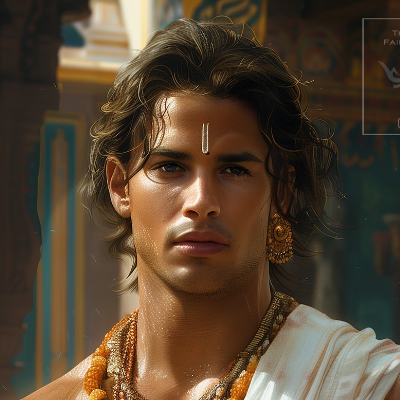
Tansu was a king of the Puru line of the Lunar Dynasty — the Chandravamsha — and one of the most distinctively born figures in that dynasty's long genealogical sequence. He was the son of King Matinara, a ruler of the Puru line, and the goddess Saraswati — the divine personification of the sacred river Saraswati and the goddess of learning, speech, and wisdom — who appeared to Matinara at the conclusion of a twelve-year sacrifice performed on her banks and chose him as her husband, bearing Tansu as the fruit of that union. His birth from a human king and a river goddess places him within the category of figures in the Puranic and epic tradition whose divine or semi-divine origin marks them as specially significant within the dynastic genealogy. Tansu married Kalingi, a princess of the Kalinga kingdom, and by her begot a son named Ilina, who continued the Puru line and whose own son Dushyanta — the celebrated king whose union with the sage Kanva's foster daughter Shakuntala produced the emperor Bharata, the eponymous ancestor of the Bharata race — is among the most famous figures of the entire Mahabharata tradition. Tansu's narrative is recorded in the Mahabharata at Book 1, the Adi Parva, Section XCV of the Sambhava Parva, in the genealogical account narrated by the sage Vaishampayana to King Janamejaya. His name appears as Trasu in the Vayu Purana, representing a variant tradition of the same figure.
✦ The Name
The name Tansu is of Sanskrit origin, though its precise etymological derivation is not elaborated in the primary sources treating this figure. One plausible analysis connects it to the Sanskrit root tan, meaning to extend, to stretch, or to continue — a root that gives rise to words such as tantu meaning thread or continuity and santana meaning lineage or progeny. In this reading, Tansu would carry the sense of "one who extends" or "the continuer," a meaning of obvious appropriateness for a figure whose primary function in the dynastic genealogy is to continue the Puru line through a moment of divine intersection — being born of the river goddess Saraswati — and to pass that line forward through his son Ilina. The variant name Trasu, found in the Vayu Purana, represents a phonological variation that is common in manuscript transmission of Sanskrit genealogical lists, where names of minor dynastic figures are particularly susceptible to scribal alteration. The Mahabharata's form Tansu is taken as the primary form in this series as the standard for the tree, with Trasu noted as the Vayu Purana's variant. The patronymic Matinara-putra means "son of Matinara," and the matronymic Saraswati-ja means "born of Saraswati," the latter being the more theologically significant of the two identifiers given the extraordinary nature of his mother.
✦ Lineage
- Father: Matinara, a king of the Puru line of the Lunar Dynasty, remembered in the tradition principally for the twelve-year sacrifice he performed on the banks of the Saraswati river — an act of devotional and ritual intensity sufficient to draw the river goddess herself into personal appearance and to move her to choose him as her husband. Matinara's position in the Puru dynastic sequence places him within the line descending from Puru — the youngest son of the lunar king Yayati who chose to accept his father's premature old age and was rewarded with the kingship — through the subsequent generations of Puru line kings recorded in the Mahabharata and Puranic genealogical lists.
- Mother: Saraswati, the goddess of the sacred river of the same name and the divine personification of speech, learning, wisdom, and creative power. One of the most ancient and revered of the Vedic goddesses, Saraswati is invoked in the Rigveda as a great river of purifying and nourishing power and as the goddess of inspired speech. In her role as Tansu's mother she appeared to Matinara at the conclusion of his twelve-year sacrifice, chose him as her husband through an act of divine initiative analogous to a svayamvara, and bore Tansu as the son who would continue the Puru line with the dual inheritance of his human royal father and his divine river-goddess mother.
- Wife: Kalingi, a princess of the Kalinga kingdom — the ancient realm of the eastern coast of the Indian subcontinent, corresponding broadly to the coastal region of present-day Odisha — who became Tansu's queen and the mother of Ilina.
- Son: Ilina, born of Tansu and Kalingi, who continued the Puru line and married Rathantari, by whom he fathered five sons. The eldest of these sons was Dushyanta according to the Mahabharata's account — the celebrated king whose union with Shakuntala, the foster daughter of the sage Kanva, produced the emperor Bharata, eponymous ancestor of the Bharata race and the figure from whom the Mahabharata itself takes its name.
✦ The Narrative of Matinara's Sacrifice and Saraswati's Choice
The episode of Tansu's birth as recorded in the Mahabharata's Adi Parva Section XCV is one of the more remarkable divine-human union narratives embedded within the epic's vast genealogical sections. King Matinara undertook a sacrifice of exceptional duration and efficacy — twelve years in length, performed on the banks of the Saraswati river — the extended timeframe itself serving as a measure of the ritual's intensity and the degree of Matinara's devotional commitment. The performance of prolonged and highly efficacious sacrifices as a means of attracting divine attention and divine favour is one of the recurring patterns of the Puranic and epic tradition, and Matinara's twelve-year sacrifice belongs to this category of ritual achievement that crosses the boundary between human aspiration and divine response.
At the sacrifice's conclusion, the river goddess Saraswati appeared in person to Matinara — a theophany that the text presents as the direct result of the sacrifice's power and efficacy — and chose him as her husband. The initiative in this union was entirely the goddess's own: the text's characterisation of Saraswati choosing Matinara mirrors the convention of the svayamvara, the ceremony of a woman's own choice of husband, transposed into the divine register. A goddess choosing a human king as her consort is a motif that appears across the epic and Puranic tradition — the river goddess Ganga's union with King Shantanu being the most prominent parallel within the Mahabharata itself — and in each case the union produces offspring of extraordinary significance. From Saraswati's union with Matinara was born Tansu, who is explicitly described in the Adi Parva as the continuer of the Puru line — his divine maternity marking him as a figure of special quality within the dynastic sequence even where his individual narrative is not elaborated beyond the genealogical record.
✦ Tansu's Position in the Puru Dynastic Sequence
The Puru line of the Lunar Dynasty is one of the two principal branches of that dynasty recorded in the Mahabharata and Puranic genealogical tradition — the other being the Yadu line from which Krishna descended. Puru was the youngest of the five sons of King Yayati, the great Lunar Dynasty king who distributed his premature old age among his sons, and who rewarded Puru — the only son willing to accept the burden — with the kingship and the continuation of the primary dynastic line. The Puru line as it descends through the generations of the Mahabharata's genealogical sections produces the two great royal houses of the epic's central conflict — the Pandavas and the Kauravas — both of whom trace their lineage through the Puru kings. Tansu occupies a position within this line at a generational remove from the epic's most celebrated figures, his significance being primarily that of a link in the chain — a king whose divine maternity from Saraswati marks the moment of an extraordinary intersection between the human royal line and the divine order, and whose son Ilina carries that combined inheritance forward toward Dushyanta and Bharata.
✦ Textual Variants
The principal textual variant concerning Tansu is the name itself. The Mahabharata's Adi Parva Section XCV gives the name as Tansu, which this series takes as the primary form. The Vayu Purana refers to the same figure as Trasu — a phonological variant representing the kind of name variation common in Sanskrit manuscript transmission of genealogical lists, particularly for figures who are not subjects of extended narrative elaboration and whose names therefore lack the stability that comes from frequent repetition across many different textual contexts. The Vayu Purana also notes a variation in the next generation — identifying Ilina's eldest son as Sushyanta rather than Dushyanta as the Mahabharata states, with Dushyanta appearing as the second son. This variant is treated in the profile of Ilina. No other significant textual inconsistencies concerning Tansu himself are recorded in the primary sources consulted for this series.
✦ Connection to the Wider Genealogy
Tansu's genealogical position places him at a node of considerable significance within the Lunar Dynasty's Puru branch. Through his father Matinara he is connected to the long sequence of Puru kings descending from Yayati and through him to the primordial Lunar Dynasty genealogy stretching back through Pururavas, Budha, and the moon god Chandra to the cosmic origins of the dynasty. Through his mother Saraswati he is connected to the Vedic divine order — the goddess of the sacred river, of speech and learning, whose Vedic invocations are among the oldest surviving texts of the Sanskrit tradition. Through his wife Kalingi and their son Ilina he is connected to the eastern kingdom of Kalinga and through Ilina's son Dushyanta and grandson Bharata to the very name and identity of the Bharata race whose history the Mahabharata narrates. The genealogical thread that runs from Saraswati's divine choice of Matinara through their son Tansu, through Tansu's son Ilina, through Ilina's son Dushyanta, and through Dushyanta's union with Shakuntala to the emperor Bharata is one of the most consequential in the entire Puru dynastic sequence — the chain of descent that ultimately produces the eponymous ancestor of the Mahabharata's world.
✦ References
Primary Sources
- Mahabharata, Adi Parva, Section XCV (Sambhava Parva): The principal primary source for Tansu's narrative, explicitly stating his birth from Saraswati by Matinara, recording the twelve-year sacrifice that preceded Saraswati's appearance and choice of Matinara as husband, identifying Kalingi as Tansu's wife, and naming Ilina as their son who continued the Puru line.
- Vayu Purana: Provides the variant name Trasu for the same figure and contains genealogical material on the Puru line relevant to situating Tansu within the broader dynastic sequence, with the noted variation in Ilina's son's name in the next generation.
- Vishnu Purana: Contains genealogical material on the Puru dynastic line relevant to the broader sequence within which Tansu's position must be understood, including the variant name Ailina for Ilina in the next generation.
Modern Reference Works
- Vettam Mani, Puranic Encyclopaedia (1975): Provides consolidated entries on the Puru dynastic line and its members across Puranic and epic sources, useful for situating Tansu within the broader genealogical tradition of the Lunar Dynasty's Puru branch.
- Wisdomlib (wisdomlib.org), entries on Tansu, Matinara, and the Puru line: Aggregates Sanskrit textual references to these figures across the Mahabharata and Puranic sources, useful for cross-referencing the Adi Parva genealogical account against parallel material in the Puranas.