
About
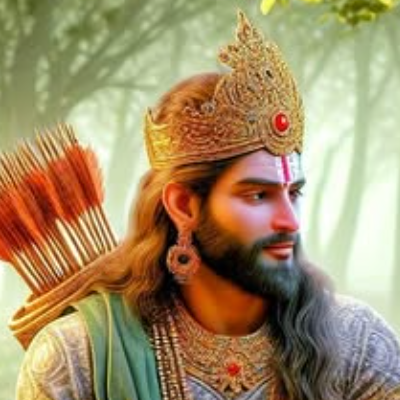
Dushyanta — King of the Puru Dynasty, Husband of Shakuntala, Father of Emperor Bharata, Progenitor of the Kuru Lineage
Dushyanta · Duṣyanta · Dushmanta · Ilina-putra · Rathantara-suta · Upadanavi-suta · Shakuntala-pati · Bharata-pita · Puru-vamsha-nripa · Kuru-pitamaha · Indra-sakhya
Dushyanta — also written Dushmanta — is a king of the Puru dynasty (Chandravamsha, the Lunar Dynasty); the son of Ilina (also written Ilin, Ailina, Ailika — identified in the Puranic genealogies with Santurodha and Transu, all names for the same king of the Puru line); the husband of Shakuntala — daughter of Vishvamitra and Menaka, raised by the sage Kanva; the father of Bharata — the great emperor after whom India is named Bharatavarsha; and the ancestor of the Kuru dynasty from which both the Pandavas and the Kauravas descended. His mother's name is given differently across the primary texts — the Mahabharata (Adi Parva, Chapter 94, Verse 17) names her as Rathantī (Rathantara); the Harivamsa and Matsya Purana name her as Upadanavi, the daughter of Vrishaparvan the Danava king (son of Kashyapa and Danu). The Puranic Encyclopaedia notes that Santurodha (identified as Ilina) and the Mahabharata's father-name are the same individual. Both maternal traditions are recorded below. He is described in the Mahabharata as an extraordinary king of justice and might, equal to Indra in power and Yama in justice, who ruled over the entire earth. His most consequential action was his marriage to Shakuntala through the Gandharva rite — and the subsequent sequence of denial, celestial vindication, and acknowledgment that established the Bharata dynasty as the Paurava dynasty's supreme flowering.
✦ The Name
The Sanskrit name Dushyanta — written Duṣyanta — derives from dush (to corrupt, to defile, to make bad) and yanta (the one who restrains, controls — from the root yam). The compound means he who restrains or defeats defilement, the overcomer of corruption. The alternate form Dushmanta gives a similar sense: he who deliberates against wickedness.
✦ Lineage — Father, Mother, and Two Textual Traditions
- Father: Ilina (Ilin, Ailina) — a king of the Puru dynasty; the son of Tansu (also written Tansurodha, Transu) of the Puru line; identified in the Puranic Encyclopaedia's reconstruction with Santurodha of the Agni Purana, Bhagavata Purana, and Vishnu Purana lineages; the Wisdomlib entry on Ilina confirms he was the son of king Tansu of the Puru dynasty with wife Rathantarī and five sons: Dushyanta, Sura, Bhima, Pravasu, and Vasu
- Mother (Mahabharata tradition): Rathantī — also written Rathantara or Rathantarī; Ilina's wife; the primary canonical authority for this identification is the Mahabharata itself (Adi Parva, Chapter 94, Verse 17) and the Wisdomlib Ilina entry; no further personal details about Rathantī are recorded in any primary canonical source
- Mother (Harivamsa and Matsya Purana tradition): Upadanavi — daughter of Vrishaparvan the Danava king (son of Kashyapa and Danu); the Harivamsa (Chapter 32, Verses 7–8) states that Ailina/Transu married Upadanavi and she bore him the sons Dushyanta, Sushmanta (Rishyanta), Pravira, and Anagha; in this tradition Dushyanta carries Danava lineage through his mother; the Puranic Encyclopaedia's footnote notes that Santurodha and Ilin may be the same individual, reconciling the two father-name traditions
- Textual note: the most precise canonical reconciliation is: Ilina (Mahabharata) = Ailina = Santurodha (Puranas) = Transu (Matsya Purana) — all names for the same Puru dynasty king who was the father of Dushyanta; his mother's name is either Rathantī (Mahabharata) or Upadanavi (Harivamsa and Matsya Purana); no primary text explicitly reconciles these two maternal names
- Paternal grandfather: Tansu (Tansurodha) — a king of the Puru dynasty; son of Matinara per the Puranic genealogies
- Brothers (Mahabharata): Sura, Bhima, Pravasu, and Vasu — Dushyanta as the eldest
- Brothers (Harivamsa and Matsya Purana): Sushmanta (Rishyanta), Pravira, and Anagha — born of Upadanavi alongside Dushyanta
- Maternal grandfather (Harivamsa-Matsya tradition): Vrishaparvan — Danava king; son of Kashyapa and Danu; patron of Shukracharya; father also of Sharmishtha (who married Yayati and bore Puru) and Hayashira; profiled separately in this series
- Danava connection: if the Harivamsa-Matsya tradition is followed, Dushyanta carries Danava blood through his mother Upadanavi — and his son Bharata therefore carries Danava blood through two channels, since Puru (from whom Dushyanta's dynasty descended) also carried Danava blood through his mother Sharmishtha (Vrishaparvan's other daughter); both channels trace to the same Danava king Vrishaparvan
- Dynasty: the Puru dynasty (Paurava vamsha) — descending from Puru, the youngest son of King Yayati; from Puru through Janamejaya, Pracinvan, Manasyu, Vítabhaya, Shundu, Bahugava, Samyati, Rahovadi, Raudrasva, Matinara, Tansu, Ilina, Dushyanta; from Dushyanta through Bharata to Hastin (founder of Hastinapura), Kuru, Shantanu, Dhritarashtra, Pandu, the Kauravas and Pandavas
- Wife: Shakuntala — daughter of Vishvamitra and Menaka; raised by the sage Kanva; who married him through the Gandharva rite; profiled separately in this series
- Son: Bharata — who became the great emperor; whose conquests unified the subcontinent; after whom India is named Bharatavarsha
✦ Character and Kingdom
The Mahabharata's description of Dushyanta before the Shakuntala episode is unambiguous in its praise. He ruled over the entire earth. He was gifted with every royal virtue. He was equal to Indra in power and to Yama in justice. He hunted with such skill that a single arrow was sufficient where other great archers needed ten. His kingdom prospered under his rule. No sage or Brahmin in his realm went without support. The Mahabharata records the extent of his kingdom: he ruled directly or through his governors from Gandhara (present-day Kandahar in Afghanistan and the Gandhara valley in Pakistan) to the Vindhyas and beyond, and from Sindhu (present-day Pakistan) to Vanga (present-day Bangladesh).
✦ The Meeting and Marriage at Kanva's Hermitage
Dushyanta arrived at Kanva's hermitage while on a hunting expedition, following an antelope that had fled into the ashrama's sacred precincts. He found Shakuntala tending the deer and plants. He questioned her about her lineage; she told him everything honestly — Vishvamitra's tapas, Menaka's mission, Menaka's departure, the birds, Kanva's adoption. Dushyanta noted that her lineage was both royal (Vishvamitra, born a Kshatriya prince) and of the highest Brahmin spiritual quality (Vishvamitra the Brahmarishi), making her entirely suitable as his queen. He proposed marriage through the Gandharva rite. She accepted on the condition that their son would be designated heir-apparent. He agreed. When Kanva returned and learned of the marriage through his ascetic powers, he blessed it unreservedly. Dushyanta returned to his capital promising to send an escort for her.
✦ The Denial and Its Two Versions
When Shakuntala arrived at court with the six-year-old Bharata, the two canonical versions diverge fundamentally. In the Mahabharata's version: Dushyanta is not under any curse. He remembers Shakuntala perfectly. He denies her publicly — questioning her character and parentage. After Shakuntala's magnificent speech of self-defence she prepares to leave. The Ashareerivani (celestial voice) speaks and confirms everything. Dushyanta then explains: he had never doubted anything but needed the divine confirmation to protect Bharata's future claim to the throne from any challenge. The Mahabharata's Dushyanta is morally complicated — his reasoning is defensible as statecraft but his conduct toward Shakuntala was a profound personal wrong. In Kalidasa's version (Abhijnanashakuntalam): Durvasa's curse causes genuine amnesia. Dushyanta gave Shakuntala his signet ring at parting. On the journey to the capital the ring slipped from her finger into a river unnoticed. She arrives ringless. Dushyanta genuinely does not remember her. Shakuntala is taken to her mother Menaka's divine abode. A fisherman finds the ring inside a fish and returns it to Dushyanta. His memory is restored. He is filled with remorse. The reunion takes place at the celestial hermitage of Maricha (Kashyapa).
✦ The War with the Asuras and the Reunion
Indra's charioteer Matali came to Dushyanta's court to request his assistance in the war against the Asuras. Dushyanta agreed, fought valiantly alongside Indra, and was victorious. On his return journey he came to the celestial hermitage of the sage Maricha (Kashyapa). He encountered a boy playing fearlessly with a lion cub — who was the spitting image of himself. He learned the boy was his son Bharata and that Shakuntala was there. The sage Kashyapa confirmed the nature of the curse and its resolution, and blessed the reunited family. Together, Dushyanta, Shakuntala, and Bharata returned to Hastinapura.
✦ References
- Mahabharata (Adi Parva, Chapters 62–74, Sambhava Parva; Adi Parva Chapter 94, Verse 17 — Ilina named as Dushyanta's father and Rathantī as his mother) — the primary canonical source
- Harivamsa (Chapter 32, Verses 7–8) — Ailina/Transu married Upadanavi daughter of Vrishaparvan the Danava; she bore Dushyanta, Sushmanta, Pravira, and Anagha
- Matsya Purana (Wisdomlib — Puru dynasty) — the same four sons of Ailina and Upadanavi confirmed; Dushyanta as the second son
- Wisdomlib — Ilina (7 definitions) — Ilina as son of Tansu; wife Rathantarī; five sons including Dushyanta; the Mahabharata citations confirmed
- Wisdomlib — Puranic Encyclopaedia: Story of Dushyanta — the genealogical chain Matināra → Santurodha → Dushyanta from the Agni, Bhagavata, and Vishnu Puranas; the footnote stating Santurodha and Ilin may be the same individual
- Kalidasa — Abhijnanashakuntalam — the alternative version with Durvasa's curse, the signet ring, amnesia, the fisherman, and the reunion at Maricha's hermitage
- Wikipedia — Dushyanta; Grokipedia — Dushyanta; Medium — King Dushyanta (Ravi Unni): modern summaries drawing from the above primary sources