
About
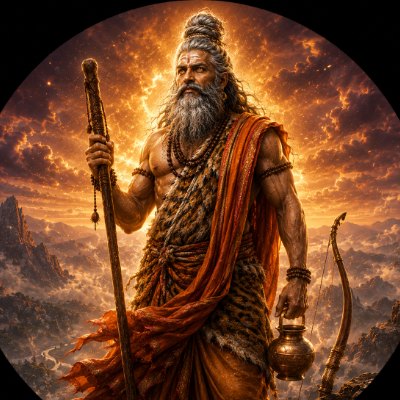
Vishvamitra (Kaushika) — Kshatriya King Who Became a Brahmarishi, Author of the Gayatri Mantra, Preceptor of Rama
Vishvamitra · Viśvāmitra · Kaushika · Vishvarata · Vishvarath · Brahmarishi · Rajarshi · Gadhi-putra · Satyavati-bhrata · Menaka-pati · Shakuntala-pita · Madhavi-pati · Ashtaka-pita · Sushruta-pita · Gayatri-drashta · Rama-guru · Saptarishi
Vishvamitra — born Kaushika (descendant of Kusha) — is one of the seven Brahmarishis of the current Manvantara; the son of King Gadhi of Kanyakubja (who was himself born as an incarnation of Indra through the Caru exchange that gave him Brahmin spiritual qualities) and his unnamed wife; the brother of Satyavati (wife of Richika, mother of Jamadagni, who became the river Kaushiki); the father of Shakuntala (by the apsara Menaka), whose son Bharata became the great emperor for whom India is named Bharatavarsha; the father of Ashtaka (by the princess Madhavi); the father of Sushruta — the father of surgery and author of the Sushruta Samhita, the foundational text of Ayurvedic surgery (per the Mahabharata); the author of most of the Rigveda's Mandala 3, including the Gayatri Mantra (3.62.10) — the most universally chanted prayer in the Hindu tradition; the preceptor of Rama and Lakshmana in the Valmiki Ramayana's Bala Kanda, to whom he gave celestial weapons, trained in the killing of Tataka and Maricha and Subahu, and led to Sita's swayamvara; and the one figure in the entire tradition whose story is primarily the story of a transformation — a king who became a sage not by birth or by inherited right but by sustained, multi-thousand-year effort against his own nature, repeatedly failing and repeatedly beginning again, until he became what he had decided to become. Only twenty-four rishis in the entire tradition are described as having fully understood and wielded the Gayatri Mantra — Vishvamitra is identified as the first of them and Yajnavalkya as the last.
✦ The Names
The name Kaushika — his birth-name — means descendant of Kusha, of the Kusha lineage, belonging to the Kaushika clan. It is a patronymic that records his royal genealogy: the same name is used for his father Gadhi and for the entire lineage. The name Vishvamitra — written Viśvāmitra — is a compound of vishva (all, universe, everything) and mitra (friend, companion, the sun as friend-god). The name means friend of all, universal friend, the one who is a friend to the entire world. It was given to him by Brahma at the culmination of his tapas — not as a description of who he had been but as a statement of what he had become: a man who had spent thousands of years battling his own fury, rivalry, and pride, who had eventually mastered every distraction, every temptation, and every provocation, and who at the end was named for the quality of universal compassion that had replaced all of that. In the Rigveda he appears as Vishvamitra Gathina — the Kaushika Vishvamitra, son of Gathin (another form of Gadhi) — confirming his identity as a Vedic figure whose Rigvedic authorship is historically attested.
✦ Lineage
- Father: Gadhi — king of Kanyakubja; son of Kushanabha; grandson of Kusha (mind-born of Brahma); an incarnation of Indra per the Mahabharata's Shanti Parva; who received the Kshatriya-charged Caru meant for Satyavati, producing a Kshatriya-born son with Brahmin spiritual fire; profiled separately in this series
- Mother: unnamed — the queen of Kanyakubja who exchanged the Caru portions with her daughter Satyavati; who bore Vishvamitra after consuming the Brahmin-charged Caru intended for Satyavati; whose name no primary canonical source records; profiled separately in this series
- Sister: Satyavati — wife of the sage Richika; mother of Jamadagni; grandmother of Parashurama; who became the river Kaushiki after her death; profiled separately in this series
- Paternal grandfather: Kushanabha — founder of Mahodaya (Kanyakubja); whose hundred daughters were deformed by Vayu and healed by Brahmadatta; profiled separately in this series
- Paternal great-grandfather: Kusha — mind-born descendant of Brahma; founder of the Kaushika dynasty; profiled separately in this series
- Daughter (by Menaka): Shakuntala — abandoned at birth on the banks of the Malini river; raised by the sage Kanva; who married King Dushyanta of the Puru dynasty through a Gandharva rite; whose son Bharata became the great emperor for whom India is named Bharatavarsha; profiled separately below in this series
- Son (by Madhavi, per the Mahabharata's Udyoga Parva): Ashtaka — who inherited Vishvamitra's kingdom and ruled after him; born of the princess Madhavi (daughter of Yayati), who was given to Vishvamitra by the sage Galava as part of a complex debt-payment arrangement
- Son (per the Mahabharata's Shanti Parva): Sushruta — the great physician, founder of surgery, and author of the Sushruta Samhita — the foundational text of Ayurvedic surgery describing surgical techniques, instruments, and procedures including plastic surgery; the Mahabharata specifically identifies Sushruta as Vishvamitra's son
- Sons (Rigveda): Madhuchhanda and others — several of Vishvamitra's sons are named as composers of Rigvedic hymns; Madhuchhanda composed many hymns in Mandala 1; their Vedic authorship establishes the Kaushika family as a significant Vedic compositional lineage
- Primary rivals: Vasishtha — the Saptarishi and family priest of the Ikshvaku Solar Dynasty; whose divine cow Nandini (calf of Kamadhenu) refused to come to Vishvamitra when he tried to take her by royal force; whose sons were killed by Vishvamitra's celestial weapons; who eventually acknowledged Vishvamitra as a Brahmarishi — the title that ended their decades-long enmity
✦ The Nandini Episode — The Revelation That Changed Everything
The Valmiki Ramayana's Bala Kanda narrates the event that transformed Kaushika from a king into a seeker. He was touring his kingdom with his army and came to Vasishtha's hermitage. Vasishtha welcomed him with full honours and — to Kaushika's astonishment — fed his entire army of thousands with a lavish feast produced by his wish-fulfilling divine cow Nandini. Kaushika recognised immediately what Nandini was worth — a cow capable of producing unlimited food was more valuable than any kingdom. He offered Vasishtha vast wealth in exchange. Vasishtha refused. Kaushika attempted to take Nandini by force, ordering his soldiers to seize her. Nandini produced from herself an entire army that overwhelmed Kaushika's forces and drove them away. Kaushika tried every celestial weapon he possessed — and Vasishtha's staff neutralised them all. Kaushika was left standing alone, defeated, humiliated, with no weapon that worked.In that moment he understood the fundamental inequality between Brahmin spiritual power and Kshatriya physical force. A king with the finest army in the world and the most powerful royal weapons was helpless before a single old sage with a staff. He resolved then and there to become what Vasishtha was. He renounced his kingdom, gave it to his sons, and set out to perform tapas severe enough to make him equal to the greatest sage he had ever encountered.
✦ The Long Path — Rajarshi, Maharshi, Brahmarshi
The Valmiki Ramayana and the Mahabharata narrate the stages of Vishvamitra's spiritual ascent across thousands of years, each stage marked by a specific title:After a thousand years of severe tapas, Brahma granted him the title of Rajarshi — royal sage — acknowledging his spiritual progress while also noting that he had not yet transcended his royal nature. Vishvamitra was unsatisfied. He wanted more than recognition of his royal virtue. He resumed his tapas.He was then tested by Menaka — Indra's apsara, sent to seduce and distract him. She succeeded. Vishvamitra lived with Menaka for ten years, during which Shakuntala was born. When he realised Indra's stratagem he was furious with himself — not with Menaka, whom he dismissed with a gentle curse of permanent separation rather than a devastating one, recognising that his love for her had been genuine and that she had lost her deceptive intentions long before the ten years ended. He resumed his tapas at the Kaushiki river (named for his family lineage and his sister's transformed form).After more thousands of years Brahma granted him the title of Maharshi — great sage. Still unsatisfied, he resumed his tapas.He then cursed the apsara Rambha — who came to test him — to become a stone for a thousand years, in a fit of rage that depleted all the spiritual merit he had accumulated. Recognising his failure, he went to the Himalayas and performed his most extreme austerity: ceasing to eat, reducing his breathing to a bare minimum, for over a thousand years. Indra came in the disguise of a poor Brahmin and asked for food at the very moment Vishvamitra was about to break a fast of many years by eating rice. Vishvamitra gave the food away instantly and resumed his fast. He refused every subsequent temptation and provocation. At the culmination of this final sustained period of tapas, Brahma appeared with all the devas led by Indra and named him Brahmarishi — and named him Vishvamitra: friend of all, for his unlimited compassion.Vishvamitra then went to Vasishtha. The meeting that had begun with a military humiliation at a hermitage ended with two Brahmarishis greeting each other as equals. Vasishtha first only blessed Vishvamitra — the greeting of a superior to an inferior. When Vishvamitra turned to leave, all pride left his heart and Vasishtha saw the change. He greeted Vishvamitra as an equal. Their enmity ended. The tradition records this final exchange as the confirmation that mattered most: not Brahma's declaration but Vasishtha's greeting.
✦ Key Episodes in the Long Tapas
Several episodes during Vishvamitra's years of tapas are sufficiently significant to note individually.Trishanku Svarga: King Trishanku of the Ikshvaku dynasty wanted to ascend to heaven in his mortal body. Both Vasishtha and the Ikshvaku dynasty's other priests refused him. Vishvamitra — who had every reason to oppose anything Vasishtha approved of — agreed to perform the sacrifice. When the other sages refused to attend, Vishvamitra threatened to curse them. They reluctantly came. When Trishanku was launched upward through the sacrifice, Indra cast him back down head-first. Vishvamitra used his accumulated tapas to halt Trishanku's fall, holding him suspended between heaven and earth, and began creating a parallel heaven — with its own Indra, its own stars and constellations, its own divine beings. Brahma and the other gods, alarmed at the creation of a parallel cosmos, negotiated a compromise: Trishanku would dwell in his own private heaven, suspended and head-downward, permanently. The stars and constellations Vishvamitra had created would remain. The episode is the tradition's most dramatic illustration of what concentrated spiritual power can achieve — and of the cosmic political economy that limits even the greatest tapas.Harishchandra: King Harishchandra, son of Trishanku, was a figure of complete truth — he never lied under any circumstances. Vishvamitra, learning of this quality, made it his business to test whether any human being could truly maintain perfect truth under the most extreme conditions. He put Harishchandra through progressively more devastating trials — the loss of his kingdom, his wife, his son, his freedom, his very identity as a king — until Harishchandra had lost everything and was working as a funeral pyre attendant. And still he never lied. Vishvamitra eventually restored everything and acknowledged the test was complete.Shunahshepa: The young Brahmin boy Shunahshepa was sold by his father Ajigarta (identified in the Aitareya Brahmana as Richika — Vishvamitra's own nephew through his sister Satyavati) to be offered as a human sacrificial victim in place of King Harishchandra's son Rohita. At the sacrificial stake, Vishvamitra taught Shunahshepa two secret mantras. Shunahshepa chanted them. Indra and Varuna appeared, freed him, and blessed him. Shunahshepa survived. Vishvamitra adopted him as his eldest son. His own sons who refused to accept Shunahshepa as their elder brother he cursed to be the lowest of the low — the tradition records this as one of his most self-aware acts of parental severity.
✦ The Gayatri Mantra
The Gayatri Mantra — Rigveda 3.62.10: Tat savitur varenyam bhargo devasya dhimahi dhiyo yo nah prachodayat — is the most universally chanted prayer in the Hindu tradition. It is a prayer to Savitri (the divine sun, the source of all light and intelligence) asking for the illumination of the intellect. It is recited in the morning, at noon, and at sunset as part of the daily Sandhyavandana (twilight prayers) by all initiated males of the three upper varnas. Modern Hindu reform movements have extended its recitation to all castes and genders. The Gayatri Mantra's metre — the Gayatri metre of twenty-four syllables arranged in three lines of eight — gave the mantra its name. The Manusmriti states there is nothing greater than the Savitri (Gayatri) Mantra. The Vishvamitra who composed it — the Kshatriya king who became a Brahmarishi by will alone — is permanently identified with the most sacred of all Vedic prayers.
✦ As Preceptor of Rama in the Valmiki Ramayana
In the Valmiki Ramayana's Bala Kanda Vishvamitra comes to Dasharatha's court and asks for Rama and Lakshmana to protect his sacrifice from the Rakshasa pair Maricha and Subahu. Dasharatha is alarmed — his son is only sixteen years old and the sages are describing terrifying demons. Vasishtha persuades Dasharatha to comply. Vishvamitra leads the two princes through the forest, teaching them along the way: the secret mantra weapons Bala and Atibala that protect from hunger, thirst, fatigue, and attack; the full celestial arsenal of divine weapons — the Astra and Shastra in their totality; how to kill the demoness Tataka (who had been given her strength by Agastya's curse); how to kill Maricha and Subahu; the backstory of every demon and every sacred site they pass through. He leads them to Mithila for Sita's swayamvara, knowing precisely what would happen there. Vishvamitra is the architect of every significant event in the Bala Kanda — he knew in advance that Rama would lift Shiva's bow and win Sita, and he had positioned the young prince to be present for it.
✦ Gotra and Living Legacy
Vishvamitra is one of the eight principal gotras of Brahmins — the Vishvamitra gotra — whose members consider themselves descended from him. All Brahmins belonging to the Kaushika or Vishvamitra gotra trace their lineage to him. The Vishvamitra pravara for the major Kaushika gotra branch is: Vishvamitra, Devarata, Audala — making Vishvamitra the founding rishi of his own gotra line. The gotra is one of the most widely distributed in northern and western India, present across UP, Bihar, Rajasthan, Gujarat, and the Deccan.
✦ References
- Rigveda (Mandala 3, especially Hymns 1–62, including 3.62.10 — the Gayatri Mantra) — the primary canonical Vedic source: Vishvamitra Gathina named as the seer of Mandala 3; the Gayatri Mantra in its original Vedic context
- Valmiki Ramayana (Bala Kanda, Chapters 51–66 — Vishvamitra's genealogy and the journey with Rama; Chapter 65 — the destruction of the hundred Kaushika sons; Uttara Kanda — the story of Trishanku) — the primary canonical narrative source for the majority of Vishvamitra's story
- Mahabharata (Adi Parva — Shakuntala's birth; Udyoga Parva — Madhavi and Ashtaka; Shanti Parva — Vishvamitra as Indra's incarnation, Trishanku Svarga; Anushasana Parva — Vishvamitra's genealogy, the Caru episode; Shanti Parva — Sushruta identified as his son)
- Bhagavata Purana (Canto 9) and Vishnu Purana (Book 4) — the genealogical confirmation of the Gadhi-Vishvamitra chain; the Caru exchange producing Vishvamitra
- Wikipedia — Vishvamitra; Dharmapedia — Vishvamitra; VedicFeed — Brahmarishi Vishvamitra; Glorious Hinduism — Vishvamitra; Religion Fandom — Vishvamitra; Hindu Temple Talk — Vishvamitra: modern summaries drawing from the above primary sources