
About
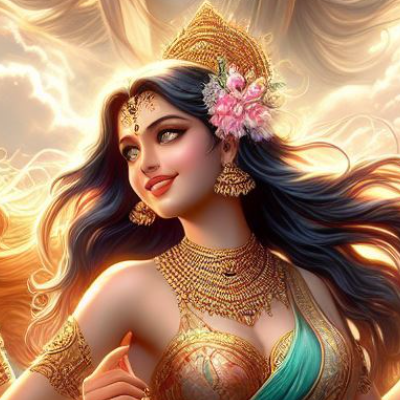
Menaka — Apsara of Indra's Court, Mother of Shakuntala, the One Who Fell in Love With Her Target
Menaka · Menakā · Apsara · Svarga-nartaki · Indra-duti · Vishvamitra-patni · Shakuntala-mata · Pramadvara-mata · Vishvavasu-priya · Samudra-manthana-sambhava
Menaka is one of the most celebrated apsaras in the Hindu tradition; described across multiple sources as the foremost of all apsaras in beauty, grace, and intelligence; a celestial dancer and musician of Indra's court; the mother of Shakuntala — born of Vishvamitra, raised by the sage Kanva, who married King Dushyanta and whose son Bharata gave India its ancient name Bharatavarsha; and the mother of Pramadvara — born of the Gandharva king Vishvavasu, raised by the sage Sthulakesha, who married the sage Ruru. She is most famous as the apsara Indra sent to distract the sage Vishvamitra from his tapas when his growing spiritual power threatened divine authority — a mission she carried out successfully but at the cost of her own heart: she fell genuinely in love with Vishvamitra, an attachment she did not lose when she returned to Svarga and that persisted through the permanent separation he decreed. The Valmiki Ramayana (Bala Kanda, Chapter 62), the Mahabharata (Adi Parva), and the Abhijnanashakuntalam of Kalidasa are the primary sources for her story. She is also described in several Puranic texts as the apsara presiding over the lunar months of Shukra and Shuchi, associated with the sun during the summer season. The earliest textual reference to an apsara named Menaka in her role as a seductress occurs in the Vajasaneyi Samhita of the Yajurveda. In the Rigveda the name Menaka appears as the daughter of a king named Vrishanashva — a different figure, not identified as an apsara.
✦ The Name
The Sanskrit name Menaka — written Menakā — has multiple interpretive traditions. One derives it from mena (fish; or alternatively, understanding, wisdom) with the suffix ka — giving either fish-woman or the wise one. Another connects it to meni (the neck, the nape) — giving the sense of the long-necked beauty. The Wikipedia article on Menaka notes that the name Mena or Menaka appears in the Rigveda as the daughter of a king, without any connection to apsara identity — suggesting the name predates the apsara mythology and was applied to the celestial figure from an existing personal-name tradition. Himavat's wife — the mother of Ganga and Parvati — is also named Mena or Menaka in some Puranic accounts, though this is a distinct figure. The apsara Menaka's name is most simply understood as a personal name whose primary significance is the figure who bears it rather than any derivable meaning.
✦ Lineage and Nature
- Origin: born from the churning of the cosmic ocean (Samudra Manthana) per the Bhagavata Purana and the Wikipedia Vishvamitra article — making her one of the divine gifts that emerged from the churning alongside Lakshmi, the Kalpavriksha, and the nectar of immortality; the most beautiful apsara who emerged from the cosmic ocean was Menaka
- Nature: apsara — a celestial nymph of Svarga; eternal, not subject to aging or death; a dancer and musician of Indra's court; capable of changing form at will; sent by Indra on multiple missions across her canonical career to disrupt the tapas of sages whose growing power threatened divine equilibrium
- Partner (first known episode): Vishvavasu — the king of the Gandharvas; with whom Menaka was connected in a relationship that produced the daughter Pramadvara (recorded in the Mahabharata's Adi Parva, Chapters 8–12); she left Pramadvara on the banks of a river near the sage Sthulakesha's hermitage and returned to heaven without any maternal hesitation — the same pattern of abandon-at-birth she repeated with Shakuntala
- Partner (celebrated episode): Vishvamitra — the Brahmarishi; with whom she lived for ten years after being sent to distract him from his tapas; by whom she bore Shakuntala; whom she genuinely loved; from whom she was separated by his curse — not of devastation but of permanent distance; whose love for her he acknowledged even as he ended the relationship
- Daughter (by Vishvamitra): Shakuntala — born on the banks of the Malini river in the shadow of Himavat; abandoned by Menaka immediately after birth; protected by a group of vultures (shakunta) until the sage Kanva found her; named Shakuntala for those protective birds; raised at Kanva's hermitage; who married King Dushyanta; whose son Bharata gave India its ancient name; profiled separately below in this series
- Daughter (by Vishvavasu): Pramadvara — who was raised by the sage Sthulakesha; who married the sage Ruru; who was bitten by a snake on her wedding day and died; whom Ruru offered to revive by giving half his remaining life; who was revived; whose story is recorded in the Mahabharata's Adi Parva (Chapters 8–12) as an introduction to the Sarpa Satra narrative
✦ The Mission — Hesitation, Compliance, and the Unintended Consequence
The Mahabharata's Adi Parva (the version Vishvamitra himself narrates to Rama in the Bala Kanda and the version narrated to Janamejaya) records Menaka's hesitation before accepting Indra's commission with a precision that distinguishes her from the tradition's other seductress-apsaras. When Indra summoned her and told her what she needed to do, she expressed genuine fear. She described Vishvamitra's formidable energy — his wrath, his self-control, his capacity to curse with devastating precision. She did not want to go. She agreed to go only if Indra promised her the assistance of the wind god Marut (to blow her garments away at the decisive moment) and Kamadeva the love god (to amplify the physical attraction). Indra agreed to both conditions. Menaka went. Marut blew her garments from her at the moment she was dancing before Vishvamitra's hermitage. She pretended to be startled and modest and tried to recover her garments. Vishvamitra saw her — her beauty, her apparent vulnerability, her grace. He invited her to stay. She accepted. They lived together for ten years in what the tradition describes as profound mutual happiness. The Dharmapedia and VedicFeed sources are explicit on a point that the tradition records carefully: Menaka fell in genuine love with Vishvamitra and lost all deceptive intention long before the ten years ended. She had come with a mission; she stayed for something different. When Vishvamitra eventually became aware of Indra's stratagem he recognised what had happened — not just that he had been tricked but that he had genuinely loved the woman who was sent to trick him. He cursed her with separation rather than with punishment: she would be gone from him forever. It was a curse that recorded his love — the cruelest possible departure when love is real is permanent absence, not destruction. She returned to Svarga weeping. He returned to his tapas.
✦ The Abandoned Shakuntala — The Pattern Repeated
The Ancient Indian Stories source records the precise sequence of Shakuntala's birth and abandonment from the primary texts. When Menaka was in the advanced stages of her pregnancy she went to the beautiful Himalayas. On the banks of the river Malini, in the shadow of the great Himavat, she gave birth to a daughter. Then, without maternal hesitation — the same absence of maternal attachment she had shown with Pramadvara — she left the newborn and departed. The child was not entirely unprotected: a group of vultures stood guard around her fragile form, keeping away wild animals. The sage Kanva, walking toward the river Malini, heard the baby's cries and found the infant watched over by the birds. He named her Shakuntala — the child protected by the shakunta birds. He raised her as his own daughter. This abandonment is one of the tradition's most discussed episodes. Kalidasa's Abhijnanashakuntalam significantly modifies it: in Kalidasa's play Menaka is given a maternal dimension largely absent in the Mahabharata's account, and when Shakuntala is abandoned by Dushyanta (due to Durvasa's curse) she is taken to her mother's divine abode rather than left humiliated at court. The Mahabharata's Menaka — who left both Pramadvara and Shakuntala on river banks without looking back — is an apsara who was never designed for motherhood and who carries out the actions appropriate to her divine nature rather than to human maternal expectation. The children she left were not abandoned to death — both were found and raised by devoted sages — but the leaving itself is the tradition's most stark illustration of the distance between celestial and human affect.
✦ In the Skanda Purana — The Reversal
The Wikipedia article on Menaka notes that the Skanda Purana presents a significant reversal of the standard narrative. In this version it is Menaka who becomes infatuated with the handsome and youthful Vishvamitra as he performs penance. She approaches him with sexual advances. He resists her. Angered by his rejection, she curses him. This version inverts the agency entirely — instead of Indra's instrument tempting a sage, it is the apsara's own desire that drives the encounter, and her anger at rejection rather than Vishvamitra's anger at deception that produces the curse. The Skanda Purana version is a minority tradition; the Mahabharata's and Ramayana's accounts are the canonical primary versions followed in this profile.
✦ In Kalidasa's Abhijnanashakuntalam
Kalidasa's Abhijnanashakuntalam — considered the greatest Sanskrit play and one of the greatest works of world literature — transforms Menaka from the epic's instrument-of-Indra into a more complex maternal figure. While retaining her role as the celestial seductress who interrupts Vishvamitra's penance, Kalidasa introduces a significant departure: when Shakuntala is abandoned by Dushyanta due to the curse, Menaka descends from heaven to comfort her daughter and take her to a celestial abode, offering protection and care. This is a profound modification of the Mahabharata's Menaka — the mother who abandoned her daughter at birth becomes, in Kalidasa, the mother who eventually reclaims and protects her. The two portrayals — the Mahabharata's absent mother and Kalidasa's eventually present one — represent the same figure read through different theological and aesthetic priorities.
✦ References
- Valmiki Ramayana (Bala Kanda, Chapter 62) — the primary canonical account of Menaka's mission to Vishvamitra: Vishvamitra narrating to Rama the story of Menaka's seduction; their ten years together; Shakuntala's birth; his dismissal of Menaka; his return to tapas
- Mahabharata (Adi Parva, Chapters 8–12) — Pramadvara's birth from Menaka and Vishvavasu; Menaka leaving her on the riverbank; Sthulakesha raising her; Ruru's marriage to Pramadvara; the snake-bite; Ruru's life-exchange; Pramadvara's revival
- Mahabharata (Adi Parva — the Shakuntala narrative; Dushyanta's visit to Kanva's hermitage; Shakuntala's account of her parentage) — the parallel account of Shakuntala's birth and abandonment
- Kalidasa — Abhijnanashakuntalam — the classical Sanskrit play (4th–5th century CE) adapting Menaka's character with maternal dimensions absent in the epics; Menaka descending from heaven to protect Shakuntala after Dushyanta's rejection
- Bhagavata Purana (12.11.35); Brahmanda Purana (2.23.6; 3.7.14; 4.33.18); Vayu Purana (52.7; 69.49); Vishnu Purana (2.10.7) — Menaka as the apsara presiding over the lunar months of Shukra and Shuchi; associated with the sun during the summer season
- Wikipedia — Menaka; Wikipedia — Shakuntala; Ancient Indian Stories — Vishvamitra and Menaka; Apam Napat — Menaka; Hindu Blog — Story of Sage Vishvamitra and Apsara Menaka; Old World Gods — Vishvamitra and Menaka; Dollsofindia — Shakuntala: modern summaries drawing from the above primary sources