
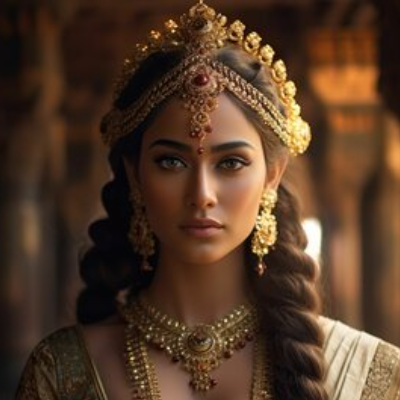
About
Satyavati (Daughter of Gadhi) — Princess of Kanyakubja, Wife of Richika, Mother of Jamadagni, the River Kaushiki
Satyavati · Satyavatī · Gadhi-putri · Kushika-pautrī · Richika-patni · Jamadagni-mata · Parashurama-pitamahi · Kaushiki-nadi · Vishvamitra-bhagini · Bhargava-vamsha-praveshini
Satyavati — not to be confused with the Satyavati who married King Shantanu and was the mother of Vyasa, profiled separately in this series — is the daughter of King Gadhi of Kanyakubja; the sister of Vishvamitra — the great Brahmarishi who is the seer of most of the Rigveda's Mandala 3 and the author of the Gayatri Mantra; the wife of the sage Richika — the son of Aurva, fifth of the five Srivatsa Gotra Pravara rishis; the mother of the great sage Jamadagni — one of the seven Saptarishis of the current Manvantara; the paternal grandmother of Parashurama — the sixth avatar of Vishnu; and after her death, the sacred river Kaushiki (the Kosi river in present-day Bihar and Nepal) — one of the most important rivers of the Himalayan foothills. Her story is narrated in the Mahabharata's Anushasana Parva (Chapter 4, Verses 7–56), the Bhagavata Purana (Canto 9, Chapters 15–16), the Vishnu Purana (Book 4, Chapter 7), and the Harivamsa (Chapter 27). The central episode of her canonical story is the Caru (sanctified porridge) exchange — in which the two portions of rice-milk prepared by Richika with different Vedic mantras for her and for her mother were inadvertently or deliberately swapped, resulting in Jamadagni being born as a Brahmin sage (with suppressed Kshatriya qualities that emerged in the third generation as Parashurama) and Vishvamitra being born as a Kshatriya prince (with Brahmin spiritual qualities that drove his entire life's mission to become a Brahmarishi). Her compassion for her mother — whose request to exchange the portions she accommodated — set in motion one of the tradition's most consequential chains of events: the Jamadagni-Renuka-Parashurama line and the Vishvamitra-Vasishtha rivalry that runs through both the Ramayana and the Mahabharata.
✦ The Name
The Sanskrit name Satyavati — written Satyavatī — is a compound of satya (truth, the real, the actual, the truthful) and the suffix vati (she who possesses). The compound means she who possesses truth, the truthful one, she of truth. It is a name that records the quality most central to Vedic spiritual identity — satya, truth as both ethical practice and cosmic principle. The name's appropriateness is confirmed by the tradition's record: when Richika discovered the Caru exchange and was angry, Satyavati fell at his feet in honest acknowledgment and begged him to mitigate the consequence — she did not deny or hide what had happened. Her transformation into the river Kaushiki after her death is both a liberation and a perpetuation: truth-bearing, always flowing, nourishing the northern plain. The river Kaushiki takes its name from the Kaushika lineage of her father Gadhi — it is simultaneously her river and her brother's river, the Kaushika line's permanent geographical memorial.
✦ Lineage
- Father: Gadhi — king of Kanyakubja (present-day Kannauj in Uttar Pradesh); son of Kushanabha (who married a princess of the Purukutsa dynasty of the Solar lineage); who demanded the bride-price of one thousand white horses with one black ear each; who was childless and performing forest penance when Satyavati was born to him; believed in some traditions to be an incarnation of Indra; profiled separately below
- Paternal grandfather: Kushanabha — son of Kusha (a mind-born son of Brahma per the Valmiki Ramayana; or son of Kushamba per the Puranas); who married a princess of the Purukutsa dynasty and thereby connected his Solar-descended and Lunar-descended lineages; who had a hundred daughters all given in marriage to Brahmadatta
- Mother: not individually named in the primary sources; known as Gadhi's wife or Kushika's daughter-in-law; whose Caru exchange with her daughter set the Caru episode in motion
- Brother: Vishvamitra — the great Brahmarishi; born of Gadhi's wife after the Caru exchange; a Kshatriya king by birth who spent his entire life performing extraordinary tapas to attain the status of Brahmarishi; the author of most of Mandala 3 of the Rigveda including the Gayatri Mantra (3.62.10); who was at constant rivalry with Vasishtha — the family priest of the Solar Dynasty — and eventually received the Brahmarishi title from Vasishtha himself; the father of Shakuntala through the apsara Menaka; Shakuntala's son was the emperor Bharata for whom the Indian subcontinent is named Bharatavarsha
- Husband: Richika — son of Aurva; fifth of the five Srivatsa Gotra Pravara rishis; who obtained the thousand horses from Varuna; who prepared the two portions of Caru; who became angry on discovering the exchange but mitigated the consequence at Satyavati's plea; who gave his son Jamadagni the divine bow Sharanga received from Vishnu through his father Aurva; profiled separately in this series
- Son: Jamadagni — the great sage; one of the seven Saptarishis of the current Manvantara; who married Renuka (daughter of an Ikshvaku king named Renuka per one source, or of King Prasenajit per another); who was killed by the sons of Kartavirya Arjuna; whose death drove Parashurama to his twenty-one rounds of Kshatriya extermination
- Grandson: Parashurama — the sixth avatar of Vishnu; the axe-wielding warrior-sage; one of the seven Chiranjivis; who killed Kartavirya Arjuna and his sons; who exterminated the Kshatriya class twenty-one times; who gave the earth to the sage Kashyapa; who taught Drona and Karna
- Liberation: after her death Satyavati became the sacred river Kaushiki — the Kosi river flowing through Nepal and Bihar — confirmed in the Harivamsa (Chapter 27, Verse 38–40), the Valmiki Ramayana (Bala Kanda, Chapter 34), the Brahmanda Purana, and the Bhagavata Purana as the river into which the truthful and pious Satyavati was transformed
✦ The Marriage — The Impossible Bride-Price
The Mahabharata's Anushasana Parva (Chapter 4, Verse 7) records the background to Satyavati's birth with a precise detail: Gadhi was childless and had gone to the forest desiring a son. Instead, while in the forest, a daughter was born to him — Satyavati, described as having no equal on earth in beauty of appearance. The tradition's standard reading of this sequence is that a king who went to the forest for a son received a daughter instead — and the daughter he received was of such beauty and quality that her birth more than compensated for the son's absence. When the elderly sage Richika came to Gadhi and asked for Satyavati in marriage, the king regarded him as unsuitable — old and ascetic, without the apparent means to maintain a princess. The Vishnu Purana's account preserves Gadhi's implicit reluctance: he was descended from Jahnu and initially hesitated to wed his daughter to the aged sage of the Bhrigu lineage viewing him as unsuitable due to his advanced age and ascetic lifestyle. To make the request impossible without outright refusal, he demanded a bride-price of one thousand white horses with one black ear each — horses of the colour of moonbeams with each having one ear black as the kusa grass. Richika obtained these from Varuna at the Ashvatirtha on the Ganga, and presented them to Gadhi. The king, his condition fulfilled, gave his daughter in marriage as dharma required.
✦ The Caru Exchange — Compassion, Consequence, and the One-Generation Delay
After their marriage Satyavati served Richika devotously. He offered her a boon. She requested not only a son for herself but also for her mother — both women desired sons, and Satyavati's affection for her mother made her ask on both their behalves simultaneously. Richika conducted a yajna and prepared two separate portions of Caru — each charged with different Vedic mantras to produce sons of different qualities. The portion prepared for Satyavati was charged with the Brahma mantra, intended to produce a son of supreme Brahmin spiritual quality. The portion for her mother was charged with the Kshatriya mantra, intended to produce a son of warrior quality appropriate for a Kshatriya queen who would rule through her son. He gave precise instructions: Satyavati was to eat her portion while embracing the Ashvattha (pipal) tree; her mother was to eat hers while embracing the Udumbara (cluster fig) tree. Then he went into the forest for austerities. In his absence Satyavati's mother proposed the exchange — reasoning that a queen's son should be a great warrior, not a gentle sage; and that since her daughter was now a sage's wife, a Brahmin son was more appropriate for her. Satyavati, out of affection for her mother, agreed. Both women ate each other's portions and embraced each other's trees. When Richika returned and saw Satyavati — the Harivamsa records that he saw her in a raudrabhava (a fierce, angry appearance) caused by the Kshatriya-charged Caru she had consumed — he knew at once what had happened. He told her: your mother will give birth to a highly terrible and ruthless son; your brother will be born as a great ascetic conversant with all the Vedas. Satyavati was distraught. She fell to the ground like a beautiful creeper cut in two. Then she gathered herself, bowed before Richika, and begged him to reverse the consequences. She did not want a Kshatriya-fierce son — she wanted a gentle Brahmin scholar, as he had originally intended. The Mahabharata preserves the exact exchange: she said she did not wish to have such a wretch of a Brahmana as her son; Richika replied that he himself had not wished for such a son — on account of the father and mother the son becomes cruel. He then granted her plea: the Kshatriya qualities would not manifest in her son but would be deferred to the next generation. Her son would be born as a Brahmin sage. Her grandson would be the fierce one. Satyavati bore Jamadagni. Her mother bore Vishvamitra. And Jamadagni's youngest son became Parashurama — the deferred Kshatriya fury, one generation later.
✦ Liberation — Becoming the River Kaushiki
The Harivamsa (Chapter 27, Verse 38) records the conclusion of Satyavati's story: the truthful and pious Satyavati now passes as the celebrated river Kaushiki. The Valmiki Ramayana (Bala Kanda, Chapter 34) identifies the river Kaushiki as the transformed form of Vishvamitra's elder sister — Satyavati — who attained liberation and became a river for the purification of the world. The Brahmanda Purana records her liberation in the same terms. The Bhagavata Purana (Canto 9, Chapter 15) confirms: Satyavati became the river Kaushiki. The Kaushiki — identified with the Kosi river flowing through Nepal and the Bihar plain — is named for the Kaushika lineage: both Satyavati's father Gadhi and her brother Vishvamitra belonged to the Kaushika clan, and the river bears the family name permanently. The Kosi is one of the major tributaries of the Ganga, known for its power and its floods — the river's character is consistent with the family whose name it bears: intense, forceful, carrying the mixed Brahmin-Kshatriya energy of the Kaushika lineage. The Mahabharata (Anushasana Parva, Chapter 137, Verse 28) also records the additional detail confirmed by the Manuscrypts.com source: Richika attained Vaikuntha and Satyavati accompanied him in flesh — meaning both sage and his wife attained the supreme divine realm together. After attaining Vaikuntha she became the river Kaushiki and flowed through northern India. This sequence — liberation to Vaikuntha, then transformation to river — is a model of divine service: having attained the highest personal liberation, she returned in a form that would give liberation to others.
✦ References
- Mahabharata (Anushasana Parva, Chapter 4, Verses 7–56 — the Vishvamitra ancestry narration by Bhishma to Yudhishthira) — the primary epic source: Gadhi's forest penance and Satyavati's unexpected birth; the bride-price demand; Richika obtaining the horses from Varuna; the Caru preparation; the exchange; Richika's discovery; Satyavati's distress; her plea; the one-generation deferral; Jamadagni born of Satyavati; Vishvamitra born of Gadhi's wife; Satyavati became the river Kaushiki
- Bhagavata Purana (Canto 9, Chapter 15, Verses 4–11) — the parallel Puranic account; Satyavati as daughter of Gadhi; wife of Richika; mother of Jamadagni; her transformation into the river Kaushiki
- Vishnu Purana (Book 4, Chapter 7) — Gadhi descended from Jahnu; Satyavati as his daughter; the Caru episode; the births of Jamadagni and Vishvamitra
- Harivamsa (Chapter 27, Verses 17–40) — the most detailed Puranic account: Gadhi giving Satyavati to Richika; the Caru preparation; Richika seeing Satyavati in raudrabhava; his statement about father and mother determining the son's nature; the deferred Kshatriya qualities; the explicit verse that the truthful and pious Satyavati became the celebrated river Kaushiki
- Valmiki Ramayana (Bala Kanda, Chapter 34) — Vishvamitra's narration to Rama; the river Kaushiki identified as the transformed form of his elder sister Satyavati who attained liberation
- Manuscrypts.com — Richika (1); Mythologyproject.com — Parashuram Avatar; Sacred-texts.com — Mahabharata Anushasana Parva Chapter 4; Wisdomlib — Satyavati (13 definitions); Wisdomlib — Satyavati and Richika (Vishnu Purana); Wikipedia — Vishvamitra; Wikipedia — Gadhi: modern summaries drawing from the above primary sources