
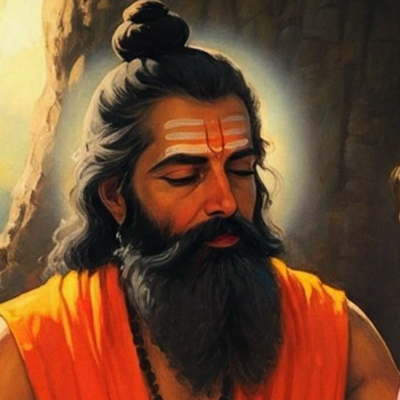
About
Richika — Son of Aurva, Husband of Satyavati, Father of Jamadagni, Grandfather of Parashurama
Richika · Ṛcīka · Rchika · Rchaka · Rishika · Aurva-putra · Satyavati-pati · Jamadagni-pita · Parashurama-pitamaha · Sharanga-dharin · Bhargava · Ajigarta
Richika — written Ṛcīka, also as Rchika and Rchaka in different sources — is the son of the sage Aurva (the thigh-born Bhargava rishi, creator of the Vadavagni); the husband of Satyavati, the daughter of King Gadhi of the Chandravamsha (Lunar Dynasty); the father of the great sage Jamadagni — one of the seven Saptarishis of the current Manvantara; and the paternal grandfather of Parashurama — the sixth avatar of Vishnu, the axe-wielding warrior sage who exterminated the Kshatriya class twenty-one times. He is the fifth and last of the five rishis of the Srivatsa Gotra Pravara — Bhrigu, Chyavana, Apnavana, Aurva, Richika — recited daily in Hindu ritual by all members of the Srivatsa and related Bhargava gotras. His most celebrated episode is the Caru (sanctified porridge) incident — the preparation of two distinct charmed portions of rice-milk for his wife Satyavati and her mother, each portion carrying the qualities of a different Varna; the inadvertent exchange of the two portions between the two women; and the resulting births of Jamadagni (intended as a Brahmin sage, actually born so but with Kshatriya intensity latent until the third generation) and Kaushika-Vishvamitra (intended as a Brahmin but born as a Kshatriya prince who fought his entire life to become a Brahmin). He is described as an old man at the time of his marriage — one of the tradition's several accounts of elderly sages marrying young princesses — and the bride-price he paid for Satyavati was one thousand white horses with one black ear each, obtained from the god Varuna. He received from his father Aurva the divine bow Sharanga — a celebrated celestial weapon — which he later gave to his son Jamadagni. A textual note on parentage: The Mahabharat-Puran Kosh source records that in one Mahabharata passage Richika is called a son of Bhrigu directly; in other Puranic sources he is the son of Aurva or of Apnavana. These are different textual traditions. The Adi Parva's Aurvopakhyana (Chapter 169 et seq.) explicitly places him as the son of Aurva — and this is the position followed in this series.
✦ The Name
The Sanskrit name Richika — written Ṛcīka — derives from the root rc or rich (to praise, to hymn, to sing sacred verses — the same root from which Rigveda derives: Rig = rc, sacred hymn). The name means the singer of hymns, the one of sacred verses, the hymn-rich one. The same root gives the Vedic designation rishi — the seer of Vedic hymns. As a name for the son of Aurva and the father of Jamadagni, placed at the most important generational link in the Bhrigu lineage between the thigh-born sage and the Saptarishi, the name records the central quality of Vedic priesthood: the power of sacred verse. The Aitareya Brahmana also calls Richika by the name Ajigarta — a name used for a Brahmin who sold his son as a sacrificial victim — connecting him to the Shunahshepa episode recorded in both the Rigveda (Mandala 1) and the Aitareya Brahmana (Chapter 33), in which a man identified as Ajigarta sold his son Shunahshepa to King Harishchandra to be offered as a human sacrifice.
✦ Lineage
- Father: Aurva — thigh-born sage; son of Apnavana and Ruchi; grandson of Chyavana and Sukanya; who gave Richika the divine bow Sharanga; profiled separately in this series
- Sister: Kandali — born from Aurva's knee; wife of Durvasa; profiled separately above
- Father-in-law: Gadhi — king of Kanyakubja (Kanauj) of the Chandravamsha (Lunar Dynasty); who demanded the bride-price of one thousand white horses with one black ear each; who received those horses from Richika through Varuna's grace; who simultaneously became the ancestor of Vishvamitra through the same Caru episode — his wife bore him a son of Brahmin quality who became the great Brahmarishi Vishvamitra
- Wife: Satyavati — daughter of King Gadhi; described as very beautiful and of great quality; who wept when Richika first came to ask for her hand because she did not want to bear a son of Kshatriya quality; who requested Richika to arrange that her own son be of Brahmin quality and her grandson be of Kshatriya quality instead; who inadvertently exchanged her portion of the sanctified Caru with her mother's portion; who gave birth to Jamadagni; who later became a river — the Kaushiki river — after attaining liberation through her son Jamadagni's request to Vishnu; not to be confused with the other Satyavati who married Shantanu and was the mother of Vyasa
- Son: Jamadagni — the great sage; one of the seven Saptarishis of the current Manvantara; who received the divine bow Sharanga from his father Richika; whose wife was Renuka; whose five sons included Parashurama as the youngest; who was killed by the sons of Kartavirya Arjuna; whose death drove Parashurama to twenty-one rounds of Kshatriya extermination
- Grandson: Parashurama — the sixth avatar of Vishnu; the axe-wielding warrior sage; Chiranjivi; who killed Kartavirya Arjuna and his sons; who exterminated the Kshatriya class twenty-one times; who gave the earth he had conquered to the sage Kashyapa; who taught Drona and Karna the arts of warfare; who still lives at Mahendragiri mountain
✦ The Bride-Price — One Thousand Horses From Varuna
When the elderly sage Richika came to King Gadhi of Kanyakubja and asked for his daughter Satyavati in marriage, Gadhi was unwilling to give his beautiful young daughter to so old a man. To make the request impossible without outright refusal, he demanded a bride-price that seemed beyond mortal capacity: one thousand white horses, each with one ear of a different colour — specifically, the traditional descriptions record one black ear with the rest of the body white, or alternatively both ears red on the inside and black on the outside. Richika, rather than being deterred, went to the sacred ford of the Ashvatirtha on the Ganga and propitiated the god Varuna — the lord of the cosmic waters and the keeper of divine horses. Varuna, pleased with Richika's devotion, produced the thousand horses from the Ganga's sacred waters. Richika brought them to Gadhi. The king, his impossible condition fulfilled, gave his daughter in marriage as promised. The thousand horses were released back into the Ganga's waters at the Ashvatirtha ford, and the place — known as Asvatiirtha — became a sacred pilgrimage site associated with Richika's devotion and Varuna's grace.
✦ The Caru Episode — The Switched Porridge and Two Destinies
After their marriage, Satyavati served Richika with complete devotion — her daily service, prayers, and care for the household moved him deeply. He offered her a boon. She requested not only a worthy son for herself but the same blessing for her mother. Richika prepared two portions of sanctified Caru — rice-milk porridge charged with specific Vedic mantras. The portion prepared for Satyavati was charged with the Brahma mantra — designed to produce a son of supreme Brahmin spiritual quality, of sattvic nature, gentle and learned. The portion prepared for Satyavati's mother was charged with the Kshatriya mantra — designed to produce a son of Kshatriya warrior quality, of rajasic nature, fierce and powerful. He gave both portions with precise instructions: Satyavati was to consume hers under the Ficus (Ashvattha) tree; her mother was to consume hers embracing a Shami tree. Different trees would reinforce the different qualities of each portion. He then left for the forest. In his absence Satyavati's mother, desiring a son of Brahmin quality rather than Kshatriya quality, proposed that they exchange portions. Satyavati — perhaps from affection for her mother, perhaps from absent-mindedness — agreed. Each consumed the other's portion and embraced the other's tree. When Richika returned and learned what had happened — probably through his divine vision — he was alarmed. He told Satyavati: you have committed a grave error. The portion I prepared for you would produce a son of Brahmin quality — if your mother consumes it, her son will be born with Brahmin qualities. The portion I prepared for your mother was charged for Kshatriya quality — and if you have consumed it, your son will be born with fierce Kshatriya nature. Satyavati was distressed. She begged Richika to modify the consequences. She did not want a son of Kshatriya violence. Richika — reviewing the situation — said he could mitigate the outcome by skipping one generation: your son will be born as a Brahmin sage; but your grandson will be the fierce one who embraces the warrior path. Satyavati accepted. Richika's mother-in-law bore Kaushika — who grew up as a Kshatriya king, then spent his life performing extraordinary tapas until he finally attained the status of Brahmarishi: this was Vishvamitra. Satyavati bore Jamadagni — the great sage, the Saptarishi, the father of Parashurama. And Jamadagni's son Parashurama was born as the fierce warrior who exterminated the Kshatriya class twenty-one times — the grandson of Richika, carrying in full the Kshatriya violence that had been one generation delayed.
✦ The Shunahshepa Connection
The Aitareya Brahmana and the Valmiki Ramayana (Bala Kanda, Chapters 62–65) record an episode in which a man named Ajigarta sold his son Shunahshepa to King Harishchandra to serve as a human sacrificial victim in place of Harishchandra's own son Rohita. The Aitareya Brahmana identifies Ajigarta as a Brahmin who belonged to the Bhrigu lineage. The Mahabharat-Puran Kosh source identifies this Ajigarta as Richika — giving Richika the additional name Ajigarta in the Aitareya Brahmana's tradition. If this identification is correct, Shunahshepa would be Richika's son — a different son from Jamadagni. The Shunahshepa episode is recorded in the Rigveda (Mandala 1, Hymns 24–30) as one of the most celebrated stories of divine rescue from a human sacrifice. Shunahshepa, bound to the sacrificial post, prayed to Varuna and was released by divine grace. He was subsequently adopted by Vishvamitra. Whether this Ajigarta is the same as Richika — and whether Shunahshepa is therefore Richika's son — is a scholarly question that cannot be resolved from the available primary evidence; both traditions are recorded here.
✦ References
- Mahabharata (Adi Parva, Chapters 169–175 — Aurvopakhyana; Chapters 115–117 — the Richika-Satyavati-Caru episode; Anushasana Parva, Chapter 115) — the primary epic source: Richika as the son of Aurva; the bride-price of a thousand horses; Varuna providing them from the Ashvatirtha; the two portions of Caru; the exchange; Richika's alarm and Satyavati's plea; the one-generation delay; Jamadagni and Vishvamitra as the respective births; Satyavati's eventual liberation as the Kaushiki river
- Bhagavata Purana (Canto 9, Chapters 15–16) — the parallel account of Richika, Satyavati, the Caru episode, Jamadagni's birth; and the Jamadagni-Renuka-Parashurama lineage
- Vishnu Purana (Book 4, Chapter 7) — the genealogical confirmation of the Aurva-Richika-Jamadagni-Parashurama chain
- Aitareya Brahmana (Chapter 33) — the Shunahshepa episode; Ajigarta's identification with Richika in the tradition
- Rigveda (Mandala 1, Hymns 24–30) — Shunahshepa's prayer to Varuna from the sacrificial post; the divine rescue
- Wikipedia — Richika; Wikipedia — Jamadagni; Purankosh.in — Richika 1; Geni.com — Rishi Richika; Hindu Blog — Story of Sage Richika; Hindupedia — Aurva; Bhargava Wikipedia: modern summaries drawing from the above primary sources