
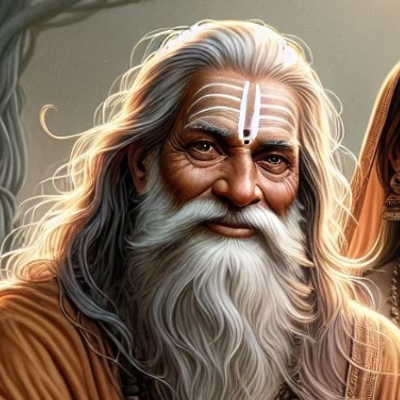
About
Jamadagni — Son of Richika and Satyavati, Saptarishi, Father of Parashurama, Possessor of Kamadhenu, and the Sage Whose Death Launched the Bhargava Campaigns
Jamadagni · Jamadagniḥ · Arcika · Bhargava · Bhrigukulatilaka · Rcika-putra · Satyavati-nandana · Renuka-pati · Parashurama-pita · Saptarishi · Kamadhenu-svami
Jamadagni is one of the seven Saptarishis — the seven great sages of the current cosmic cycle — a descendant of the primordial sage Bhrigu through the line of Chyavana, Aurva, and Richika, the husband of Renuka the Kshatriya princess, the father of five sons of whom the youngest and most celebrated is Parashurama the sixth avatar of Vishnu, and the possessor of the divine cow Kamadhenu whose theft by Kartavirya Arjuna precipitated the chain of events that led to Jamadagni's murder and Parashurama's twenty-one campaigns of annihilation against the Kshatriya race. He is a figure of extraordinary contradictions — a brahmin sage of supreme ascetic power who was also deeply knowledgeable in weapons and warfare, a deeply devotional man who was prone to extreme and disproportionate anger, a sage who was slain with complete non-resistance after instructing his son to perform penance for the sin of killing and who was restored to life by Shukra through the Mritasanjivani — and whose death despite this restoration became the occasion for Parashurama's most violent cosmic missions. He descended from Vishnu in the following order: Brahma — Bhrigu — Chyavana — Aurva — Richika — Jamadagni. The Mahabharata records that Jamadagni was known to possess knowledge of the entire Vedas. He is also listed in the Upanishadic metaphorical identification of the body's sense organs with the seven sages — the two eyes are Vishvamitra and Jamadagni, the right eye being Vishvamitra and the left being Jamadagni. He appears in the Mahabharata's Adi Parva, Drona Parva, Shanti Parva, Anushasana Parva, and Ashvamedha Parva, in the Valmiki Ramayana's Bala Kanda and Uttara Kanda, in the Bhagavata Purana, the Vishnu Purana, the Brahmanda Purana, the Vayu Purana, and the Agni Purana.
✦ The Name
The name Jamadagni is a compound of jama — a variant form of yama meaning restraint, control, the disciplined order — and agni — fire. The compound thus yields "he who controls fire" or "the one who restrains the fire" — encoding simultaneously the sage's relationship to the sacred fire of sacrifice and the more metaphorical fire of the passions whose control and whose occasional failure of control define his biography's most dramatic episodes. The alternative reading gives jama as a root related to jambh — to eat, to consume — making the name "fire-eater" or "the consumer of fire" — a name of austere power appropriate to a sage of his standing. The Mahabharata uses several synonyms for Jamadagni — Arcika (relating to the hymns of praise), Bhargava (of the Bhrigu lineage), Bhrigukulatilaka (the crest-jewel of the Bhrigu family), and Rcika-putra (son of Richika) — all identifying his lineage and his position within the Bhrigu tradition.
✦ Lineage
- Father: Richika — the sage of the Bhrigu lineage whose marriage to Satyavati and the subsequent charu episode directly produced the genealogical swap that made Jamadagni a brahmin sage with kshatriya energy and his brother-by-extension Vishvamitra a kshatriya king with brahmin aspiration. The sage Richika was asked by King Gadhi to bring a thousand white horses with black ears to marry Satyavati. He accomplished this through Varuna's help and married her.
- Mother: Satyavati — the daughter of King Gadhi of the Chandravamsha, sister of Vishvamitra. The critical episode of Jamadagni's birth involves the charu exchange. Richika prepared two portions of milk boiled rice — one with the Brahma mantra for Satyavati and one with the Kshatra mantra for his mother-in-law. Satyavati's mother asked her daughter to swap their portions. Richika said that the child born of his mother-in-law would be a great Brahmana but that his son would become an aggressive warrior. Satyavati prayed to amend this outcome so that her son would be the great Brahmana but her grandson would be the aggressive warrior. This resulted in Jamadagni being born as a sage and eventually Parashurama being born as Jamadagni's son, a warrior with a fearful reputation.
- Paternal lineage: Bhrigu — Chyavana — Aurva — Richika — Jamadagni. Through this chain Jamadagni is a fifth-generation descendant of Bhrigu, one of the seven mind-born sons of Brahma and one of the tradition's most consequential primordial sages.
- Wife: Renuka — the daughter of King Prasenajit (or King Renu in some accounts) of the Solar race. The Mahabharata relates that Jamadagni "obtained entire possession of the Vedas," went to King Renu or Prasenajit of the Solar race, and demanded of him his daughter Renuka. The king gave her to him, and he retired with her to his hermitage. Her profile is given separately in this series.
- Sons — five in the most widely attested account: Rumanvat, Suhotra or Sushena, Vasu, Vishvavasu, and the best known, Parashurama. The Wikipedia Renuka article gives the five as Rumanvan, Suhotra, Vasu, Vishvavasu, and Rama Bhargava (later known as Parashurama). The eldest was Rumanvat. Parashurama — the sixth avatar of Vishnu, the brahmin warrior who destroyed the Kshatriya race twenty-one times — was the youngest and most celebrated.
- Daughter — Anjana: The Wikipedia Renuka article confirms that Renuka and Jamadagni had a daughter, Anjana. This Anjana as Jamadagni's daughter is a separate figure from Anjana the mother of Hanuman who is profiled elsewhere in this series — the name is shared by two distinct figures in different genealogical lineages.
- The divine cow — Susila (Kamadhenu): Once the sage Jamadagni went to Goloka and propitiated Kamadhenu by his tapas. Kamadhenu gave her sister Susila to Jamadagni. The sage presented that cow to his wife Renuka. In some accounts the cow is called Kamadhenu directly; in others Susila is identified as Kamadhenu's sister or a wish-fulfilling cow of equivalent power. The cow's extraordinary hospitality-providing capability — feeding the entire retinue of Kartavirya Arjuna — was the origin of the conflict that led to Jamadagni's murder.
✦ Early Life, Education, and Meeting Renuka
Being of orthodox habits regarding religious observances, Richika brought up his son to be the same way. Jamadagni grew up in the peaceful and sylvan environs of his father's hermitage and diligently studied the Vedas. He regularly meditated and performed austerities and above all was devoted to his parents. The Mahabharata's specific statement that he engaged deeply in study and obtained entire possession of the Vedas gives him the highest possible characterisation of brahminical scholarly achievement. His knowledge extended beyond the Vedas to weapons — he is described as possessing knowledge of all kinds of art and also versed in Vedic texts, Puranas and other sacred Hindu texts, as well as being well versed in handling weapons. When Jamadagni grew up, he wanted to make a long pilgrimage to various sacred places and worship the presiding deities. On his return journey he met King Prasenajit, who observing his bright and calm visage urged him to accept his hospitality. While in the palace Jamadagni became acquainted with the king's daughter Princess Renuka and they fell in love.
✦ The Episode of Renuka's Distraction and the Beheading
The most morally complex episode in Jamadagni's biography — one that every major primary source narrates with variations in detail but consistency in its essential arc — is the beheading of Renuka. According to the Brahmanda Purana, Renuka once went to the banks of the river Narmada to fetch some water. There she observed the king of the Salva kingdom playing with his queen in the water. She stood there mesmerised by the beauty of the sight. The Bhagavanbhakthi source gives the king as the Gandharva Chitraratha rather than the Salva king — different texts specify different figures. The essential event across all accounts is that Renuka was momentarily captivated by the sight of marital happiness she was not herself experiencing — a moment of distraction or desire that caused a lapse in the concentrated spiritual purity through which she maintained her extraordinary powers.As she was distracted she lost her spiritual power, granted to her through her chastity, causing her to lose the water she collected. When she came back to the ashram, Jamadagni divined these events through his yogic power and cursed her lack of devotion. Wikipedia Jamadagni ordered his elder four sons to kill his wife but all of them refused. Jamadagni cursed his four sons and reduced them to ashes for disobeying his order. Wikipedia Enraged, Jamadagni cursed them to lose their minds and live as idiots. Universal Teacher Different sources give different forms of the curse on the disobedient sons — loss of mind, reduction to ashes, exile to the forest — but all agree they suffered for refusing. Then Jamadagni called his fifth son Parashurama, who was meditating on Shiva, and ordered him to behead Renuka. Parashurama immediately obeyed his father's words and beheaded his mother with his axe. Wikipedia
Jamadagni was pleased by Parashurama's devotion and obedience. He then offered a boon to Parashurama, who wisely asked for his mother and brothers to be brought back to life. Jamadagni was impressed by Parashurama's pragmatism and brought Renuka and her four sons back to life. Jamadagni felt strong remorse for what he had done to his beloved and compassionate wife. He then vowed not to get angered ever again and gave up krodha forever. This vow — to abandon anger entirely — is a remarkable biographical fact: the sage who had ordered his wife's beheading in a fit of rage subsequently renounced the very passion that had led him to do so, making his spiritual growth through the episode explicit in the narrative's own account.
✦ Kartavirya Arjuna, the Kamadhenu, and the First Death
Kartavirya Arjuna went for hunting in the forests and feeling exhausted after some time went to the ashrama of Jamadagni with his retinue. Jamadagni received them well and with the help of the Kamadhenu named Susila, gave a sumptuous feast to the king and his followers. When after the meals they started to take leave, a minister of Kartavirya Arjuna brought to the notice of the king the superior powers of Kamadhenu Susila. The king wanted to get the cow and asked the minister to tell the sage about it. Though the minister told Jamadagni about the royal desire, the sage refused to part with the cow. Infuriated by his defiance, the minister struck down Jamadagni, and took Kamadhenu to the king's capital city of Mahishmati.
Parashurama returned, learned what had happened, went to Mahishmati, fought Kartavirya Arjuna, killed him, and retrieved the cow. Jamadagni instructed his son to perform a penance at Mahendragiri in order to cleanse himself of his sins. While Parashurama was away on this penance, Shurasena, a son of Kartavirya Arjuna, and his men exacted their vengeance by beheading Jamadagni at his hermitage, and taking his head with them so that he could not be resurrected again. After waiting for a long time, Renuka started in search of her husband. She saw Jamadagni lying almost dead, in a pool of blood. She fell down and beating her breast cried aloud.
After that they took the dead body of Jamadagni and placed it on fire and began to sing the song of Vishnu. Then the hermit Shukra came by that way and with the help of Mritasanjivani brought Jamadagni to life again. Despite this restoration — a remarkable instance of the Mritasanjivani's power applied to the very situation its acquisition had been meant to prevent — Parashurama's commitment to the twenty-one campaigns was already made irrevocable. The specific mechanism by which the campaigns were triggered is the gesture of his mother: when she saw her son Parashurama she beat her breast twenty-one times and cried. Parashurama took an oath that since his mother beat her breast twenty-one times, he would travel around twenty-one times and put an end to the Kshatriya kings.
✦ Other Mahabharata Episodes
The Vettam Mani Wisdomlib source records several further Mahabharata references to Jamadagni's activities beyond the central narrative. Jamadagni once delivered a speech on the bad sides of accepting rewards to the King Vrishadarbhi. Jamadagni vowed that he was innocent in the affair of the stealing of Agastya's lotus. During the time of the battle of Mahabharata, Jamadagni entered Kurukshetra and advised Drona to stop the battle. According to the Mahabharata, Jamadagni was once unable to tolerate the heat caused by the sun god and shot several arrows into the sky. The sun god, unable to bear the heat of Jamadagni's tapas, appeared before him and gave him a divine bow and a pair of sandals that protected him from the heat — a story that gives Jamadagni a combative relationship with Surya parallel to his son Parashurama's combative relationship with the Kshatriyas. Jamadagni was present at the birth celebration of Arjuna. This hermit is a luminary in the assembly of Brahma.
✦ Jamadagni as Saptarishi
Jamadagni is one of the Saptarishis. The Vishnu Purana, Agni Purana, and Mahabharata list the Saptarishis as: Vasistha, Kashyapa, Atri, Jamadagni, Gautama, Vishvamitra, and Bharadvaja. His inclusion in this supreme group of seven cosmic sages who preside over the current Manvantara gives him a cosmic role beyond the biographical — he is simultaneously a historical figure in the Bhrigu genealogical tradition and a permanently significant cosmic presence maintaining the sacred knowledge of the current age.
✦ Textual Variants and Inconsistencies
The identity of the figure Renuka saw at the river: The Brahmanda Purana gives the king of the Salva kingdom. The Bhagavanbhakthi source gives the Gandharva Chitraratha. The Dharmawiki source gives a different king. The essential event — Renuka's momentary distraction by the sight of royal happiness — is consistent across all accounts while the identity of the figures she observed varies.
The form of the curse on the four sons: The Wikipedia article says they were exiled to forests. The Renuka Wikipedia article says Jamadagni reduced them to ashes. The Dharmawiki says they were cursed to lose their minds and live as idiots. These different forms of the curse are genuine textual variants across the primary source tradition.
Whether Jamadagni was fully killed or only nearly killed by Kartavirya's minister: The Brahmanda Purana version in the Wikipedia article says the minister "struck down Jamadagni" and the Bhagavanbhakthi source says Shurasena subsequently beheaded him during Parashurama's absence. The sequence across different sources is not uniform — some give two assaults, others give one. The most coherent reading from the Vettam Mani source is that the minister struck him near-fatally, Shukra restored him after the first assault, and then the sons of Kartavirya beheaded him irreversibly during Parashurama's penance.
✦ Theological Significance
Jamadagni's theological significance operates through the paradox at the heart of his biography — he is the sage whose excessive anger produced his most destructive act (the beheading of Renuka), and whose non-violent acceptance of death without resistance produced his most cosmically consequential consequence (Parashurama's twenty-one campaigns). The tradition uses him as a portrait of the brahmin warrior whose spiritual power and martial knowledge are inseparable but whose anger — the fusion of both — when it burns beyond its appropriate boundary destroys what it most loves. His eventual vow to abandon anger entirely and his willingness to die at the hands of Kartavirya's sons without fighting back represent the tradition's account of his spiritual transformation — the sage who had ordered his wife's beheading in rage became the sage who accepted his own killing with complete non-resistance, having renounced the very passion that had made him dangerous.
✦ References
- Mahabharata, Adi Parva, chapter 66, stanza 45: Jamadagni as one of the hundred sons of Richika.
- Mahabharata, Drona Parva, chapter 190, stanza 35: Jamadagni entering Kurukshetra and advising Drona to stop the battle.
- Mahabharata, Shanti Parva, chapter 49: The Brahmanda Purana account of Jamadagni's death and restoration confirmed in the Mahabharata.
- Mahabharata, Anushasana Parva, chapters 93-94: Jamadagni's speech on the bad sides of accepting rewards; his vow of innocence in the Agastya lotus affair.
- Bhagavata Purana, Book 9: The birth narrative through the charu exchange between Satyavati and her mother; Jamadagni's lineage from Richika.
- Brahmanda Purana, chapters 61 and 69: The Kamadhenu episode and the death-restoration narrative.
- Vishnu Purana, Book 4, chapter 7: Genealogical confirmation of Jamadagni in the Bhrigu lineage.
- Vettam Mani, Puranic Encyclopaedia (1975): Entry on Jamadagni — the most comprehensive collation of all primary references across the Mahabharata, Ramayana, and the full range of Puranas.