
About
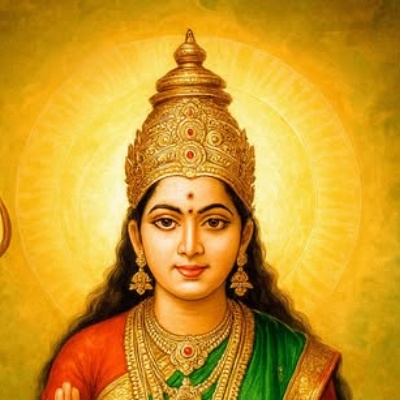
Renuka — Daughter of King Prasenajit, Wife of Jamadagni, Mother of Parashurama, and the Goddess Worshipped Across South and Western India
Renuka · Reṇukā · Yellamma · Manchalamma · Ekvira · Ellai Amman · Jagadamba · Prasenajit-putri · Jamadagni-patni · Parashurama-mata · Pativrata · Shakti-svarupa
Renuka is the wife of the sage Jamadagni, the mother of Parashurama the sixth avatar of Vishnu, and one of the most widely worshipped goddess figures across South and western India — venerated under many regional names in Karnataka, Andhra Pradesh, Telangana, Tamil Nadu, Maharashtra, Madhya Pradesh, and Gujarat, and regarded in these traditions as a manifestation of the Shakti, the divine feminine power, in her most protective and most compassionate form. She is the daughter of King Prasenajit — a Solar dynasty king — making her a Kshatriya princess who married the brahmin sage Jamadagni, giving their household the specific brahmin-kshatriya combination that produced the warrior-sage Parashurama. She is regarded as the mother of Parashurama, the sixth avatar of Vishnu, and is considered a manifestation of the Mother Goddess or Shakti in regional devotional traditions. Her biography contains one of the tradition's most morally charged episodes — the beheading ordered by her husband Jamadagni on the grounds of her momentary mental distraction, her execution by Parashurama, and her subsequent restoration — and her posthumous deification as a goddess is directly connected to the manner of her death and to the quality of her devotion throughout her life. After her death she is worshipped as an incarnation of Goddess Parvati, in various names and in various temples, like Yellamma in Karnataka and Manchalamma in Mantralayam, Andhra Pradesh. She appears in the Mahabharata, the Valmiki Ramayana, the Bhagavata Purana, the Brahmanda Purana, the Skanda Purana, and in an enormous range of regional and oral traditional sources across the Indian subcontinent.
✦ The Names
The name Renuka derives from the Sanskrit renu — dust, pollen, a grain of sand, a particle — and the feminine suffix ka, yielding "the particle one," "she of the dust," or "the one born of a grain." The name is associated with the earth and with the humility of small and essential things — the dust that makes up the earth's surface, the pollen that fertilises flowers, the grain that feeds life. As a goddess name it encodes the principle of the sacred earth-mother, the divine feminine in her most fundamental and most pervasive form — present in every particle of matter rather than in grand cosmic gestures. The regional names under which she is worshipped encode different aspects of her divine identity: Yellamma means "mother of all" or "the mother goddess who is all" — from yella (all) and amma (mother); Ekvira means "the single hero" or "the one powerful one"; Ellai Amman means "the boundary mother," the protective goddess who guards the boundaries of the village; Jagadamba means "mother of the universe." The epithet Prasenajit-putri means "daughter of Prasenajit." Parashurama-mata means "mother of Parashurama."
✦ Lineage
- Father: King Prasenajit — a Solar dynasty king, identified in the Mahabharata as a king who observed Jamadagni's qualities and offered him his daughter. The Mahabharata relates that Jamadagni went to King Renu or Prasenajit of the Solar race and demanded of him his daughter Renuka. The king gave her to him, and he retired with her to his hermitage. Some sources give her father's name as Renu — from whom her name Renuka derives as "daughter of Renu." The two identifications — Prasenajit and Renu — may refer to the same person under different names, or may represent variant traditions about her father's identity.
- Husband: Jamadagni — the Saptarishi, descendant of Bhrigu, one of the most powerful brahmin sages of the tradition. His profile is given separately in this series.
- Sons — five: Rumanvan, Suhotra, Vasu, Vishvavasu, and Rama Bhargava (later known as Parashurama). The four elder sons refused their father's order to behead Renuka and were cursed; the youngest Parashurama obeyed and was granted the boon of restoring his mother and brothers to life.
- Daughter — Anjana: Renuka and Jamadagni had a daughter, Anjana. This Anjana is distinct from Anjana the mother of Hanuman. Her further biography is not elaborated in the primary sources.
✦ Renuka's Extraordinary Spiritual Power Before the Episode
Before the episode of distraction at the river, the tradition records that Renuka possessed extraordinary spiritual powers derived from her complete purity, chastity, and devoted service to her husband. The most celebrated example of this power is the account given in several Puranic sources of her ability to mould water into vessels — to scoop up water from the river in her hands and carry it back to the ashrama without any physical vessel, because her concentrated spiritual purity gave the water a solid-enough consistency to be held. She was distracted — she lost her spiritual power, granted to her through her chastity, causing her to lose the water she collected. The loss of the water she was carrying — the water that her spiritual power had been maintaining in formless-vessel form — was the external sign of the internal lapse, and Jamadagni perceived both dimensions simultaneously through his yogic vision.
✦ The Episode at the River — the Distraction
The tradition gives different accounts of what Renuka saw at the river that caused her momentary distraction. According to the Brahmanda Purana, Renuka once went to the banks of the river Narmada to fetch some water. There she observed the king of the Salva kingdom playing with his queen in the water. She stood there mesmerised by the beauty of the sight. The Bhagavanbhakthi source gives the figure as the Gandharva Chitraratha. The Dharmawiki source — giving perhaps the most morally precise account — records that Renuka felt envious of their beauty, felicity, and happiness, and stood gazing at them for a long time. She finally dragged away her eyes but not her mind. She returned to the hermitage disquieted; cleansed, but not purified. Her mind had given way to very low thoughts. This description — cleansed but not purified, the eyes averted but the mind lingering — is one of the tradition's most psychologically precise accounts of the specific failure it is describing: not an act of transgression but a failure of mental control that allowed desire or envy to enter the mind briefly.
The tradition across all versions is clear that what Renuka experienced was a momentary mental event — not a physical act, not a prolonged fantasy, not a deliberate abandonment of her vows — but a brief, involuntary moment of the mind moving toward what it should not have moved toward. When she came back to the ashram, Jamadagni divined these events through his yogic power. The disproportionality of the punishment — death for a moment's mental lapse — is one of the tradition's most debated moral episodes. The tradition does not resolve this tension but presents it fully and records that Jamadagni himself felt deep remorse afterward and renounced anger entirely.
✦ The Beheading, Restoration, and Jamadagni's Remorse
The episode of the four sons' refusal, their cursing, Parashurama's obedience, the beheading, and the restoration is narrated in the Jamadagni profile above in full. Renuka's specific position in this episode is that of the person to whom everything happens rather than the person who acts — she is the one who was distracted, who was ordered killed, who was killed, who was restored. Jamadagni felt strong remorse for what he had done to his beloved and compassionate wife. He then vowed not to get angered ever again and gave up krodha forever. The characterisation of Renuka as "beloved and compassionate" in Jamadagni's own remorseful description is significant — the tradition acknowledges through the husband's own guilt that the punishment was disproportionate to the offence and that the wife's fundamental quality was compassion rather than transgression.
✦ Renuka's Death and the Sati Account
When Kartavirya Arjuna's sons killed Jamadagni at the hermitage, his wife Renuka performed sati. The Wikipedia Jamadagni article confirms this. The Renuka Wikipedia article gives a variant: according to one legend, the emperor Sahasrarva wanted to marry Renuka. When Parashurama was away, Sahasrarva killed Jamadagni and his four sons and then Renuka jumped into the pond known as Ramsarover. Different regional traditions preserve different accounts of Renuka's death — some through sati at the funeral pyre, some through drowning in a sacred pond, some through a different mechanism — but all traditions agree that her death followed immediately upon Jamadagni's and that from this death her deification arose.
✦ The Goddess Renuka — Regional Worship Traditions
Renuka is venerated across India under various regional names, including Aai Yellamma, Ekvira, Yamai, Ellai Amman, Padmakshi Renuka, Ucchangi Mariamma, and Ellai Amma Mahar. Her worship spans multiple local traditions, where she is regarded as a protective mother goddess. After her death she is worshipped as an incarnation of Goddess Parvati in various names and in various temples, like Yellamma in Karnataka and Manchalamma in Mantralayam, Andhra Pradesh. Devotees revere her as Jagadamba — Mother of the Universe.
The most important temple centre for the Yellamma tradition — Renuka's most widely used South Indian name — is the Saundatti Yellamma temple in the Belagavi district of Karnataka, one of the most visited pilgrimage sites of the region. The Renukamba temple at Mahur in Maharashtra is the site of one of the most ancient Renuka worship traditions in the north Deccan. The Ekvira temple at Karla near Pune — traditionally patronised by the Koli fishing community and by many Maratha families — is another important Renuka centre. The goddess's association with marginalised communities — the Jogini and Devadasi traditions, the Dhobi community, the transgender Hijra community whose patron deity she became in certain regional traditions — reflects the tradition's understanding of her as a goddess who specifically protects those who are vulnerable, liminal, or outside the structures of conventional social protection.
✦ The Mixed-Head Variant
A common version of this story in South India is that a low or out-caste woman sees Renuka being taken to the forest to be killed by her son and the woman intervenes. Unfortunately this only results in her head and Renuka's being cut off, and when the women are restored to life they become goddesses — sometimes this is used as the origin of Yellamma and Mariamman, with each goddess coming from each woman. In this variant, Renuka's and the other woman's heads were accidentally exchanged during the restoration, giving Renuka the body of the low-caste woman and the low-caste woman the body of a brahmin — producing two distinct goddesses from the confusion of the restoration, each carrying a mixed identity that became the theological foundation of their respective communities' worship.
✦ Textual Variants and Inconsistencies
The father's name — Prasenajit versus Renu: The Mahabharata gives her father as King Renu or Prasenajit depending on the specific passage. The name Renuka as "daughter of Renu" supports the Renu identification as her father's name, while other passages give Prasenajit. These may be the same king under two names or two distinct traditions about her paternal identity.
The specific nature of Renuka's distraction: The different primary sources give different objects of her distraction — a human king, a gandharva, a royal couple — and characterise the nature of her reaction differently — mesmerisation at beauty, envy of happiness, desire for intimacy. These variants reflect different theological readings of the episode's moral significance rather than simply different accounts of the same event.
✦ Theological Significance
Renuka's theological significance operates on two distinct levels that the tradition holds simultaneously. At the level of the canonical narrative she is the paradigmatic figure of the devoted wife whose single moment of mental weakness made her the object of punishment so disproportionate that even her husband immediately regretted it — a figure whose story is used in the tradition's moral discourse both as an example of the highest pativrata virtue (before the episode) and as an occasion for examining the limits and excesses of that virtue's demands (the episode itself). At the level of the living goddess tradition she is the supreme protective mother goddess of marginalised communities across South and western India — a goddess whose specific association with those who suffer unjustly, who are beheaded metaphorically or literally by the power structures above them, and who nevertheless are restored to divine dignity gives her worship a specifically consoling and empowering quality for the communities that venerate her most intensely.
✦ References
- Mahabharata, Adi Parva and Drona Parva: The canonical accounts of Jamadagni's family and Renuka's role within it.
- Brahmanda Purana, chapters 61 and 69: The most detailed Puranic account of the river episode and the beheading-restoration narrative.
- Skanda Purana and Devi Bhagavata Purana: Further elaborations of Renuka's biography and her deification as Yellamma-Shakti.
- Valmiki Ramayana, Uttara Kanda: The genealogical context in which Parashurama's parentage — and therefore Renuka's identity — is given.
- Vettam Mani, Puranic Encyclopaedia (1975): Entry on Renuka; collates all primary references across the Mahabharata and the Puranas.
- Alf Hiltebeitel and Barbara Miller (editors), Hair: Its Power and Meaning in Asian Cultures (1998): Contains scholarly analysis of the Renuka-beheading episode and its relationship to the goddess traditions of South India, including the Yellamma cult and the question of the mixed-head restoration variant.
- William Harman, The Sacred Marriage of a Hindu Goddess (1989): Contains analysis of the Renuka goddess tradition in the context of South Indian village goddess worship and the specific communities that centre their devotional practice on her.