
About
Parashurama — Sixth Avatar of Vishnu, Warrior-Sage of the Bhrigu Lineage, Teacher of Bhishma, Drona and Karna, Annihilator of the Kshatriya Race, and the Immortal Who Bridges the Ages
Parashurama · Rama Jamadagnya · Rama Bhargava · Jamadagniputra · Rambhadra · Bhrigukulatilaka · Kshatriyantaka · Samanthapanchaka-karta · Chiranjivi · Kalki-guru · Mahendragiri-vasi
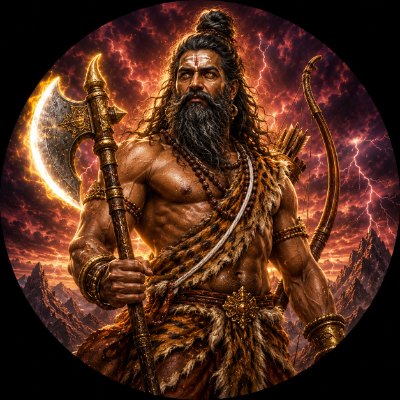
Parashurama is the sixth avatar of Vishnu in the Dashavatara sequence, the son of the Saptarishi Jamadagni and the Kshatriya princess Renuka, the youngest of five brothers, and the only avatar of Vishnu who never dies, never returns to the abstract Vishnu identity, and continues to live in meditative retirement in the Mahendra Mountains in the present age. He is simultaneously a brahmin by lineage and a warrior by vocation — inheriting his father's brahminical learning and his mother's kshatriya martial energy — and the tradition uses this dual identity to position him as the figure who embodies the most extreme consequence of the brahmin-warrior combination: a being whose devotion to the sacred tradition and whose capacity for violence are both without limit. He is the only avatar of Vishnu to coexist with other Vishnu avatars in the same texts — appearing in the Valmiki Ramayana to confront the seventh avatar Rama, and appearing in the Mahabharata as the teacher of warriors who fought on both sides of the eighth avatar Krishna's greatest human conflict. His most consequential biographical act — the twenty-one campaigns of annihilation against the Kshatriya race to avenge his father Jamadagni's murder — is the tradition's most extreme portrait of the consequences of violence answered by further violence, of filial duty carried to cosmic excess. He filled five lakes with the blood of the Kshatriyas he killed — these five lakes are the Samantha Panchaka near Kurukshetra, regarded as sacred ground. He was taught by Shiva himself, received the divine axe Parashu from Shiva, and received the knowledge of all weapons including the Brahmastra. He taught Bhishma the complete science of arms (Mahabharata chapter 5.178), taught Drona weapons knowledge (chapter 1.121), and taught Karna the complete martial arts including the Brahmastra (chapter 3.286) — and the curse he placed on Karna for his deception directly shaped the Kurukshetra war's outcome. As a Chiranjivi he lives in the present age and is prophesied in the Kalki Purana to emerge from his meditative retirement to train Kalki, the tenth avatar of Vishnu, in the use of weapons before the final destruction of the current cosmic cycle. He appears in the Rigveda's Mandala 7 in certain interpretations, in the Mahabharata across multiple Parvas, in the Valmiki Ramayana's Bala Kanda, in the Bhagavata Purana, the Vishnu Purana, the Brahmanda Purana, the Padma Purana, the Agni Purana, the Devi Bhagavata Purana, the Kalki Purana, and in an enormous range of regional traditions particularly along India's western coast.
✦ The Names
The name Parashurama is a compound of parashu — the axe, specifically the battle-axe or single-bladed broad axe — and Rama — a name meaning pleasing, charming, beautiful, or the dark one. The compound thus means "Rama with the axe" or "the axe-bearing Rama" — distinguishing him from his contemporary Rama of Ayodhya, the seventh avatar. His birth name was Rambhadra — "the gracious Rama" or "the auspicious Rama." He is also called Rama Jamadagnya — "Rama son of Jamadagni" — and Rama Bhargava — "Rama of the Bhrigu lineage." The patronymic Jamadagniputra means "son of Jamadagni." Bhrigukulatilaka means "the crest jewel of the Bhrigu clan." Kshatriyantaka means "the destroyer of the Kshatriyas." Samanthapanchaka-karta means "the maker of the five ponds" — a reference to the five lakes of Kshatriya blood. Kalki-guru means "the teacher of Kalki." Mahendragiri-vasi means "the dweller of the Mahendra Mountains."
✦ Lineage
- Father: Jamadagni — the Saptarishi, descendant of Bhrigu through Chyavana, Aurva, and Richika. His profile is given separately in this series. The tradition notes that Parashurama inherited from his father both complete Vedic learning and — through the charu exchange that preceded his father's birth — a portion of kshatriya energy that his father's brahmin austerities had tempered but not extinguished.
- Mother: Renuka — the daughter of King Prasenajit of the Solar dynasty, who possessed extraordinary spiritual power derived from her pativrata devotion. Her profile is given separately in this series. The Vayu Purana's variant account of Parashurama's birth states that he was born from Renuka after she ate a sacrificial offering made jointly to Shiva and Vishnu — giving him dual characteristics of the Kshatriya and the Brahmin from the moment of conception.
- Paternal lineage: Vishnu — Brahma — Bhrigu — Chyavana — Aurva — Richika — Jamadagni — Parashurama. This is a lineage of extraordinary spiritual intensity — from the primordial creative line through the Bhrigu tradition's most ascetically powerful members to the sixth avatar of Vishnu himself.
- Elder brothers: Rumanvat, Suhotra, Vasu, and Vishvavasu — the four elder sons of Jamadagni and Renuka who refused to obey Jamadagni's order to behead their mother and were cursed with loss of reason. They were restored by Parashurama's boon after he had beheaded Renuka and received his father's blessing.
- Teacher — Shiva: Parashurama received his complete martial education from Mahadeva Shiva himself — the divine axe Parashu, the knowledge of all weapons, the Brahmastra and all other divine weapons, and the complete science of warfare. The Vishnu Purana states that he was trained by Shiva and was initiated with the Rudramsha — the element of Shiva's own destructive power — making him protected by the same force that animates the cosmic principle of dissolution. The tradition notes that only Shiva himself can kill those who received the Rudramsha.
- Teacher — Dattatreya: The Tripura Rahasya records that Parashurama received the knowledge of Advaita Vedanta — the teaching of non-dual consciousness — from Dattatreya after his military campaigns were complete. Dattatreya transmitted to him the Tripura Rahasya, the text of non-dual knowledge that balanced the warrior-sage's military formation with philosophical depth.
- Students: Bhishma — who received the complete science of arms from Parashurama at Mahabharata 5.178; Drona — who received weapons knowledge at Mahabharata 1.121; Karna — who received the full martial arts and the Brahmastra at Mahabharata 3.286, under the deception of presenting himself as a brahmin student.
- The primary sources do not give Parashurama a wife or children. Like Kripacharya, his identity is defined entirely by his role as teacher and warrior rather than by domestic or dynastic relationships. He is understood as a lifelong brahmachari-warrior whose vocation excluded the householder's path entirely.
✦ The Divine Axe and Shiva's Training
Parashurama's defining weapon — the Parashu, the divine axe given to him by Shiva — is the instrument whose name became his permanent epithet and whose specific character as a weapon encodes the theological character of his mission. An axe is not a weapon of precision or elegance — it is a weapon of raw power, of cutting down without discrimination, of the force that removes rather than defeats. Unlike the bow which requires precision and skill and the discrimination of target, the axe's function is closer to the woodsman's or the surgeon's — cutting through the diseased or the overgrown with a single clean stroke. That Parashurama's primary weapon is an axe rather than a bow is the tradition's encoding of the nature of his mission: the annihilation of the Kshatriya class was not a war of precision but a comprehensive clearing. Shiva's training gave Parashurama the complete knowledge of all weapons and of all the astras — the divine weapons invoked by mantra. The Brahmastra was among the weapons he received and subsequently taught to both Drona and Karna — the same weapon whose misuse in later generations produced some of the Mahabharata's most catastrophic consequences. Shiva also gave him the boon of immortality through the Rudramsha — making Parashurama's survival of the twenty-one campaigns of annihilation and his continued existence through the Ramayana and Mahabharata periods theologically coherent: the Rudramsha cannot be destroyed by any force other than Shiva himself.
✦ The Beheading of Renuka and the Restoration
The full account of Jamadagni's order to behead Renuka, the four elder brothers' refusal and cursing, and Parashurama's obedience and the subsequent restoration is given in the Jamadagni and Renuka profiles in this series. From Parashurama's perspective the episode is the tradition's most concentrated examination of the quality of total obedience — the willingness to perform an act one would never choose to perform because the father's authority demands it, without hesitation or qualification. The tradition does not present this obedience as morally simple or morally endorsed — the episode generates profound discomfort in every tradition that engages with it — but it presents it as the quality of absolute surrender to the guru that Parashurama embodied more completely than any of his brothers. His immediate request for his mother's restoration as the boon shows that the obedience was not cold indifference to his mother's life but rather a surrender to the hierarchy of authority that did not collapse the higher loyalty even in the moment of its most extreme demand.
✦ Kartavirya Arjuna — the Theft of the Divine Cow and the First Killing
The chain of events leading to Parashurama's twenty-one campaigns began with Kartavirya Arjuna's visit to Jamadagni's ashrama and the subsequent theft of the divine cow Kamadhenu. The full account of the theft and Jamadagni's striking-down is given in the Jamadagni profile. When Parashurama returned to the ashrama and found what had happened, he immediately went to Mahishmati — the capital of Kartavirya Arjuna's kingdom. The battle between them was direct and without extended parley. Parashurama cut off Kartavirya Arjuna's thousand arms with his axe and killed him — the most powerful king of the age, the ruler who had bound even Ravana in battle and imprisoned him, killed by the brahmin sage's son with a single battle-axe. The Padma Purana gives the combat's detail: the mighty son of Renuka cut off Kartavirya's head as Indra cuts a peak from a mountain, and then killed the surrounding kings who fled before him as Garuda kills serpents. The Mahabharata adds that Parashurama spared only the family of Ikshvaku — the Solar dynasty — out of respect for his mother's own Solar lineage connection. He then performed penance at Mahendragiri at his father's instruction to cleanse himself of the sin of killing a king. During this penance, Kartavirya's sons came to Jamadagni's ashrama and beheaded the defenceless sage. When Parashurama returned and found his father's headless body and his mother beating her breast in grief twenty-one times, the cosmic scale of his response was set: he vowed to travel the earth twenty-one times — one circuit for each blow of his mother's grief — and to destroy the Kshatriya race in each circuit.
✦ The Twenty-One Campaigns and the Samantha Panchaka
Parashurama's twenty-one campaigns of Kshatriya annihilation are described across the Mahabharata's Sangraha Parva and Anukramanika Parva and across multiple Puranas as an act without precedent in the tradition's history — the systematic destruction of an entire social class across the known world, repeated twenty-one times because in each circuit the Kshatriya women who survived bore new sons who grew to manhood before the next circuit's beginning. The Mahabharata's account describes him filling five lakes with Kshatriya blood — the five lakes being the Samantha Panchaka near Kurukshetra. These five pools of blood became sacred — the Mahabharata notes that the Pandavas performed religious rites near the Samantha Panchaka before the Kurukshetra war, giving the site of Parashurama's most extreme act a role in the war that ultimately fulfilled the dharmic restoration his campaigns had been intended to achieve. The scale of destruction involved is theological as much as martial — the tradition describes it as the annihilation of the Kshatriya class through multiple generations, a cosmic surgical act whose purpose was to remove the cancer of royal abusiveness that Kartavirya Arjuna represented in its most extreme form. The subsequent repopulation of the Kshatriya class — the widows going to brahmin sages to bear sons who would re-establish the warrior tradition — gives the twenty-one campaigns a paradoxical result: the Kshatriya class that emerged from the campaigns was constituted differently from the one that preceded them, carrying brahmin spiritual discipline into the reconstituted warrior lineages. After the campaigns were complete Parashurama performed severe penance to atone for the sin accumulated through the violence — recognising that even justified violence creates karmic consequences requiring expiation. He offered the earth itself to the sage Kashyapa as the sacrificial fee for the yajna he performed, and Kashyapa told him thereafter to live outside the land he had given away. Parashurama then threw his axe into the Arabian Sea and the land that rose from the sea as the axe landed became the Parashurama Kshetra — the western coastal regions of India from Gokarna to Kanyakumari, including the modern states of Kerala, Karnataka's coastal strip, Goa, and parts of Maharashtra's Konkan coast. He then settled in the Mahendra Mountains.
✦ The Encounter with Ganesha at Kailasha
After defeating Kartavirya Arjuna and rescuing Ravana who had been imprisoned by him, Parashurama went to Mount Kailasha to pay respects to Shiva. At the entrance to Kailasha he encountered Ganesha — Shiva's son — who told him that Shiva was resting and could not be disturbed. Parashurama's nature — the being who could not accept the restriction of access to his own guru — erupted into conflict. He fought Ganesha and threw his divine axe at him. Ganesha, recognising the axe as his father's gift to Parashurama, received it with his tusk rather than deflect it — and the axe, which could not be stopped without causing injury, cut off the tusk. Ganesha's iconography as the single-tusked deity — Ekadanta — is explained in this tradition by the loss of the tusk to Parashurama's axe. The episode gives Parashurama a role in one of the most distinctive features of the most widely worshipped deity in the Hindu tradition.
✦ Teaching Bhishma — the Battle Between Equals
The Mahabharata's Udyoga Parva narrates one of the tradition's most extended teacher-student conflict episodes — the battle between Parashurama and Bhishma. Bhishma had been Parashurama's student and had received the complete science of arms from him. When Amba — the princess of Kashi whom Bhishma had abducted for Vichitravirya's marriage and who had subsequently been refused by Shalva and by Vichitravirya — came to Parashurama and asked him to compel Bhishma to marry her since Bhishma had caused her misfortune, Parashurama agreed to intercede. He went to Bhishma and asked him to marry Amba or release her to be married. Bhishma refused — his vow of lifelong celibacy was irrevocable and he could not marry Amba regardless of whose authority requested it. Parashurama challenged him to battle. The battle between Parashurama and Bhishma is described in the Mahabharata as lasting twenty-three days without either achieving victory over the other — a combat between the teacher who had given Bhishma his weapons and the student who had developed those weapons to their fullest expression, each one capable of matching the other in every dimension of martial skill. Parashurama eventually attempted to use the most powerful weapons in his arsenal but was counselled by the divine beings present to stop — the celestial sages told Parashurama that Bhishma could not be defeated and that Amba would have to find another resolution to her misfortune. Parashurama withdrew, telling Amba directly that he could not compel Bhishma. The episode establishes Bhishma as the only student who matched his teacher completely — Parashurama's acknowledgement of Bhishma's invincibility is the most unambiguous possible marker of Bhishma's standing in the tradition.
✦ Teaching Drona and Distributing Wealth
The Mahabharata's Adi Parva narrates that Drona came to Parashurama at a period when Parashurama was distributing all his possessions — his wealth and knowledge — to brahminical recipients. Drona arrived and asked for the knowledge of all weapons including the Brahmastra. Parashurama, having already given away most of his material wealth, gave Drona what remained — the complete knowledge of all weapons and the specific mantras for invoking and withdrawing each divine weapon including the Brahmastra. This gift to Drona was one of the most consequential single acts of weapon-transmission in the tradition — the Brahmastra that Drona received from Parashurama was the same weapon he subsequently refused to transmit completely to Karna, that Drona transmitted to Arjuna, that Ashvatthama later misused against Parikshit in the womb. The entire cascade of Brahmastra use and misuse in the Mahabharata's later books originates from Parashurama's gift to Drona.
✦ Teaching Karna and the Curse
The Mahabharata's Vana Parva narrates that Karna — who had been humiliated at the tournament when Kripacharya questioned his lineage and who had been refused as a student by Drona on the grounds that he taught only princes — came to Parashurama and presented himself as a brahmin student. Parashurama accepted him and taught him everything he knew, holding nothing back — believing his student to be the brahmin he had claimed. After the complete training was given, the truth emerged: one day while Parashurama was resting with his head in Karna's lap, an insect bored into Karna's thigh. Karna, not wishing to disturb his teacher, endured the pain without moving. When Parashurama woke and saw the wound and the blood, he understood immediately that no brahmin could have endured pain in silence with such kshatriya-style stoicism — and confronted Karna directly. Karna confessed his true identity as the son of a charioteer. Parashurama was not merely angry at the deception — he was devastated by the violation of the teacher-student relationship's foundation of trust. He pronounced the curse that has become one of the Mahabharata's most fateful single acts: that Karna would forget the knowledge of the Brahmastra at the moment when he needed it most. The curse was fulfilled at the Kurukshetra war's seventeenth day when Karna's chariot wheel was stuck and he was struggling to free it, and he could not remember the mantra to invoke the Brahmastra against Arjuna — leading directly to his death.
✦ The Encounter with Rama in the Valmiki Ramayana
The Valmiki Ramayana's Bala Kanda narrates Parashurama's encounter with Rama immediately after Sita's Svayamvara and the breaking of Shiva's bow. When Parashurama heard the tremendous sound of the Pinaka bow breaking — a sound that shook all three worlds — he came immediately to Mithila and confronted the party of King Dasharatha. He was furious at the breaking of the bow that had been given to Janaka by Vishvamitra and that Parashurama regarded as connected to his own guru Shiva. He challenged Rama to prove his worth by stringing a second bow — the Sharanga, the bow of Vishnu — and shooting it. The significance of the bow challenge was not merely martial: the Sharanga was Vishnu's own bow, and only a being of Vishnu's level of divine power could string and shoot it. Parashurama was testing whether the young prince who had broken Shiva's bow was merely a powerful human archer or whether he was something more. Rama took the Sharanga effortlessly, strung it, drew it, and aimed it at Parashurama — asking him to choose between his accumulated merit from austerities and his freedom of movement as targets for the arrow that had to be shot once drawn. Parashurama, seeing the ease with which Rama handled Vishnu's own bow, understood in that moment that Rama was Vishnu himself — a higher incarnation of the same divine identity that Parashurama himself embodied as the sixth avatar. His challenge was the recognition of a superior, and his act of asking Rama to destroy the fruits of his own austerities — giving Rama the weapon's power to consume his accumulated tapas — was an act of surrender to the higher avatar and a formal transfer of avataric responsibility. The Ramayana presents this episode as the marking of the transition from one avatar's era to the next.
✦ The Creation of the Parashurama Kshetra
The tradition of the western coastal lands of India as the Parashurama Kshetra — the Land of Parashurama — is one of the most geographically specific mythological traditions in the entire corpus. After Parashurama completed his campaigns and performed his penance, he was told by Kashyapa to leave the land he had donated as the sacrificial fee. He threw his axe — the divine Parashu — into the sea from a specific point, and the sea receded to the point where the axe landed, revealing land from the water. This land — the narrow coastal strip between the Western Ghats and the Arabian Sea, running from Gokarna in Karnataka to Kanyakumari at India's southern tip, including the modern state of Kerala, Goa, and the Konkan coast of Maharashtra — is the Parashurama Kshetra. The tradition explains the geographical character of this coastal strip — extremely narrow, extremely fertile, receiving exceptional rainfall, bounded on one side by the Ghats and on the other by the sea — as the specific land that the sea gave up at Parashurama's axe-throw. He then brought brahmin families from the north to settle this land, establishing the communities that became the dominant priestly tradition of Kerala and the western coast.
✦ Parashurama as Chiranjivi and the Prophesied Role with Kalki
Parashurama is one of the seven Chiranjivis — he lives in meditative retirement at the Mahendra Mountains, specifically cited in the Bhagavata Purana at 2.3.47. The Kalki Purana prophesies that at the end of the Kali Yuga, when Kalki — the tenth and final avatar of Vishnu — is born to destroy the degenerated order of the age and restore the Satya Yuga, Parashurama will emerge from his meditation at the Mahendra Mountains to serve as Kalki's martial teacher. Having taught Bhishma, Drona, and Karna in the Dvapara Yuga, Parashurama will teach the final avatar the use of weapons in the Kali Yuga — completing the arc from the sixth avatar through the tenth across three cosmic ages. This role makes him not merely an immortal survivor but a cosmic teacher whose presence spans the entire range of the tradition's historical theology from the campaigns against the Kshatriyas through the final dissolution of the current age.
✦ Textual Variants and Inconsistencies
The number of campaigns and the mechanism of Kshatriya repopulation: The number twenty-one is the most consistently attested account across the Mahabharata and the principal Puranas — derived from the twenty-one strikes of Renuka's breast in grief. The mechanism of repopulation across circuits — Kshatriya women bearing sons from brahmin sages who then grew to become new Kshatriyas before the next circuit — is the most widely attested explanation for why twenty-one circuits were required rather than one. Birth from Renuka's thigh in the Devi Bhagavata: The Devi Bhagavata Purana at chapter 6 gives a variant birth account in which Parashurama was born from his mother's thigh with intense light that blinded all warriors present. This variant, not present in the canonical Mahabharata and Vishnu Purana birth accounts, is a specific Devi Bhagavata elaboration emphasising his divine radiance. The sparing of the Ikshvaku lineage: The Padma Purana notes that Parashurama specifically spared the Ikshvaku Solar dynasty — the lineage to which Rama of Ayodhya belonged — out of respect for his mother's Solar lineage connection and at his mother's specific request. This sparing of the Ikshvaku line is what allowed Rama's own ancestry to survive the campaigns, giving the tradition a specific explanation for why the Solar dynasty's lineage was unbroken despite the twenty-one campaigns. Whether Parashurama withdrew his challenge to Rama willingly or was subdued: Different versions of the Ramayana's Bala Kanda encounter give different accounts of how the encounter concluded — some emphasising Parashurama's willing recognition of Rama's superiority, others giving Rama a more explicit martial victory. The Valmiki Ramayana's own account is closer to the mutual recognition version.
✦ Iconography
The Vishnudharmottara Purana and Rupamandana describe Parashurama in his simplest form as a man with matted locks carrying an axe in one hand. The Agni Purana gives him four hands carrying the axe, bow, arrow, and sword. The Bhagavata Purana describes a four-armed warrior icon carrying the axe, bow, arrows, and a shield. In temple iconography he is typically depicted as a vigorous mature figure with matted locks, wearing the sacred thread of the brahmin, carrying the Parashu axe prominently, and often also holding a bow. His stance is warrior-like rather than the meditative posture typical of sages. In the traditions of the Parashurama Kshetra — Kerala, Goa, Karnataka, Maharashtra — his temples place him in the iconographic role of the land's founding protector-deity, combining the sage's ascetic quality with the warrior's martial bearing.
✦ Theological and Philosophical Significance
Parashurama's theological significance is concentrated in three dimensions. The first is his position in the Dashavatara sequence — as the avatar who precedes Rama he represents the penultimate stage of the tradition's account of divine descent into the human world to restore cosmic order, and his specific form — the brahmin warrior who destroys the corrupted Kshatriyas — represents the extreme case of the dharmic correction principle: when the guardians of dharmic order themselves become the violators of dharma, the corrective must come from outside their class. The second dimension is his role as teacher across the tradition's greatest warriors — his weapon knowledge flowed through the Bhishma, Drona, and Karna lineages into the Kurukshetra war itself, making him the indirect progenitor of the martial capabilities that fought on both sides. The third is the moral complexity his narrative embodies — the legends of Parashurama are, as the Wikipedia article's own language notes, specifically notable for their discussion of violence, the cycles of retaliation, the impulse of krodha, the inappropriateness of krodha, and repentance. He is not the tradition's simple hero but its most extended meditation on the relationship between justified anger and cosmic excess, between the legitimate grievance and the disproportionate response.
✦ Connection to the Wider Genealogy
Through his father Jamadagni and the Bhrigu-Chyavana-Aurva-Richika lineage, Parashurama descends from Bhrigu the mind-born son of Brahma and through him from the primordial creative line. Through his mother Renuka and her father Prasenajit, he descends from the Solar dynasty — giving him simultaneous descent through both the brahminical Bhrigu tradition and the royal Solar line. Through his teaching of Bhishma he is the martial ancestor of the Kuru household's entire training tradition. Through his teaching of Drona and the subsequent transmission of the Brahmastra to Ashvatthama and to Arjuna, he is the originating teacher of the most powerful weapon in the Mahabharata's war world. Through his teaching of Karna and the curse on Karna, he is the indirect agent of Karna's death and therefore of the war's final outcome. Through the creation of the Parashurama Kshetra he is the founding ancestral figure of the western coastal traditions. Through his prophesied role as Kalki's teacher he is connected to the final act of the current cosmic cycle. As a Chiranjivi his connection to the wider genealogy is not merely historical but present — he continues to exist in the tradition's understanding of the current age, carrying forward in his living person the lineage that runs from Bhrigu through Jamadagni to the sixth avatar of Vishnu.
✦ References
Primary Sources
- Mahabharata, Adi Parva, chapter 121 (Drona Parva): Parashurama's teaching of Drona including the gift of complete weapons knowledge and the Brahmastra.
- Mahabharata, Vana Parva, chapter 286: Parashurama's teaching of Karna — the deception, the insect episode, the discovery, and the curse.
- Mahabharata, Udyoga Parva, chapters 178–196 (the Parashurama-Bhishma battle): The twenty-three-day battle between teacher and student over the question of Amba; Parashurama's acknowledgement of Bhishma's invincibility.
- Mahabharata, Sangraha Parva and Anukramanika Parva: The twenty-one campaigns, the five lakes of Kshatriya blood, the Samantha Panchaka near Kurukshetra.
- Valmiki Ramayana, Bala Kanda, sargas 75–77: The encounter with Rama after the breaking of Shiva's bow — Parashurama's challenge, Rama's stringing of the Sharanga, Parashurama's recognition of Rama as Vishnu and his withdrawal.
- Bhagavata Purana, Book 2, chapter 3, verse 47: Parashurama's retirement to the Mahendra Mountains in meditative withdrawal.
- Bhagavata Purana, Book 9, chapter 15–16: The birth narrative, the Kamadhenu episode, the killing of Kartavirya Arjuna, the twenty-one campaigns, and the atoning sacrifice.
- Vishnu Purana, Book 4, chapter 7: Genealogical confirmation of Parashurama's lineage through Jamadagni-Richika-Aurva-Chyavana-Bhrigu.
- Kalki Purana: The prophesy of Parashurama's emergence from meditation to train Kalki in the use of weapons before the end of the Kali Yuga.
- Tripura Rahasya: Dattatreya's teaching of Advaita Vedanta to Parashurama after the completion of the military campaigns.
Modern Reference Works
- Vettam Mani, Puranic Encyclopaedia (1975): Entry on Parashurama — the most comprehensive single-volume collation of all primary references across the Mahabharata, Ramayana, and the full range of Puranas.
- Alf Hiltebeitel, The Ritual of Battle: Krishna in the Mahabharata (1990): Contains analysis of the Parashurama tradition's relationship to the Mahabharata's martial theology and the cycles of violence and expiation that his biography embodies.
- Robert P. Goldman (translator), The Ramayana of Valmiki — Bala Kanda (1984): Critical translation with scholarly notes on the Parashurama-Rama encounter episode and its theological significance as a transfer of avataric authority.
- Wendy Doniger, The Hindus: An Alternative History (2009): Contains analysis of Parashurama's place in the Dashavatara sequence and the specific theological function of the warrior-brahmin avatar in the tradition's account of dharmic restoration.