
About
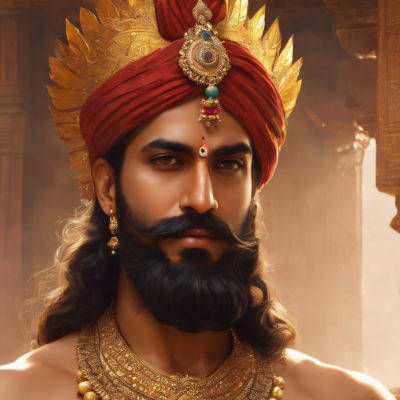
Bharata — Son of Dushyanta and Shakuntala, Emperor of All India, the Name of the Subcontinent, Progenitor of the Kuru Dynasty
Bharata · Bhārata · Sarvadamana · Chakravarti · Digvijaya Chakravartin · Dushyanta-putra · Shakuntala-suta · Kanva-poshita · Bhumanyu-pita · Kuru-vamsha-mula · Bharatavarsha-namahetu · Jivanmukta-tritaya
Bharata is the son of King Dushyanta of the Puru dynasty (Chandravamsha) and Shakuntala — daughter of Vishvamitra and Menaka, raised by the sage Kanva; the great emperor (Chakravarti) who conquered and ruled the entire Indian subcontinent from the Himalayas to the southern sea; the figure after whom India bears its ancient and present name Bharatavarsha — the land of Bharata; the ancestor of the entire Kuru-Paurava dynasty from which both the Pandavas and the Kauravas descended; the performer of an extraordinary series of sacrifices that have never been equalled in the tradition; and a figure of profound spiritual significance — described in the Bhagavata Purana through a separate but connected tradition as having three successive births (as a king, a deer, and finally a fully liberated Brahmin sage) that culminated in complete liberation. He was born as Sarvadamana — the subduer of all — a name his foster-grandfather Kanva gave him for his childhood habit of opening the mouths of lions and tigers and counting their teeth; renamed Bharata by the celestial voice at the moment of his recognition by his father Dushyanta. He had the mark of Vishnu's Sudarshana Chakra on the palm of his right hand and the mark of a lotus whorl on the soles of his feet — divine markings that confirmed his destiny as a Chakravarti emperor. His story is recorded in the Mahabharata's Adi Parva (Chapters 74–79), the Bhagavata Purana (Canto 9, Chapters 20–21), the Vishnu Purana (Book 4, Chapter 19), the Drona Parva, and the Vayu and Brahmanda Puranas.
✦ The Names
His birth-name Sarvadamana — from sarva (all) and damana (subduing, taming) — means the tamer of all, the subduer of everything. It was given by Kanva at his hermitage, recording the child's fearless taming of wild animals as his primary characteristic. His imperial name Bharata is explained through two parallel traditions in the primary texts. The celestial voice at the moment of his recognition declared: since Dushyanta would cherish (bharaswa) this son, the boy would be called Bharata — from the verb root bhr (to bear, to cherish, to nourish, to maintain). The tradition also gives a second meaning: the one who supports and maintains — recording his function as the emperor who sustained the entire subcontinent under one rule. His full imperial title — Digvijaya Chakravartin Samraj Sarvadamana Bharata — the World-Conquering Chakra-possessing Emperor Sarvadamana Bharata — is the tradition's complete designation. The name Bharatavarsha — the land of Bharata — is the ancient Sanskrit name for India that is still used in the Constitution of India in the form Bharat: Article 1 of the Constitution begins India, that is Bharat, shall be a Union of States.
✦ Lineage
- Father: Dushyanta — king of Hastinapura; son of Ilina and Rathantī (Mahabharata) or of Ailina and Upadanavi (Harivamsa); who denied Shakuntala at court until the celestial voice confirmed the union; who named the boy Bharata; profiled separately in this series
- Mother: Shakuntala — daughter of Vishvamitra and Menaka; raised by Kanva; who confronted Dushyanta with magnificent dignity; profiled separately in this series
- Foster great-grandfather: Kanva — the sage at whose hermitage Shakuntala was raised and where Bharata spent his first six years; who named him Sarvadamana; who officiated at all of Bharata's great sacrifices; who donated countless horses and received ten trillion gold coins from Bharata as offerings
- Paternal lineage: Brahma → Chandra → Budha → Pururavas → Ayu → Nahusha → Yayati → Puru → ... → Ilina → Dushyanta → Bharata
- Maternal lineage: Brahma → Kusha → Kushanabha → Gadhi → Vishvamitra (Bharata's maternal grandfather) → Shakuntala → Bharata; Bharata therefore carries both the Lunar Dynasty's royal Kshatriya blood and the Kaushika Brahmarishi's spiritual blood
- Danava lineage (through both parents): through his father Dushyanta (whose mother was Upadanavi per the Harivamsa, daughter of Vrishaparvan the Danava king) and through the Puru dynasty itself (Puru's mother Sharmishtha was also Vrishaparvan's daughter) — Bharata carried Danava blood through two independent channels both tracing to Vrishaparvan
- Wives: three daughters of the Vidarbha king per the Bhagavata Purana (Canto 9, Chapter 20, Verse 34); and in the Mahabharata's first tradition for Bhumanyu's birth, a princess Sunanda daughter of Sarvasena king of Kashi
- Sons by the three Vidarbha wives: nine sons — all killed by their own mothers because Bharata declared they bore no resemblance to him; the mothers feared he would abandon them for perceived infidelity and preemptively killed the children
- Son Bhumanyu — two traditions:
- First tradition (Mahabharata Adi Parva): Bharata married Sunanda daughter of Sarvasena the king of Kashi and begot upon her Bhumanyu
- Second tradition (Mahabharata Adi Parva alternate): after the nine sons were killed, Bharata performed the Marut-stoma sacrifice with the sage Bharadvaja officiating; Bhumanyu was born from this sacrifice as a gift from Bharadvaja; the Drona Parva states this Bhumanyu was also called Vitatha
- Dynasty through Bhumanyu: Bharata → Bhumanyu → Suhotra → Hastin (founder of Hastinapura) → Vikunthana → Ajamidha (who had multiple sons and whose line produced several important clans) → ... → Kuru (of Kurukshetra) → Shantanu → Bhishma, Dhritarashtra (through Vichitravirya, born of Vyasa and Ambalika via Niyoga), Pandu → the Pandavas and Kauravas
✦ Childhood — The Lion-Tamer of Kanva's Hermitage
Bharata grew up at Kanva's hermitage for his first six years, with no human companions other than his mother and the ascetics of the ashrama. Wild animals were his playmates. The Mahabharata records his childhood quality with the image that has become his most celebrated characteristic: he used to open the mouths of lions and tigers and count their teeth. No wild animal could intimidate him, overpower him, or refuse him. The child who had been born with the strength of ten thousand elephants and the marks of a Chakravarti emperor on his palms and soles expressed those qualities from his very first years — through the taming of the most dangerous animals the forest offered, with his bare hands, as a game. When Kanva sent Shakuntala and the boy to Hastinapura for recognition, the Mahabharata records that even the courtiers of Dushyanta recognised that this was no ordinary child.
✦ Recognition — The Celestial Voice and the Name
When Shakuntala arrived at Dushyanta's court with the six-year-old Sarvadamana, Dushyanta denied knowing them. After Shakuntala's celebrated speech and at the moment she turned to leave, the Ashareerivani (celestial voice) spoke. The Mahabharata preserves the exact words of the divine declaration: the mother is only the receptacle; it is the father by whom a son is begotten; cherish thy son Dushyanta; treat not Shakuntala with disrespect; sons who are born from the paternal loins rescue their progenitors from the infernal regions; thou art the parent of this boy; Shakuntala has spoken truth. From the command to cherish (bharaswa) — the boy was named Bharata. Dushyanta acknowledged him, installed him as heir-apparent, and explained his prior denial as a necessary strategy to protect the boy's future claim to the throne from any question of doubtful paternity.
✦ The Imperial Conquests — Bharatavarsha
After succeeding Dushyanta on the Hastinapura throne, Bharata undertook the Digvijaya — the all-directional conquest — that established his title of Chakravarti emperor. He conquered the entire subcontinent from the Himalayan ranges in the north to the southern sea — an extent of territory the Vishnu Purana defines as extending from north of the ocean to south of the snowy mountains, the land called Bharata where the descendants of Bharata dwell. The Drona Parva (Mahabharata) records the extraordinary scale of his sacrificial programme: he performed one thousand eight hundred Ashvamedha yajnas (horse sacrifices — each of which symbolically claimed universal sovereignty), one hundred Rajasuya yajnas, and hundreds of Vajapeya yajnas. These numbers are the Mahabharata's measure of the incomparable extent of his rule and the incomparable scale of his religious merit-making. Kanva officiated at these sacrifices. Bharata donated countless horses and ten trillion gold coins to his grandfather Kanva as the dakshina (sacrificial fee). He distributed so many cows that each of thousands of Brahmins received one badva (approximately thirteen thousand) as his individual share. He bound thirty-three hundred horses for these sacrifices and astonished all other kings. The Bhagavata Purana records that he ruled for twenty-seven thousand years — the tradition's measure of a reign of such extraordinary completeness that it could only be expressed in cosmological time.
✦ The Nine Sons Killed — The Wife-Mother Paradox
Despite his extraordinary reign Bharata was not satisfied with his children. He had nine sons by three wives — all daughters of the Vidarbha king — but none of them resembled him in physical appearance or quality. The Mahabharata records his response directly: he looked at them and said these are not mine. This statement — intended as a factual observation about resemblance — was received by his wives as an accusation of infidelity. Fearing that he would abandon them for having borne him children who did not appear to be his, the three queens killed all nine children. Bharata was left without an heir of his own blood. He performed the Marut-stoma sacrifice with the great sage Bharadvaja and received the boy Bhumanyu as the son born from that sacred ceremony — or in the alternate tradition married the Kashi princess Sunanda and had Bhumanyu by her. Bhumanyu continued the dynasty.
✦ Retirement, the Deer, and Three Births — The Bhagavata Purana Tradition
The Bhagavata Purana (Canto 5, Chapters 7–14) narrates a celebrated separate tradition — the Jada Bharata narrative — which describes the retirement and successive births of Bharata as a philosophical teaching about the nature of attachment and liberation. After fulfilling all his royal duties and distributing the kingdom to his children, Bharata retired to the Himalayan forests to perform tapas with the ultimate purpose of attaining liberation. His meditation deepened and advanced to the highest stages. One day he rescued a fawn from a river — a baby deer whose mother had leaped across the river in fright and died on the other bank. He brought the fawn home to his forest cottage. He became attached to it — fed it, played with it, worried about it when it wandered. His meditation suffered. Eventually Bharata died not in meditation but in anxiety about the missing fawn — and because of this attachment his next birth was as a deer. The tradition carefully records that he retained memory of his previous human life throughout his deer-birth — he avoided the company of other deer, sought out holy men's ashramas, and waited. He was born again as a human — a Brahmin named Jada Bharata (the dull or silent one) who pretended to be dim-witted to avoid entangling himself in worldly affairs, walking without looking down so as not to step on insects, refusing to work, and behaving as an idiot to all who met him. Eventually King Rahugana encountered him, had him carry his palanquin, grew angry at his uneven gait, and challenged him — and from the exchange that followed Jada Bharata delivered the most celebrated philosophical discourse of the Bhagavata Purana's fifth Canto on the nature of consciousness, time, and the illusory distinction between the carrier and the carried. He attained liberation. A note on these two Bharatas: the Bhagavata Purana's Jada Bharata is traditionally identified as the same figure as the emperor Bharata who follows his dharma to completion and then follows his attachment to its consequence and then follows the consequence to liberation. Not all scholars accept this identification but the tradition affirms it.
✦ The Name of India
The Vishnu Purana (Book 2, Chapter 3) contains the defining verse: uttaram yat samudrasya himadreshchaiva dakshinam — varsham tad bharatam nama bharati yatra santatih — the country that lies north of the ocean and south of the snowy mountains is called Bharata, where the descendants of Bharata dwell. This verse — cited in courts, constitutions, scholarship, and devotion — is the formal Puranic statement of what Bharata's name means for the subcontinent. The modern Indian Constitution uses this heritage explicitly: Article 1 recognises both India and Bharat as the official names of the republic. The tradition that recorded Bharata's story began by noting that a celestial voice named a six-year-old boy at his father's court for the act of cherishing him — and that name, carried forward through a dynasty and an empire and a subcontinent, is still in use.
✦ References
- Mahabharata (Adi Parva, Chapters 74–79) — the primary canonical source: Bharata named by the celestial voice; his childhood taming of wild animals; the nine sons killed by their mothers; Bhumanyu born of the Marut-stoma sacrifice with Bharadvaja; the dynasty chain through Bhumanyu and Suhotra to Hastin and Kuru
- Mahabharata (Drona Parva) — the scale of Bharata's sacrifices: one thousand eight hundred Ashvamedhas, one hundred Rajasuyhas, hundreds of Vajapeyas; Kanva officiating; the ten trillion gold coin donation
- Bhagavata Purana (Canto 9, Chapters 20–21) — the three Vidarbha wives; the nine sons killed; the Marut-stoma sacrifice; Bhumanyu born; the twenty-seven thousand year reign; Bharata's marks of a Chakravarti on palm and sole
- Bhagavata Purana (Canto 5, Chapters 7–14) — the Jada Bharata narrative: Bharata's retirement; the rescue of the fawn; the fatal attachment; death in anxiety about the fawn; rebirth as a deer with memory; the Brahmin birth as Jada Bharata; the palanquin episode with Rahugana; the philosophical discourse; liberation
- Vishnu Purana (Book 2, Chapter 3) — the defining Bharatavarsha verse; Book 4, Chapter 19 — the genealogical chain from Bharata through Bhumanyu to the Kuru dynasty
- Wikipedia — Bharata (Mahabharata); VedicFeed — King Bharata; Mahabharata-resources.org — Bharata; Storiesofindiaretold.com — Shakuntala Dushyanta Birth of Bharata; Amar Chitra Katha — Shakuntala Dushyanta and Birth of Bharata: modern summaries drawing from the above primary sources