
About
Sarvasena — King of Kashi, Father of Sunanda
Sarvasena · Kashiraja · king of Kasi · father of Sunanda
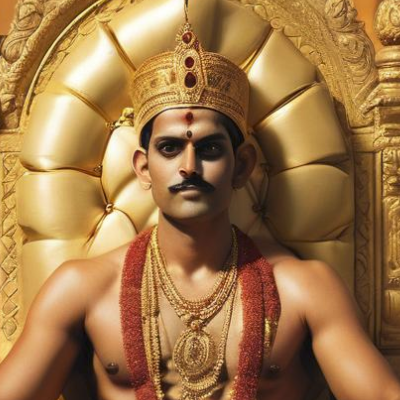
Sarvasena is a figure in the Hindu epic tradition, identified in the Mahabharata's Adi Parva as the king of Kashi — the sacred kingdom on the Ganga also known as Varanasi or Benares — and as the father of Sunanda, who became the wife of Emperor Bharata of the Puru-Bharata lineage of the Chandravamsha lunar dynasty. He appears in a single verse of the genealogical recension preserved in Adi Parva Chapter 95, introduced in the same breath as his daughter in a passage recited by the sage Vaishampayana during his narration of the Puru-Bharata dynastic sequence to King Janamejaya. Beyond this single mention his reign, parentage, personal history, and any narrative episodes are entirely unrecorded in the primary sources. His significance in the tradition is structural — he represents the first attested marriage alliance between the Kashi kingdom and the Puru-Bharata imperial line, a pattern of political-matrimonial connection between these two dynasties that recurs across subsequent generations in the Mahabharata tradition. He is entirely distinct from the later Kaurava prince of the same name who appears in the lists of Dhritarashtra's sons.
✦ The Name
The name Sarvasena is a Sanskrit compound of sarva — meaning all, entire, or complete — and sena, meaning army or military force. The name therefore carries the sense of "he who commands the entire army" or "lord of all forces," a name of martial aspiration entirely consistent with Kshatriya naming conventions and with the identity of a king ruling one of the most powerful kingdoms of the ancient Indian tradition. The title Kashiraja combines Kashi — the name of the kingdom and sacred city — with raja, the Sanskrit word for king, functioning as a standard royal designation for the ruler of Varanasi. The name Sarvasena recurs in the Mahabharata as the name of one of the hundred sons of Dhritarashtra, the blind Kuru king — a completely separate figure belonging to a much later generation of the same broad dynastic world, whose appearance in Kaurava army lists has no connection to the Kashi king recorded here.
✦ Lineage
- Kingdom: Kashi — one of the most ancient and sacred kingdoms of the Indian tradition, situated on the western bank of the river Ganga; a recurring power in the Mahabharata's political geography and a kingdom that maintained consistent matrimonial and political relations with the Kuru-Bharata house across multiple generations.
- Daughter: Sunanda — given in marriage to Emperor Bharata of the Puru-Bharata line; mother of Bhumanyu, Bharata's son and successor in the Chapter 95 genealogical recension of the Adi Parva.
✦ Textual Variants and Inconsistencies
Sarvasena's attestation rests entirely on the single verse in Adi Parva Chapter 95 in which he is named as Sunanda's father and identified as the king of Kashi. He does not appear in the alternative Bharata succession account of Chapter 94, which does not name Bharata's wives or their fathers at all. No other primary source independently names a Kashi king called Sarvasena in this genealogical context. The homonym problem with the Kaurava prince Sarvasena — listed among Dhritarashtra's hundred sons in later parvas of the Mahabharata — requires explicit disambiguation: these are two separate individuals in different genealogical lines separated by many generations, sharing only a name.
✦ Connection to the Wider Genealogy
Sarvasena's genealogical significance is carried entirely through his daughter Sunanda and the alliance her marriage represents. By giving Sunanda to Emperor Bharata, Sarvasena established the first recorded matrimonial connection between the Kashi royal house and the Puru-Bharata imperial line — the dynasty from which the Kuru kings, the Pandavas, and the Kauravas all ultimately descend in the Chapter 95 recension. This pattern of Kashi-Kuru matrimonial alliance is one of the recurring structural features of the Mahabharata's dynastic geography, reaching its most celebrated later expression when Bhishma — the grand-uncle of the Pandavas and Kauravas, son of the Kuru patriarch Shantanu and the river goddess Ganga — abducted the three Kashi princesses Amba, Ambika, and Ambalika for his half-brother Vichitravirya, an episode that directly precipitates several of the Mahabharata's most consequential narrative developments. Sarvasena stands at the beginning of this long thread of Kashi-Kuru connection, his single verse of attestation anchoring a genealogical relationship whose consequences extend far beyond his own unelaborated reign.
✦ References
- Mahabharata, Adi Parva, Chapter 95 (verse 32 / Mbh.1.95.5266): The sole primary source naming Sarvasena; identifies him as the king of Kashi and as the father of Sunanda who was given in marriage to Emperor Bharata; the verse is part of a genealogical recitation by the sage Vaishampayana to King Janamejaya.
- Mahabharata, various parvas, Dhritarashtra's sons lists: Names a separate Sarvasena as one of the hundred sons of the blind Kuru king Dhritarashtra; recorded here solely for the purpose of distinguishing this later figure from the Kashi king of the same name.
- Vettam Mani, Puranic Encyclopaedia (1975): Secondary reference consolidating Mahabharata data on the Kashi kingdom and its recurring role in the matrimonial politics of the Kuru-Bharata dynastic world.