
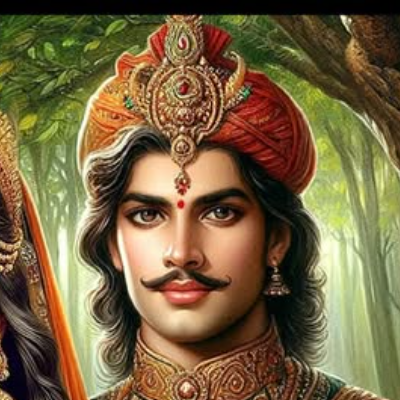
About
Bhumanyu — Son of Emperor Bharata, King of the Paurava Line
Bhumanyu · Bhumanyu Bharata · Bharataputra
Bhumanyu is a king of the Paurava branch of the Lunar dynasty, son of the great emperor Bharata — the son of Dushyanta and Shakuntala from whom the Indian subcontinent takes the name Bharatavarsha — and father of Suhotra, who is in turn the father of Hastin, founder of Hastinapura. Bhumanyu is attested in the Mahabharata, the Bhagavata Purana, the Vishnu Purana, and the Harivamsha as a son of Bharata and as the continuation of the Paurava royal line toward the Kuru-Pandava generation. His narrative significance extends beyond a purely genealogical role: his birth is connected in some Puranic accounts to the dramatic episode of Bharata's rejection of his biological sons as unworthy heirs and the obtaining of a suitable successor through exceptional means, making Bhumanyu one of the more narratively contextualised figures in this stretch of the Paurava dynastic sequence. The primary sources for this profile are the Mahabharata's Adi Parvan, the Bhagavata Purana's ninth skandha, the Vishnu Purana, and the Harivamsha.
✦ The Name
The name Bhumanyu is a Sanskrit compound of bhuma or bhumi (the earth, the ground, or existence in its most expansive sense) and anyu or the root an (to breathe, to live, or to be animated) — yielding the meaning "one animated by the earth," "the earth-spirited one," or "he who breathes with the power of the earth." An alternative etymological reading connects the second element to manyu (spirit, ardour, wrath, or passionate energy), giving the compound the meaning "he whose spirit is as vast as the earth" or "the earth-wrathful one" — a name entirely consistent with the Kshatriya tradition of names expressing power, vastness, and martial energy. The earth association in the name is significant in the context of Bharata's lineage: Bharata himself is the great emperor who is said to have conquered and unified the entire earth, and a name meaning "earth-spirited" for his son carries the implicit suggestion of inherited dominion over the earthly realm.
✦ Lineage
- Father: Bharata — the great emperor of the Paurava Lunar dynasty, son of the king Dushyanta and the hermit girl Shakuntala (foster daughter of the sage Vishvamitra and born of the apsara Menaka). Bharata is celebrated in the Mahabharata and across the Puranic tradition as the greatest of the Paurava kings — a universal monarch (chakravartin) who conquered the entire earth and performed numerous great sacrifices. His name is given to the Indian subcontinent as Bharatavarsha. The Mahabharata's Adi Parvan narrates his story in detail, including the famous episode of Dushyanta's initial failure to recognise Shakuntala due to the sage Durvasa's curse and his eventual recognition of her and their son. Bharata's reign is presented as a golden age of righteous imperial rule against which subsequent generations are measured.
- Mother: The question of Bhumanyu's mother is a point of genuine variance across the primary texts and is connected to the dramatic episode of Bharata's rejection of his sons described below. Different accounts give different mothers for Bhumanyu depending on which version of the heir-obtaining narrative they follow. The Mahabharata account and the Puranic accounts are not fully consistent on this point and the variance is noted honestly in the episode section below.
- Son (principal): Suhotra — the father of Hastin, the founder of Hastinapura. Suhotra is the most genealogically consequential of Bhumanyu's sons for this reference series, as it is through Suhotra that the Paurava line descends to Hastin, Ajamidha, and the entire branching structure of Kuru and Panchala royal lines documented in the lower portions of the tree.
- Additional sons: The Bhagavata Purana and the Vishnu Purana name additional sons of Bhumanyu alongside Suhotra. The Bhagavata Purana Skandha IX gives Bhumanyu's sons as including Suhotra and several others — the names vary between the Bhagavata Purana, the Vishnu Purana, and the Harivamsha accounts without producing a fully consistent list. The most genealogically important of these sons for the present tree is Suhotra; the additional sons are recorded here as a statement of the tradition's acknowledgement that Bhumanyu's household was not limited to a single son, without asserting specific names that are not uniformly confirmed across sources.
✦ Bharata's Rejection of His Sons and Bhumanyu's Birth
The most significant narrative context for Bhumanyu's existence in the primary texts is the episode of the emperor Bharata's rejection of his sons as unworthy heirs. The Mahabharata's Adi Parvan and several Puranas narrate that Bharata had multiple sons born of his wives, but that when he evaluated them he found none of them possessed the qualities — the brilliance, the righteousness, the martial and spiritual excellence — that he deemed necessary for the heir to his great empire. He accordingly rejected all of his biological sons as unfit to succeed him, an act of extraordinary royal severity that left the succession in crisis.
In response to this crisis, the tradition narrates that Bharata performed great sacrifices and austerities to obtain a worthy son through divine intervention. The Mahabharata account states that the Maruts — the Vedic storm deities, the divine companions of Indra — gave Bharata a son in response to his sacrifices. This divinely granted son is identified in some accounts as Bhumanyu, making him a figure of exceptional origin — not merely the biological son of a great king but a divine gift to the royal line, obtained through sacrificial merit when natural succession had failed. This account of Bhumanyu's origin gives him a status parallel to other divinely obtained sons in the Puranic tradition — figures whose exceptional birth circumstances mark them as specially destined for the royal function they inherit.
The Harivamsha and some Puranic accounts give a variant of this episode in which the divine origin of the heir is narrated differently or in which Bhumanyu is identified as the son of a specific wife of Bharata rather than as a divinely granted son. The Bhagavata Purana's account of this stretch of the dynastic sequence is more compressed than the Mahabharata's and does not narrate the rejection episode in the same detail. These variant accounts cannot be fully harmonised in their literal particulars and are presented here as separate strands of the tradition surrounding the same genealogical transition.
✦ Textual Variants and Inconsistencies
The principal textual inconsistencies surrounding Bhumanyu are the following. The question of whether Bhumanyu is the divinely granted son obtained through the Marut sacrifice or a biological son of Bharata by a specific wife is not resolved consistently across the Mahabharata and the Puranas. Some accounts of the heir-obtaining narrative assign the divinely granted son a different name — in certain passages the son obtained through the Marut sacrifice is given a name other than Bhumanyu, and Bhumanyu is then placed as a biological son of Bharata from a different narrative strand. The number and names of Bhumanyu's own sons vary between the Bhagavata Purana, the Vishnu Purana, and the Harivamsha without producing a fully consistent list. The generational count between Bharata and Hastin — within which Bhumanyu is placed — itself varies between sources as noted in the Suhotra profile, meaning that Bhumanyu's precise position in the generational sequence is subject to the same overall variance that characterises this entire stretch of the Paurava dynasty.
✦ Connection to the Wider Genealogy
Bhumanyu occupies the generation immediately below the emperor Bharata in the Paurava Lunar dynasty tree of this reference series — a position of considerable symbolic weight, as Bharata is the figure from whom the subcontinent takes its name and whose reign represents the tradition's paradigm of righteous imperial rule. Through his son Suhotra, Bhumanyu connects downward to Hastin — the founder of Hastinapura — and through Hastin and Ajamidha to the entire branching structure of Kuru and Panchala royal lines whose profiles are documented throughout this genealogical series. Through his father Bharata, Bhumanyu connects upward to Dushyanta, Shakuntala, Puru, Yayati, Nahusha, Pururavas, and ultimately Soma the moon god, the progenitor of the entire Lunar dynasty. If the account of his divine origin through the Marut sacrifice is followed, Bhumanyu also carries a connection to the Maruts — the Vedic storm deities of the divine retinue of Indra — making him one of the few kings in the Paurava line whose parentage is both royal and divine in the direct sense rather than merely through the distant ancestry of the lunar lineage.
✦ References
Primary Sources
- Mahabharata, Adi Parvan: The principal epic source for the episode of Bharata's rejection of his sons, the Marut sacrifice, and the obtaining of a worthy heir; contains the narrative context within which Bhumanyu's birth is placed and the genealogical passages that establish his position as Bharata's son and Suhotra's father.
- Bhagavata Purana, Skandha IX: The most systematically organised Puranic account of the Paurava Lunar dynasty including Bhumanyu's position as Bharata's son and Suhotra's father, and the names of Bhumanyu's sons.
- Vishnu Purana: Provides a parallel Puranic genealogical account of the same dynastic stretch, confirming Bhumanyu's position while giving a variant account of his sons.
- Harivamsha: The appendix to the Mahabharata containing supplementary genealogical and narrative material on the Paurava dynasty including variant accounts of Bharata's heir-obtaining episode and Bhumanyu's position in the succession.
Modern Reference Works
- Pargiter, F.E. Ancient Indian Historical Tradition. Oxford University Press, 1922: The genealogical reconstruction examining Bhumanyu's position in the Paurava dynasty, the variant accounts of his birth and sons, and the broader question of the generational sequence between Bharata and Hastin.
- Mani, Vettam. Puranic Encyclopaedia. Motilal Banarsidass, 1975: Provides an entry on Bhumanyu covering his identification as Bharata's son, his connection to the Marut sacrifice narrative, and his position as Suhotra's father in the Paurava dynastic sequence.
- Hiltebeitel, Alf. Rethinking the Mahabharata. University of Chicago Press, 2001: Addresses the narrative of Bharata's rejection of his sons and the obtaining of a divine heir within the broader context of the Mahabharata's dynastic theology and the tradition's understanding of righteous succession.