
About
Vijaya — Dasarha Princess and Queen of the Bharata Line
Vijaya · Vijayā · Dasarhi · Dāśārhī · Dasarhakanya
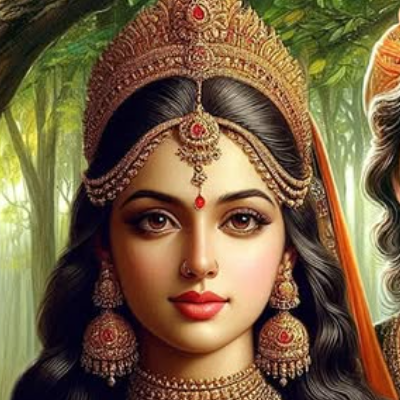
Vijaya is a princess of the Dasarha branch of the Yadu lineage and the wife of Bhumanyu, a king of the Puru dynasty and son of the celebrated Emperor Bharata. She is the mother of Suhotra, through whom the Puru royal succession continued toward the line of Kuru, Shantanu, and the Kuru dynasties of the later epic age. Vijaya is attested in the prose genealogical recitation of the Puru dynasty contained in the Adi Parva of the Mahabharata, the passage known as the Puru Vamsha Kathana, which was recited at the snake sacrifice of King Janamejaya. Her profile is necessarily brief, as the text records her identity and maternal role in a single genealogical statement without further narrative elaboration.
✦ The Name
The name Vijaya is among the most common auspicious names in the Sanskrit tradition, formed from the root vi-ji, meaning to conquer or to be victorious, with the suffix -a yielding the noun victory or the victorious one. As a feminine name, Vijaya carries the sense of she who is victorious or the embodiment of victory. The name is borne by numerous figures across the Vedic, epic, and Puranic traditions and carries no distinctive etymological marker specific to this queen beyond its general royal and auspicious character. She is identified in the Puru Vamsha Kathana passage by the gentilic epithet Dasarhi or Dasarhim — meaning the daughter of Dasarha or the princess of the Dasarhas — which designates her paternal lineage. The Dasarhas are a well-attested branch of the Yadu clan, one of the primary divisions of the Lunar dynasty, with their own territorial identity in the Puranic geographical tradition. The same gentilic Dasarhi is used in the Mahabharata for women of this lineage more broadly, but in the Puru Vamsha Kathana it functions as the specific designation of Vijaya's origin.
✦ Lineage
- Father: Dasarha — a king and founder of the Dasarha branch of the Yadu clan within the Lunar dynasty. The Dasarhas are recorded in the Puranic tradition as a significant Yadava sub-lineage with their own territorial domain. Dasarha's parents are not named in the Puru Vamsha Kathana passage.
- Mother: Not named in the primary source passage.
- Father-in-law: Emperor Bharata — the celebrated son of King Dushyanta and Shakuntala, one of the most prominent sovereigns of the Lunar dynasty and the figure from whom the Bharatavarsha tradition takes its name. Bharata's imperial reign is narrated extensively in the Adi Parva of the Mahabharata.
- Mother-in-law: Sunanda — a princess of Kashi and wife of Bharata, recorded in the same Puru Vamsha Kathana as the mother of Bhumanyu.
- Husband: Bhumanyu — a king of the Puru dynasty and son of Emperor Bharata and Sunanda. He succeeded his father in the Puru royal line and is the figure through whom the dynasty continued toward the Kuru kings of the later epic age.
- Son: Suhotra — born of Vijaya and Bhumanyu; a king of the Puru line whose own succession continued through Hasti, the figure credited in the tradition with the foundation of the city of Hastinapura, the capital of the Kuru kingdom in the Mahabharata.
✦ Textual Variants and Inconsistencies
The Vishnu Purana and certain parallel Puranic accounts name Bhumanyu's wife as Pushkarini rather than Vijaya. These two names are given to the same positional figure — wife of Bhumanyu, mother of Suhotra — and the sources do not explain the divergence or equate the two names within their own texts. Whether Pushkarini and Vijaya are two names for the same queen, or whether they represent distinct women in variant traditions of the Puru genealogy, cannot be determined from the surviving primary sources. The Puru Vamsha Kathana of the Mahabharata Adi Parva reads Vijaya; the Vishnu Purana reads Pushkarini. Both are primary sources of authority and the discrepancy is noted here without adjudication.
✦ Connection to the Wider Genealogy
Vijaya's marriage to Bhumanyu represents a significant matrimonial alliance between two major branches of the Lunar dynasty — the Puru line descending from Puru, son of Yayati, and the Yadu line descending from Yadu, the elder son of the same Yayati. Both branches trace their ultimate patrilineal origin to Yayati, making this union a convergence of the two principal Chandravamsha lines at the level of Bhumanyu's generation. In the Puranic tradition, Yayati cursed his elder son Yadu for refusing to exchange his youth, and the Yadava line accordingly lost the right of succession to Yayati's throne, which passed to the younger son Puru. The Dasarha branch, as a division of the Yadava lineage, thus belongs to the collateral line that was excluded from the main Puru royal succession. Vijaya's entry into the Puru royal house through her marriage to Bhumanyu therefore brings Yadava blood into the main dynastic line at a critical early juncture.
Through her son Suhotra and the subsequent generations of Hasti, Ajamidha, and the Kuru kings, Vijaya is a direct matrilineal ancestress of the entire Kuru house of the Mahabharata's central narrative, including both the Pandavas and the Kauravas.
✦ References
- Mahabharata, Adi Parva, Adhyaya 95 (critical edition; corresponding to Adhyaya 90 or 94 in some regional recensions including the Kumbakonam and Ganguli editions): The primary source for Vijaya. The Puru Vamsha Kathana prose passage names her as a Dasarha princess, wife of Bhumanyu, and mother of Suhotra. All genealogical facts in this profile derive from this passage.
- Vishnu Purana, Book IV: Names Bhumanyu's wife as Pushkarini rather than Vijaya in the corresponding genealogical passage; the primary source for the Vijaya-Pushkarini variant and the basis for the inconsistency noted in the Variants section.
- Kisari Mohan Ganguli (trans.), The Mahabharata of Krishna-Dwaipayana Vyasa, Adi Parva, Chapter 95: English translation of the Puru Vamsha Kathana, used for cross-reference of the genealogical sequence involving Bhumanyu, Vijaya, and Suhotra.
- Mani, Vettam. Puranic Encyclopaedia. Motilal Banarsidass, 1975: Provides entries on Bhumanyu and the Dasarha lineage relevant to establishing Vijaya's paternal origin and her position in the Puru genealogy.