
About
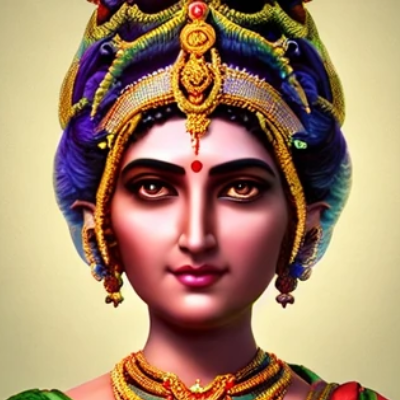
Somaprabha — Daughter of Maya, Wife of Nalakubara
Somaprabha · Soma-prabha · daughter of Maya Danava
Somaprabha is a daughter of Maya — the celebrated Danava architect, one of the most renowned figures among the asura races for his mastery of architecture, illusion, and the arts of construction — and his wife Hema, an Apsara of the heavenly realms. She is the sister of Svayamprabha, and she became the wife of Nalakubara, the son of Kubera, lord of wealth. Her marriage to Nalakubara is recorded in the Kathasaritsagara, the celebrated classical Sanskrit narrative collection composed by Somadeva in the eleventh century, which draws upon older narrative traditions. Somaprabha is a figure of mixed Danava and Apsara descent through her parents, and her marriage to Nalakubara — a being of divine and sage lineage through Kubera and Vishrava — represents one of the tradition's characteristic unions across the boundaries of divine and demonic lineage. Her individual narrative profile beyond the genealogical record of her parentage and marriage is limited in the currently available primary sources.
✦ The Name
The name Somaprabha is a Sanskrit compound of two elements. The first, soma, carries a range of meanings in Sanskrit — it refers to the moon, to the sacred Soma plant and its ritual juice, and to qualities of coolness, gentleness, and luminosity associated with the moon. The second element, prabha, means "radiance," "lustre," "light," or "splendour." The compound name thus means "she of lunar radiance," "she who shines like the moon," or "moonlight-splendoured." It is a name of considerable poetic beauty encoding qualities of cool, gentle brilliance — a fitting name for the daughter of Maya, whose own name is associated with illusion and the magical manipulation of appearances, and whose architectural and artistic genius produced structures of extraordinary beauty. Her sister's name Svayamprabha — meaning "self-luminous" or "she whose radiance is her own" — forms a natural companion name, both sisters bearing names built around the concept of prabha, radiance or light.
✦ Lineage
- Father: Maya — also called Mayasura and Maya Danava, one of the most celebrated figures among the Danava race, son of Kashyapa and Danu. He is renowned across the Mahabharata, the Ramayana, and the Puranas as a master architect and engineer of supernatural skill, whose works include the palace of illusions built for the Pandavas in the Mahabharata — the assembly hall whose deceptive floors of crystal misled Duryodhana — and the construction of the city of Tripura, the triple city of the asuras destroyed by Shiva. He is also credited with authorship of the Surya Siddhanta, an astronomical treatise, in some traditions. Through his mother Danu he belongs to the Danava lineage descending from Kashyapa and Danu, daughter of Daksha.
- Mother: Hema — an Apsara of the heavenly realms, wife of Maya. Her union with Maya gives Somaprabha a dual ancestry — Danava on the paternal side through Maya and Danu, and Apsara on the maternal side through Hema. This dual lineage is itself characteristic of certain figures in the Puranic tradition where Danava males and Apsara females produce offspring of mixed celestial and demonic descent.
- Sister: Svayamprabha — a daughter of Maya and Hema, named alongside Somaprabha in the sources that record Maya's family. The Kathasaritsagara identifies both Svayamprabha and Somaprabha as daughters of Maya. Svayamprabha is also attested in the Valmiki Ramayana's Kishkindha Kanda as the ascetic woman who dwells in the cave of Riksha on behalf of the Apsara Hema — a figure of great spiritual power who helps Hanuman and the Vanaras during their search for Sita by transporting them out of the cave. Whether the Svayamprabha of the Ramayana and the Svayamprabha named as Maya's daughter in the Kathasaritsagara are the same figure or different figures sharing the same name cannot be conclusively established from the available sources, and this should be noted as an unresolved question.
- Half-sister through father: Mandodari — the celebrated wife of Ravana, king of Lanka, described in the Valmiki Ramayana as a woman of great beauty and virtue. The Uttara Ramayana identifies Mandodari as a daughter of Maya by a different mother — the Apsara Hema in some accounts, though other accounts give different details of her maternal parentage. If both Mandodari and Somaprabha are daughters of Maya, they are sisters or half-sisters. This would make Somaprabha the sister or half-sister of Mandodari, and thereby the sister-in-law of Ravana — the same Ravana whom her husband Nalakubara's brother Nalakubara cursed for violating the Apsara Rambha. The sources do not explicitly draw this connection, but it follows from the genealogical record.
- Husband: Nalakubara — a son of Kubera, lord of wealth, and his wife Bhadra, daughter of the Danava Mura. Nalakubara is known in the tradition for his liberation by the infant Krishna in the Yamala-Arjuna episode narrated in the Bhagavata Purana, and for his curse upon Ravana following Ravana's violation of his wife Rambha, which restrained Ravana from violating Sita during her captivity in Lanka.
✦ Her Father Maya and His Significance
Understanding Somaprabha's identity requires some elaboration of her father Maya, one of the most consequential Danava figures in the Puranic and epic tradition. Maya is the pre-eminent architect among the asura races, whose counterpart among the divine beings is Vishvakarma, the architect of the gods. He is attested across a remarkably wide range of texts and episodes. In the Mahabharata he is the builder of the Pandavas' magnificent assembly hall at Indraprastha — the hall whose crystal floors appeared as water and whose water appeared as floors, leading to Duryodhana's humiliation and his burning enmity toward the Pandavas. This assembly hall is presented as the finest structure ever built on earth, a work of such supernatural craft that it exceeded anything previously seen in the mortal world.
In the Ramayana tradition Maya is associated with the construction of Lanka and with the cave palace described in the Kishkindha Kanda. In the Shiva Purana he is the architect of Tripura, the triple city of gold, silver, and iron that housed the asuras until its destruction by Shiva in the form of Tripurantaka. In some Puranic accounts Maya is credited with the composition of the Mayamata, a text on architecture and town planning, and with the Surya Siddhanta, a foundational astronomical text. His daughter Mandodari became the wife of Ravana, making Maya the father-in-law of the demon-king of Lanka and the grandfather of Meghanada, also known as Indrajit, who defeated Indra in battle.
Somaprabha thus belongs to one of the most distinguished Danava families in the tradition — a family whose head is the supreme architect of the asura world, whose works shaped the physical landscape of the epics' most significant locations, and whose daughter through another line became the queen of Lanka.
✦ The Significance of Her Dual Lineage
Somaprabha's parentage — a Danava father and an Apsara mother — places her in a genealogically complex position characteristic of several figures in the Puranic tradition. The Danavas are a class of asuras born of Kashyapa and Danu, ranged in cosmic opposition to the Devas. The Apsaras are celestial beings of the divine realm, associated with beauty, music, and the pleasures of heaven, and are not classed among the asuras. The union of a Danava male with an Apsara female produces offspring who carry both lineages — the power and the sometimes turbulent nature of the Danava inheritance combined with the beauty and celestial quality of the Apsara lineage.
This dual inheritance is reflected in the names given to Maya's daughters: Somaprabha and Svayamprabha are names of luminous, gentle beauty — names more typical of Apsaras or divine beings than of Danavas — suggesting that in the tradition's understanding, the daughters inherited the Apsara quality of their mother Hema more than the Danava quality of their father Maya. That Somaprabha became the wife of Nalakubara, son of Kubera and grandson of a Saptarishi, reinforces this reading: she is received into the divine household of the lord of wealth as a fitting consort, her dual lineage not presenting an obstacle to her marriage into the highest levels of the divine order.
✦ Textual Base and Attestation
Somaprabha's attestation in the primary sources is limited to the Kathasaritsagara, in which her parentage as a daughter of Maya and her marriage to Nalakubara are recorded. The Kathasaritsagara, composed by the Kashmiri poet Somadeva in the eleventh century CE, is a classical Sanskrit text of considerable authority that draws upon older narrative traditions — including the now-lost Brihatkatha of Gunadhya — and preserves genealogical and narrative material not always found in the Puranas or the epics. Its testimony is legitimate as a primary classical source, though it belongs to a different stratum of the tradition than the Mahapuranas or the two great epics, and information attested only in the Kathasaritsagara should be understood as belonging to the classical narrative tradition rather than to the core epic or Puranic canon.
No individual narrative episode specific to Somaprabha herself — beyond the genealogical record of her parentage and marriage — is preserved in any primary source currently available. Her profile is accordingly brief and proportional to the evidence, following the principle that honesty about the limits of the textual base is preferable to padding with uncertain material.
✦ Connection to the Wider Genealogy
Somaprabha's position in the wider genealogical tradition is determined by the convergence of several significant lineage streams in her own person and in her marriage. Through her father Maya she belongs to the Danava lineage of Kashyapa and Danu, and to the most celebrated architect family of the asura world. Through her mother Hema she belongs to the celestial Apsara lineage. Through her probable half-sister Mandodari she is connected to Ravana and to the entire Rakshasa royal family of Lanka. Through her husband Nalakubara she is connected to Kubera and through him to the entire Pulastya-Vishrava sage lineage descending from Brahma, to the solar dynasty through Vishrava's maternal grandfather Trinabindu, and to the Krishna narrative of the Bhagavata Purana through the Yamala-Arjuna episode. These connections make Somaprabha, despite her limited individual narrative profile, a figure who stands at the junction of the Danava, Apsara, Rakshasa, divine, and sage lineages of the Puranic world — a genealogical position of considerable complexity and interest.
✦ References
- Primary Sources
- Kathasaritsagara, Madanamancukalambaka, Taranga 3 (Somadeva, 11th century CE): The principal and sole currently identified primary source recording Somaprabha as a daughter of Maya and wife of Nalakubara, and naming her alongside her sister Svayamprabha as one of Maya's two daughters.
- Mahabharata, Sabha Parva: Provides the fullest account of Maya the Danava as architect of the Pandavas' assembly hall, establishing the identity and significance of Somaprabha's father within the epic tradition.
- Valmiki Ramayana, Uttara Kanda: Provides narrative detail on Maya as the father of Mandodari, wife of Ravana, establishing the broader family of which Somaprabha is a member through her father.
- Valmiki Ramayana, Kishkindha Kanda: Contains the episode of Svayamprabha in the cave of Riksha, providing narrative context for the figure who shares Somaprabha's paternal lineage, with the caveat that the identification of this Svayamprabha with Maya's daughter is not conclusively established.
- Vishnu Purana, Book I: Records the genealogy of Kashyapa and Danu and the Danava lineage descending from them, establishing the broader cosmological context for Somaprabha's paternal birth lineage through Maya.
- Secondary Sources
- Mani, Vettam. Puranic Encyclopaedia. Motilal Banarsidass, 1975: Provides entries on Maya the Danava and on Nalakubara, within which Somaprabha's parentage and marriage are noted with reference to the Kathasaritsagara passage.
- Penzer, N. M. (ed.). The Ocean of Story: Somadeva's Kathasaritsagara. 10 vols. Chas. J. Sawyer, 1924–1928: Provides an English translation and annotation of the Kathasaritsagara, including the Madanamancukalambaka section in which Somaprabha's identity and marriage are recorded.
- Wisdomlib (wisdomlib.org): Offers cross-referenced citations of both Somaprabha and Maya across digitised Sanskrit texts, confirming their attestation in the Kathasaritsagara and related classical sources.