
About
Khara — Son of Vishrava and Raka, Governor of Janasthana
Khara · Kharavana · Son of Raka · Half-brother of Ravana · Governor of the Danda Kingdom
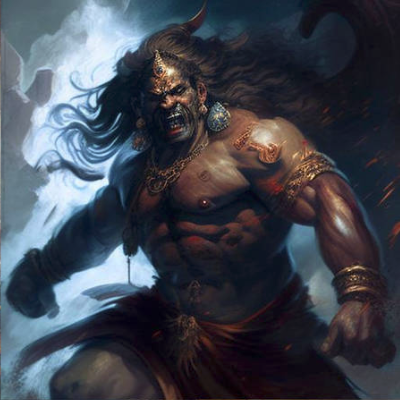
Khara is a Rakshasa warrior and regional governor prominent in the Aranya Kanda of the Valmiki Ramayana. He is the son of the sage Vishrava — son of Pulastya and a grandson of Brahma — by Raka, a Rakshasi who was given to Vishrava as an attendant by his eldest son Kubera. Khara is thus the half-brother of Ravana, Kumbhakarna, Vibhishana, and Surpanakha — who were born to Vishrava by Kaikesi — and is the full brother of Surpanakha in the Mahabharata's account, where Khara and Surpanakha are named as twins born of Raka. He is closely associated with his brothers Dushana and Trishiras, who served as his generals in the Dandaka region. Ravana appointed Khara as the governor and military commander of Janasthana, the principal settlement and administrative centre within the Dandaka forest, which functioned as the northern frontier garrison of the Lanka kingdom on the Indian mainland. Khara is renowned as a formidable archer and warrior. His death at the hands of Rama in the Dandaka forest, along with the annihilation of his fourteen-thousand-strong Rakshasa army, is one of the pivotal events of the Aranya Kanda and directly precipitates Ravana's decision to abduct Sita. His son Makaraksha subsequently fought in the Lanka war on Ravana's side and was killed by Rama.
✦ The Name
The name Khara derives from the Sanskrit root meaning "harsh," "sharp," "rough," or "severe." In Sanskrit lexical usage, khara denotes roughness of surface or sound, and by extension conveys qualities of fierceness and unyielding force. The name is entirely fitting as a designation for a warrior Rakshasa commander, evoking both the sharpness of weaponry and the ferocity of the being who bears it. The name occurs in other contexts across Sanskrit literature as a common adjective rather than a personal name, and in the Ramayana its application to this particular Rakshasa carries the force of a characterising epithet fixed into a proper name.
✦ Lineage
- Father: Vishrava — a sage of great power and learning, son of Pulastya and grandson of Brahma; he fathered multiple children across different wives, the most celebrated being Ravana and Kubera
- Mother: Raka — a Rakshasi given to Vishrava by Kubera as an attendant; she is named in the Mahabharata's Vana Parva account as the mother of Khara and Surpanakha, and may have been a sister or half-sister of Kaikesi through their common parentage from the line of Sumali
- Half-brothers (by Kaikesi): Ravana — the ten-headed demon king of Lanka and principal antagonist of the Ramayana; Kumbhakarna — the giant younger brother of Ravana; Vibhishana — the righteous youngest brother of Ravana who defected to Rama's side
- Half-sister / Full sister (variant): Surpanakha — the Rakshasi sister whose humiliation at the hands of Lakshmana in the Dandaka forest directly precipitated Khara's attack on Rama; she is named as Khara's twin sister born of Raka in the Mahabharata account, or as his half-sister born of Kaikesi in the Valmiki Ramayana account
- Half-brother (by Ilavida): Kubera — the god of wealth and lord of the Yakshas, eldest son of Vishrava; it was Kubera who gave Raka to Vishrava as an attendant, making Kubera indirectly responsible for Khara's birth
- Brothers: Dushana — twin brother and military commander who fought alongside Khara at Janasthana and was killed by Rama in the same battle; Trishiras — a three-headed Rakshasa commander who served as general under Khara and was killed by Rama in the same engagement
- Son: Makaraksha — a Rakshasa warrior who fought in the Lanka war under Ravana to avenge his father Khara's death, and was killed by Rama during that conflict
✦ The Battle of Janasthana
The central narrative episode involving Khara unfolds across the Aranya Kanda of the Valmiki Ramayana, principally in Sargas 18 through 29. When the Rakshasi Surpanakha approached Rama and Lakshmana in the Panchavati forest and was disfigured by Lakshmana — who cut off her nose and ears in response to her attack on Sita — she fled to Khara at Janasthana and reported her humiliation. Khara initially dispatched fourteen Rakshasas to punish the brothers, but Rama destroyed all fourteen single-handedly. Surpanakha returned to Khara a second time, this time urging a full military response and warning that failure to act would expose the entire Dandaka garrison to destruction. Khara then assembled a vast army, described in the Ramayana as numbering fourteen thousand Rakshasas, and marched on Rama's hermitage with Dushana and Trishiras as his principal commanders. The celestial world grew alarmed at the approach of this army, and divine beings gathered to witness the impending confrontation.
Rama directed Lakshmana to take Sita to safety in a cave and faced the Rakshasa host alone. In the engagement that followed, described across several sargas of the Aranya Kanda, Rama destroyed the entire army. Dushana was killed early in the battle, and Trishiras fell thereafter. Khara then engaged Rama directly in single combat, wielding powerful weapons and displaying exceptional martial skill. Despite Khara's ferocity and the celestial origin of his weapons, Rama countered every assault and finally killed Khara with an arrow. The text of the Valmiki Ramayana presents this episode as a demonstration of Rama's extraordinary martial power and divine nature — a point made explicitly by Vibhishana's wife to Ravana later in the Yuddha Kanda, where she recalls that the destruction of Khara and his fourteen-thousand-strong army by a single warrior should have been sufficient proof that Rama was no ordinary human. The aftermath of the battle at Janasthana — reported to Ravana by the survivor Akampana — directly motivated Ravana's scheme to abduct Sita, making Khara's defeat the proximate cause of the central crisis of the Ramayana.
✦ Textual Variants and Inconsistencies
The principal textual variant concerns Khara's parentage and his relationship to Surpanakha. The Valmiki Ramayana's Aranya Kanda refers to Khara as Surpanakha's brother but does not make their parentage explicit in that passage; elsewhere in the Ramayana, Surpanakha is identified as the daughter of Vishrava and Kaikesi, which would make Khara her half-brother through a different mother. The Mahabharata's Vana Parva, Chapter 275, however, explicitly names Raka as the mother of both Khara and Surpanakha, presenting them as twins born of the same Rakshasi, distinct from the Kaikesi line. This is a genuine discrepancy between the two epics that is not resolved in the primary texts. The Puranic Encyclopaedia's entry on Khara draws on the Mahabharata account and presents Khara and Surpanakha as twins born of Raka, while the dominant popular and literary tradition of the Valmiki Ramayana tends to present Surpanakha as the sister of Ravana born of Kaikesi.
A further variant concerns a claimed identification of Khara with the Asura Madhu. The Manuscrypts compilation, drawing on a secondary source, records that Khara and Atikaya were held to be incarnations of Madhu and Kaitabha — the primordial Asuras destroyed by Vishnu at the beginning of creation. This identification, if attested in a primary Puranic source, would place Khara within the tradition of Asura rebirth, but the specific primary text cannot be confirmed from the sources available and this claim is noted with appropriate caution.
✦ Connection to the Wider Genealogy
Through his father Vishrava, Khara belongs to the line of the sage Pulastya, one of the seven mind-born sons of Brahma, and is therefore genealogically connected to the most distinguished sage lineage in the Pulastya tradition. Vishrava's father Pulastya also fathered Dattoli by his wife Priti, daughter of Daksha — making Dattoli the half-uncle of Vishrava and consequently the great-uncle of Khara. Kubera, Khara's half-brother through their common father Vishrava, is the god of wealth and lord of the Yakshas, whose genealogical prominence in the Puranic tradition makes him the most celebrated of Vishrava's sons. Ravana, Khara's half-brother through Kaikesi, is the adversary of Rama and the central antagonist of the Ramayana, in whose cause Khara ultimately dies. Khara's son Makaraksha extended the family's involvement in the conflict with Rama into the Yuddha Kanda, where he too was killed by the same hero who had destroyed his father.
✦ References
Primary Sources
- Valmiki Ramayana, Aranya Kanda, Sargas 18–29: The principal narrative source for Khara's role as commander of Janasthana, the sequence of events following Surpanakha's humiliation, and the battle in which Khara, Dushana, and Trishiras were slain by Rama.
- Valmiki Ramayana, Yuddha Kanda, Sarga 111 and Sarga 123: Confirms Khara's death at Janasthana in retrospective references during the Lanka war; names Makaraksha as Khara's son who fought on Ravana's side.
- Mahabharata, Vana Parva, Chapter 275, Verses 1–8: The principal source for the genealogical account naming Raka as the mother of Khara and Surpanakha, presented as twins, born through Vishrava's relationship with Kubera's gift of attendants.
Modern Reference Works
- Vettam Mani, Puranic Encyclopaedia (via Wisdomlib): Entry on Khara synthesises the Mahabharata account of his birth and the Ramayana account of his military role and death; records the twin-birth with Surpanakha from Raka.
- Wisdomlib, "Khara: Significance and symbolism": Aggregates Puranic and epic references to Khara across multiple texts, confirming his role as father of Maharaksha and his position as commander killed by Rama at Janasthana.
- Wikipedia, "Danda kingdom": Provides the geographical identification of Janasthana with the Nashik region and confirms Khara's role as its Rakshasa governor under Ravana's authority.
- Valmikiramayan.net (Aranya Kanda translations): Used for direct verse-level verification of the battle narrative in the Aranya Kanda sargas.